Puget Bench Spotlight: AMD
We have partnered with several OEMs, including AMD, to ensure that our benchmarks are accurate to customer workflows and properly utilize the latest hardware advancements.
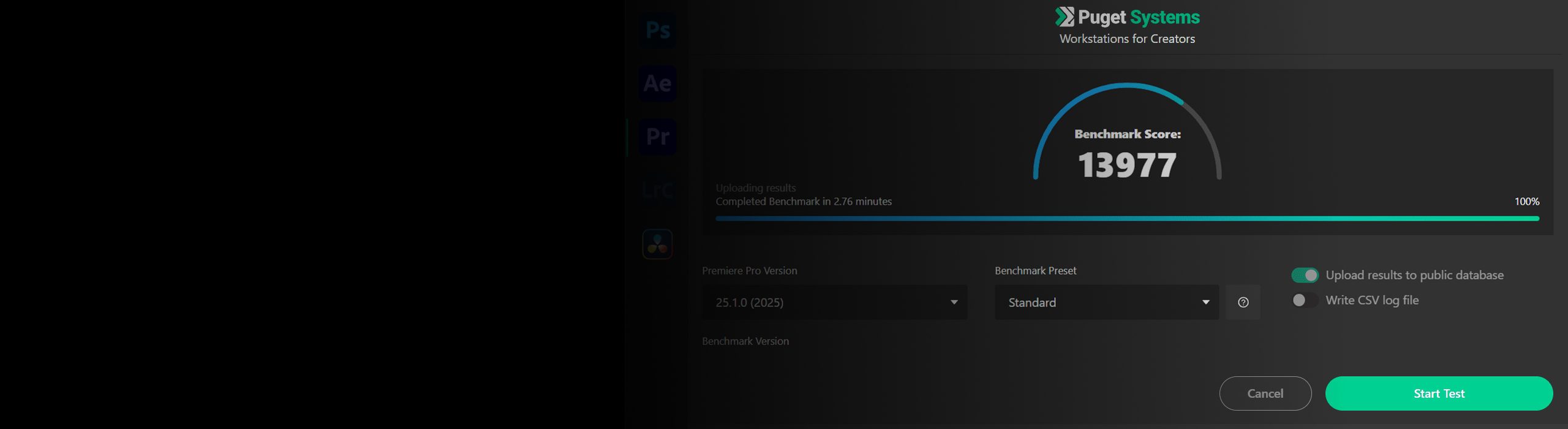
Puget Bench for Creators has quickly become the industry’s most relied upon benchmark for testing and understanding hardware and software performance in creative workflows. It was designed to benchmark professional workloads in the most common video editing, photography, VFX, and motion graphics applications.
We have also been working closely with developers to continue to improve and refine our benchmarks and make them more valuable for customers and the industry in general. In fact, we recently announced the formal launch of the Puget Bench Development Program.
This program provides a way for industry leaders in the hardware, software, and workflow spaces to collaborate with us to ensure that benchmark testing of participants’ systems, hardware components, and software workflows is relevant to the work end users are doing every day, while accurately reflecting the latest advances in technology. It also provides them with direct input into the design and evolution of performance benchmarks. Participants collaborate with our benchmarking team to ensure workloads reflect real-world usage, identify key performance metrics, and validate testing methodology.

Partnering with Industry Leaders: AMD in the Spotlight
We actively partnered with industry-leading OEMs to test and refine the Development Program prior to its formal launch. Participants in the program include a diverse range of organizations spanning hardware manufacturers, software developers, and creative software vendors. These are the types of companies building tools and platforms that power modern creative work, from GPU acceleration and AI-based effects to real-time engines and post-production pipelines.
One of those key early partners is AMD. It may go without saying, but AMD is a high performance and adaptive computing leader, powering the products and services that help solve the world’s most important challenges. Their technologies advance the future of the data center, embedded, gaming, and PC markets.
We recently spoke with Chris Hall, the senior director of software development and software performance engineering at AMD. Chris is responsible for working with application vendors to help them optimize their applications to improve performance on AMD hardware.
Chris Hall, AMD“Puget Bench helps us evaluate performance in a way that allows us to deliver significant performance improvements to our customers, and share that information to customers in a meaningful and valuable way.”
“We’ve been working with Puget System and Puget Bench to evaluate the performance of our products and to help us identify some of the opportunities to further optimize performance in a way that will deliver value to the end user,” said Chris. “It delivers results in a way that helps customers understand performance data in real-world environments and in ways that mean something to them.”
Chris added, “Puget Bench provides us with a language to talk to customers about performance in a way that is not just us saying ‘it runs well.’ It gives us a way to represent the performance of those products that allows users to compare with other products in the market and make informed decisions.”
Benefits of the Program: Collaboration
Through the program, AMD benefits from early access to benchmark updates, the ability to help shape upcoming features, and a robust filtering system to protect against NDA hardware leaks. Whether optimizing for a new rendering engine, codec, or workflow, the Puget Bench Development Program ensures participants’ software or hardware is accurately represented—and users get actionable performance data. This collaborative approach also ensures benchmarks stay relevant as workflows and technology evolve and provides a valuable feedback loop between software development and hardware testing.
“Puget Systems has been transparent with their benchmark plans, and the team is willing to engage in healthy discussion about what operations do and don’t matter to users. We can have discussions about the way the benchmark helps us understand which performance improvements will be most impactful for our customers. We have used Puget Bench in several cases to work with application vendors to introduce significant performance uplifts for these operations. This is a great example of how we’ve worked together to ensure this benchmark really helps our customers,” Chris added.
Chris Hall, AMD“Performance evaluation is a very complicated subject, and while there are no perfect benchmarks, we appreciate the fact that Puget Systems takes the time to include workloads they believe are representative of real customers in their benchmarks…”
“Performance evaluation is a very complicated subject, and while there are no perfect benchmarks, we appreciate the fact that Puget Systems takes the time to include workloads they believe are representative of real customers in their benchmarks, which means that using these projects to evaluate our products and drive performance optimizations delivers benefits to real-world users.”
More information is available on our website about Puget Bench and the Puget Bench for Development Program.
For more information about AMD, please visit their website.
Check Out Puget Bench
Puget Bench for Creators is designed to benchmark professional workloads in the most common video editing, photography, VFX, and motion graphics applications. Our tests run directly on the host application, instead of relying on artificial or synthetic workloads, to give the most real-world results possible. It is a good way to ensure that your system is running as expected, with no abnormal slowdowns or issues.

Download Puget Bench
Test your system! Freely available for Windows and MacOS.

Browse Puget Bench Results
Check out performance across a wide range of CPUs and GPUs.