Table of Contents
Introduction
When Intel® launched its 12th-Gen Core™ processors back in 2021, the introduction of Performance Cores (P-cores) and Efficient Cores (E-cores) brought a hybrid architecture to desktop CPUs for the first time. That design promised the best of both worlds: high per-core performance where needed, energy efficiency for background processes, and high parallel throughput when workloads could scale.
At the time, we performed some testing to see what these different cores would theoretically be capable of if offered in higher core counts. Three years later, Intel has expanded that concept to the data center with the Xeon® 6 family, this time offering separate P-core and E-core variants rather than mixing the two on a single die. The result is two distinct CPU lines that utilize the same motherboards:
- Xeon 6700P (P-cores): focused on per-core performance and large cache.
- Xeon 6700E (E-cores): focused on maximizing core density and power efficiency.
Test Setup
This separation gives us a unique opportunity to revisit the P-core vs E-core question on equal footing. Intel sent us samples of two models from this generation with similar pricing, which we can test on the same platform. Benchmarking these should show us how E-cores stack up against the traditional P-core design for CPU rendering.
| CPU Model | Expected Cost | Cores | Threads | Cache | Base Clock | Boost Clock | TDP |
|---|---|---|---|---|---|---|---|
| Intel® Xeon® 6740P | $4650 | 48 | 96 | 288MB | 2.1 GHz | 3.3 GHz | 270 W |
| Intel® Xeon® 6746E | $4447 | 112 | 112 | 96 MB | 2.0 GHz | 2.7 GHz | 250 W |
Intel Xeon 6 Platform
| CPUs: Intel Xeon 6740P Intel Xeon 6746E |
| RAM: 8x DDR5-6400 ECC Reg. 64GB (512 GB total) |
| System: ASUS RS700-E12-RS12U BIOS version: 0501 |
| Storage: Samsung 980 Pro 2TB |
| OS: Windows Server 2025 Standard |
Benchmark Software
Results
Analysis
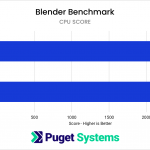
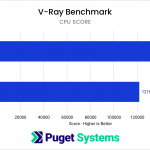
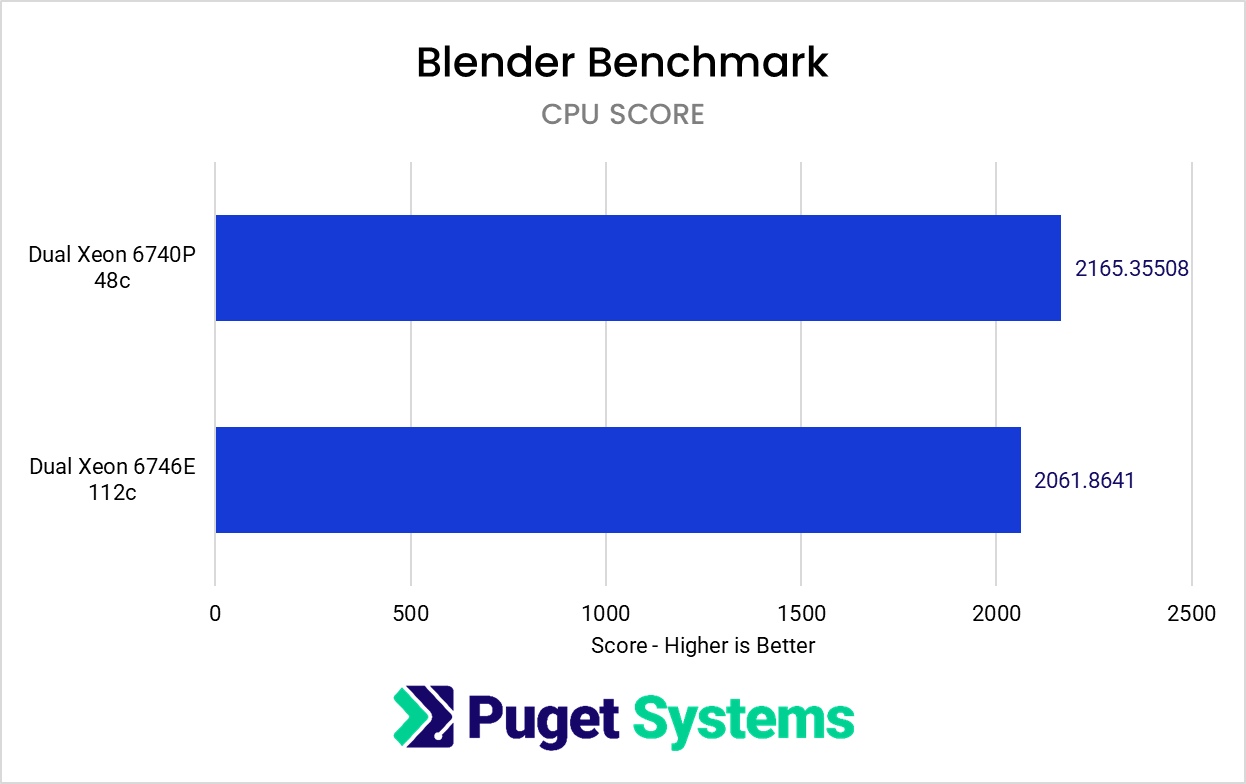
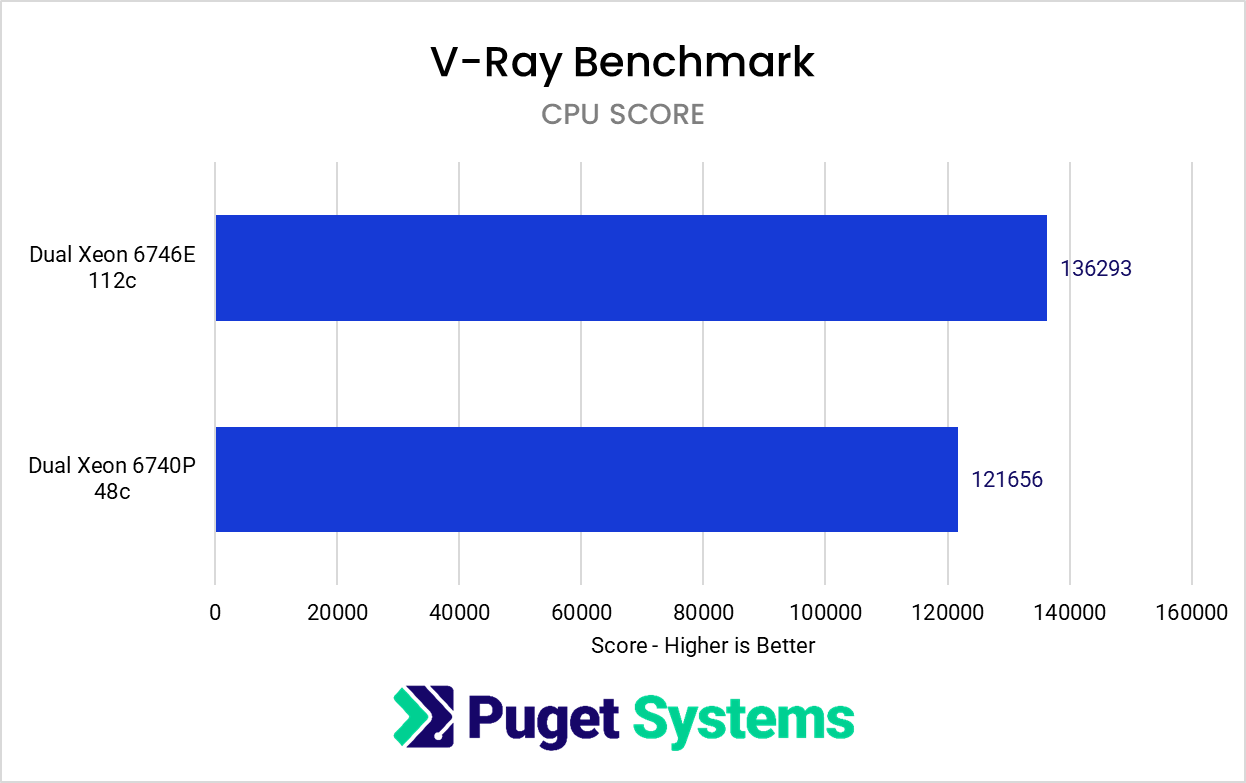
Across the three benchmarks, we see mixed results. In Blender, the P-core system took the lead over the E-Core system, though only by 5%. That flipped in V-Ray, where the E-core system outperformed the P-core system by 12%, which is close to the difference in the number of threads (16%). We can attribute this to how the two renderers function. The V-Ray benchmark uses the progressive renderer to render the whole frame simultaneously. Meanwhile, the Blender benchmark uses their tile rendering tech, which is a mix of progressive and bucket.
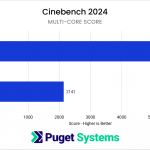
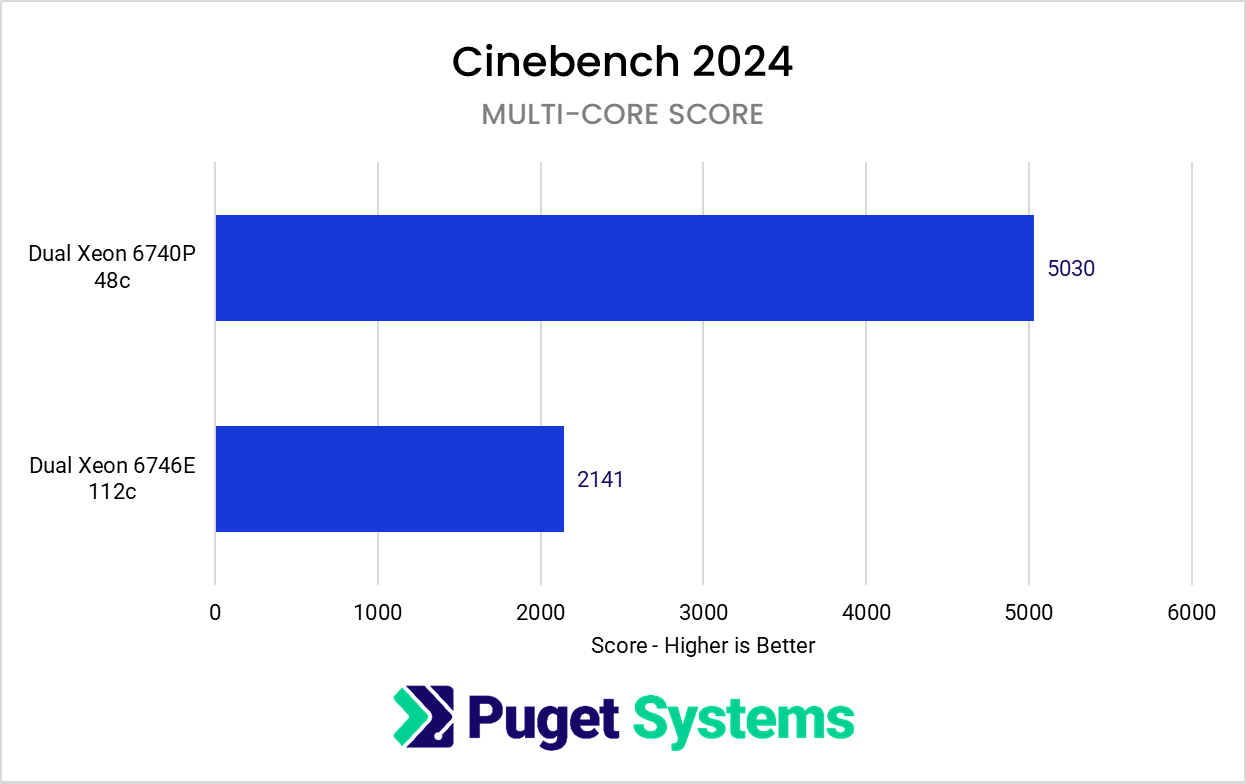
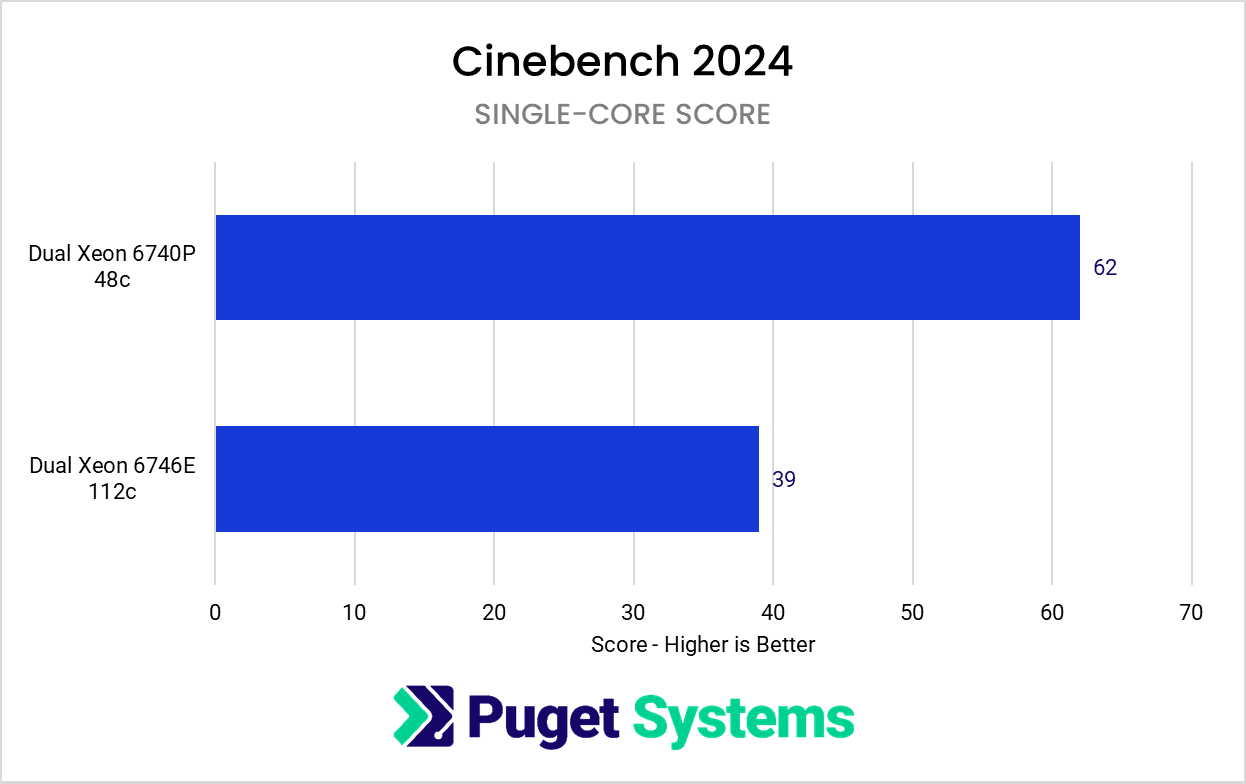
Cinebench 2024 is a little different because only a single CPU would work at 100% during the test, despite Cinebench reporting that there were two CPUs in the system. Even when doing a custom test where the number of threads was explicitly defined, only 1 CPU would activate. Despite that, the P-core CPU showed strong performance – but the E-core CPU did not fare nearly as well. We theorize that this is a Cinebench limitation, because this drastic of a difference was not seen in the other benchmarks. We also recorded Cinebench’s single-core score, and while it is not at all a fair rendering comparison it can help show the different in per-core performance between the two designs; unsurprisingly, the P-core model was over 50% faster.
Conclusion
While the results show that E-cores can provide impressive throughput and P-cores deliver stronger per-thread performance, neither Xeon 6 model is necessarily aimed at CPU rendering. These processors are designed first and foremost for data-center workloads, where efficiency, density, and total compute per watt take priority over raw clock speed.
Even so, it’s interesting to see how they perform in rendering tasks. The E-core Xeon 6746E demonstrated excellent scaling and very low power draw for its performance level, while the P-core 6740P offered better balanced results across more mixed workloads. Xeon 6’s efficiency and flexibility make it an intriguing option for specialized or power-constrained environments.
In the near future, we hope to test a similar system using AMD’s EPYC™ server processors so that we can help guide artists and studios on what the best overall solution is for a dedicated CPU render node.

Looking for a network render node?
We build computers tailor-made for your workflow.

Don’t know where to start?
We can help!
Get in touch with our technical consultants today.