We look at AI the way our customers do, which is why we built the Puget Systems Docker App Packs: to help you get up and running with AI inference fast!
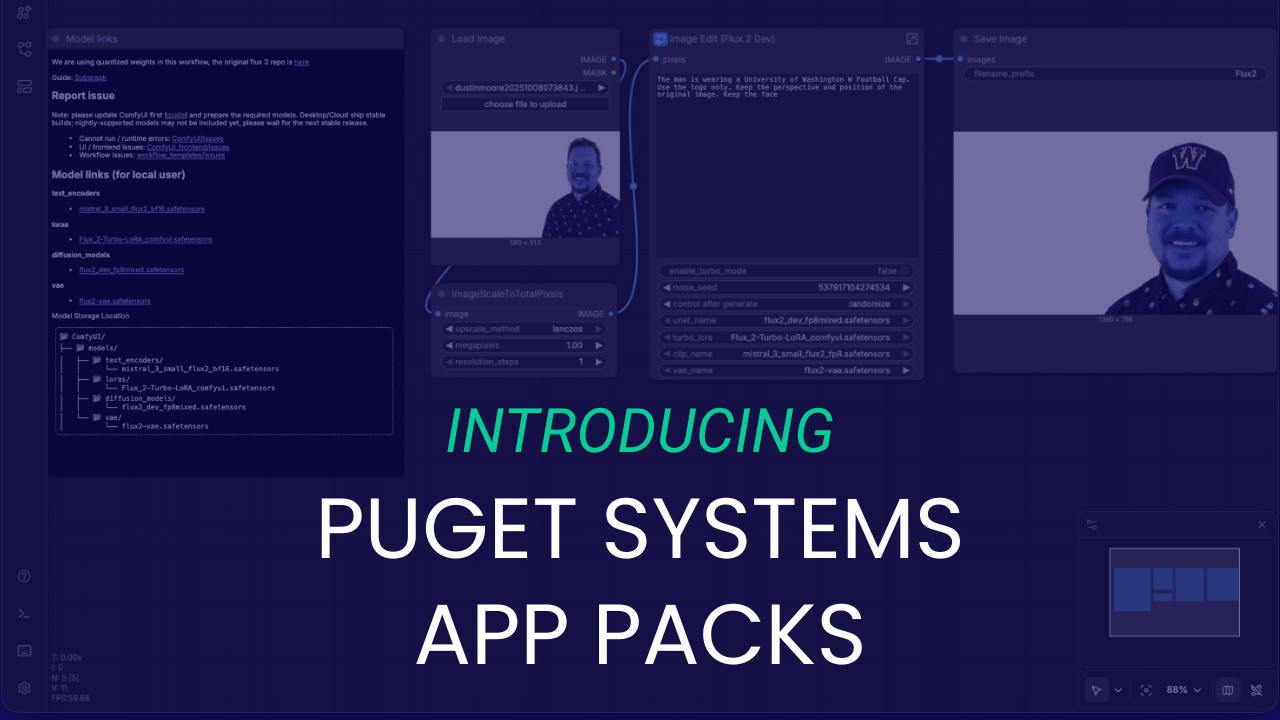
We look at AI the way our customers do, which is why we built the Puget Systems Docker App Packs: to help you get up and running with AI inference fast!
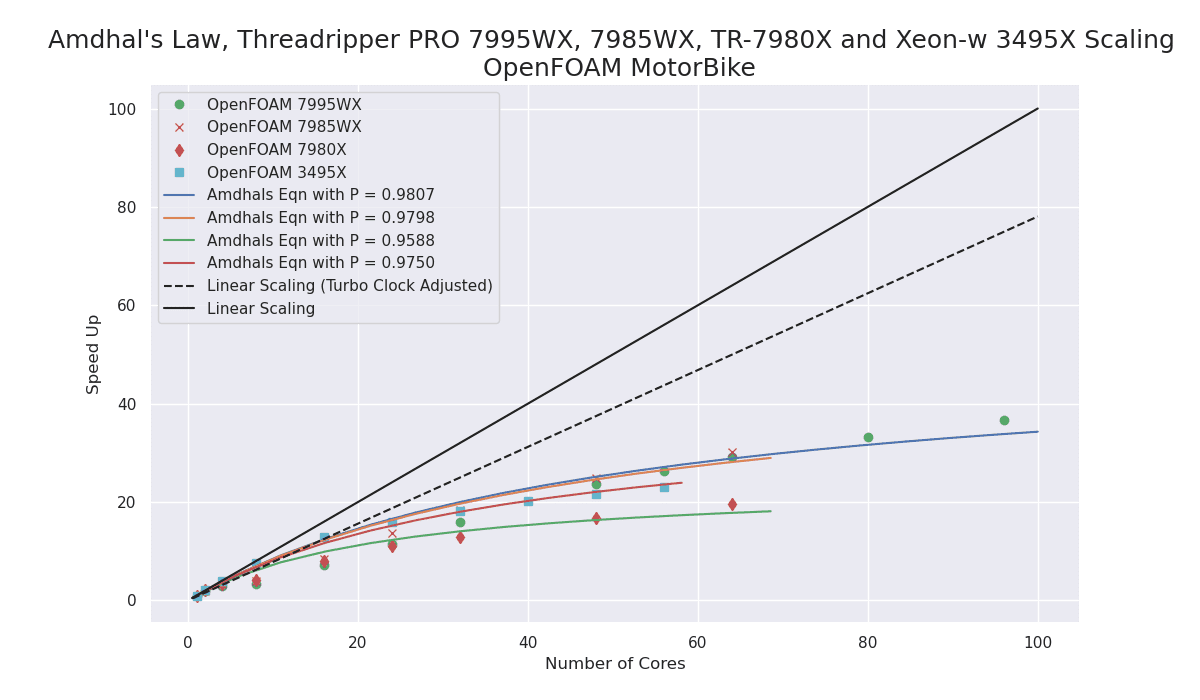
The performance improvement with the new Zen4 TrPRO over the Zen3 TrPRO is very impressive!
My first recommendation for a Scientific and Engineering workstation CPU would now be the AMD Zen4 architecture as either Zen4 Threadripper PRO or Zen4 EPYC for multi-socket systems.

NVIDIA GTC 2023 was outstanding! To say that about a virtual conference tells you how much I value it. This post is largely a catalog of the talks I found interesting along with titles that I think will be interesting to a larger audience and my colleagues at Puget Systems.
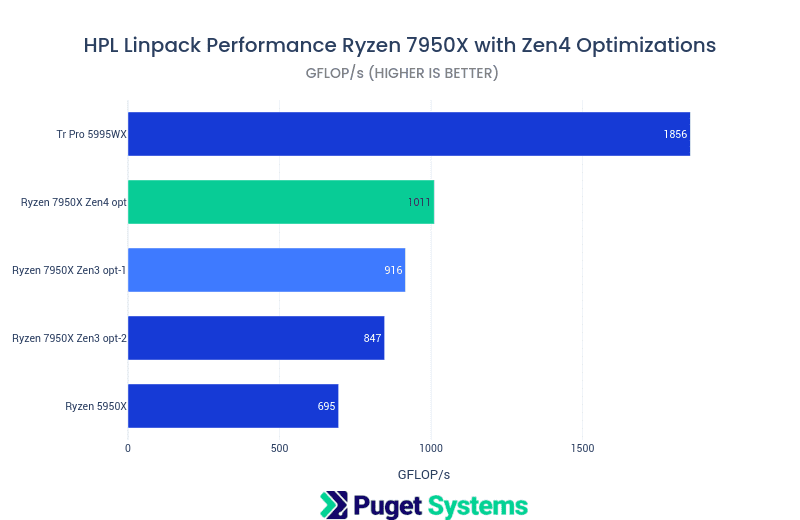
This post is a first-look at performance of the Ryzen7 7950x CPU using the latest AMD compiler release with support for Zen4 arch including AVX512 vector instructions. Performance is tested using the HPC standard benchmarks, HPL (High Performance Linpack), HPCG (High Performance Conjugate Gradient) and the newer HPC Top500 benchmark, HPL-MxP (formerly HPL-AI).

This post presents preliminary ML-AI and Scientific application performance results comparing NVIDIA RTX 4090 and RTX 3090 GPUs. These are early results using the NVIDIA CUDA 11.8 driver.
This post presents scientific application performance testing on the new AMD Ryzen 7950X. I am impressed! Seven applications that are heavy parallel numerical compute workloads were tested. The 7950X outperformed the Ryzen 5950X by as much as 25-40%. For some of the applications it provided nearly 50% of the performance of the much larger and more expensive Threadripper Pro 5995WX 64-core processor. That’s remarkable for a $700 CPU! The Ryzen 7950X is not in the same platform class as the Tr Pro but it is a respectable, budget friendly, numerical computing processor.
We’ve been curious about the performance of WSL for scientific applications and decided to do a few relevant benchmarks. This is also a teaser for some hardware-specific optimized application containerization that I’ve been working on!
The single socket version of Intel third generation Xeon SP is out, the Ice Lake Xeon W 33xx. This is a much better platform with faster large capacity 8 channel memory and PCIe v4 with plenty of lanes. The new Intel platform is very much like the AMD Threadripper Pro (single socket version of EPYC Rome) so this is the obvious comparison to make. Read on to see how the numerical computing testing went!
NVIDIA Enroot has a unique feature that will let you easily create an executable, self-contained, single-file package with a container image AND the runtime to start it up! This allows creation of a container package that will run itself on a system with or without Enroot installed on it! “Enroot Bundles”.
For computing tasks like Machine Learning and some Scientific computing the RTX3080TI is an alternative to the RTX3090 when the 12GB of GDDR6X is sufficient. (Compared to the 24GB available of the RTX3090). 12GB is in line with former NVIDIA GPUs that were “work horses” for ML/AI like the wonderful 2080Ti.
Puget Systems builds custom workstations, servers and storage solutions tailored for your work.
We provide:
Extensive performance testing
making you more productive and giving better value for your money
Reliable computers
with fewer crashes means more time working & less time waiting
Support that understands
your complex workflows and can get you back up & running ASAP
A proven track record
as shown by our case studies and customer testimonials