AMD’s new Ryzen 3rd generation processors have arrived and shaken up the dynamic between Intel and AMD in many workloads. But how well do they handle heavy Photoshop workloads compared to the AMD Threadripper, Intel 9th Gen, and Intel X-series CPUs?
AMD’s new Ryzen 3rd generation processors have arrived and shaken up the dynamic between Intel and AMD in many workloads. But how well do they handle heavy Photoshop workloads compared to the AMD Threadripper, Intel 9th Gen, and Intel X-series CPUs?
AMD launched their third generation of mainstream Ryzen processors today, but we were only provided with the low-end Ryzen 5 3600 ahead of time. We have ordered the Ryzen 7 3800X and Ryzen 9 3900X, and should be testing them soon, but until then we can at least look at how the overall architecture is doing with the example we do have.

When the performance of AMD’s Threadripper processors is brought up, the discussion can often turn toward some of the oddities of this CPU’s architecture and how it interacts with thread scheduling in Windows 10. That is something which AMD has attempted to improve with their Ryzen Master software, and which has been partially addressed by Microsoft as well (via Windows updates). Some folks in the wider AMD enthusiast community have tried to tackle this issue too.

Pix4D is an advanced photogrammetry application, suited to a wide range of uses, with a focus on handling images captured by drone cameras. Processing of those images into point clouds and 3D meshes/textures is time-consuming, heavily using a computer’s CPU and GPU. We have recently updated our benchmark tools for Pix4D, and published articles looking at CPU and GPU performance on version 4.3 – but in the midst of our testing, 4.4 was released. Is it any faster?

RealityCapture, like other photogrammetry applications, is built to take a batch of photographs and turn them into digital, 3D models. The many steps involved in that process can take a lot of time, and utilize both the CPU and GPU at different points. We recently put together a benchmark tool for RealityCapture, and in our first article focusing on this software we are going to take a look at how Intel’s Core i7 and i9 processors stack up against AMD’s Threadripper chips.

Metashape, formerly known as PhotoScan, is a photogrammetry program that takes a set of images and combines them to create a 3D model or map. Processing of those images into point clouds and 3D meshes/textures is time-consuming, heavily using a computer’s CPU and GPU. We have updated our benchmark tools, following the recent rebranding of this software, so in our first article focusing on the new Metashape we will take a look at how Intel’s Core i7 and i9 processors stack up against AMD’s Threadripper chips.

Pix4D is an advanced photogrammetry application, suited to a wide range of uses, with a focus on handling images captured by drone cameras. Processing of those images into point clouds and 3D meshes/textures is time-consuming, heavily using a computer’s CPU and GPU. We have recently updated our benchmark tools for Pix4D, so lets take a look at how Intel’s Core i7 and i9 processors stack up against AMD’s Threadripper.
Over the last couple of years, several new vulnerabilities have been found in modern microprocessor architectures. Many of these have been related to speculative execution techniques used across most of Intel’s product line, and a patch was released for Windows 10 last week which was intended to address some of those weaknesses. Unfortunately, it has also reduced performance in some applications – which this article will demonstrate by comparing processing speed in three photogrammetry programs before and after the update.
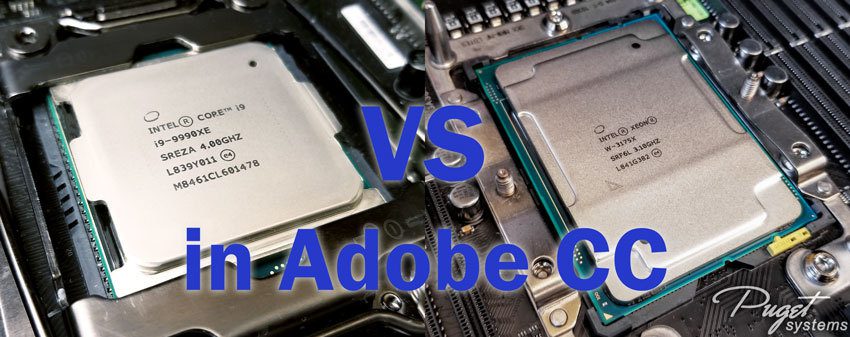
Intel has recently released a pair of highly exclusive – and expensive – processors: the Core i9 9990XE and Xeon W-3175X. The question is: does either one make sense to use for Adobe Creative Cloud applications?
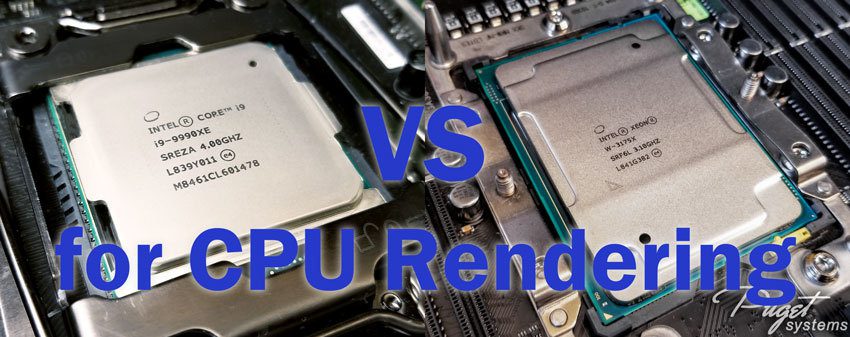
Intel recently released a pair of rather odd high-end processors: the 14-core Core i9 9990XE and the 28-core Xeon W-3175X. Both have higher clock speeds than other models with similar core count, run much hotter, and have other peculiarities. Because of that, neither of these processors will have a home in our product line at this time – but they are still interesting to test for insight into what current CPU designs are capable of when pushed beyond what is practical.
Puget Systems builds custom workstations, servers and storage solutions tailored for your work.
We provide:
Extensive performance testing
making you more productive and giving better value for your money
Reliable computers
with fewer crashes means more time working & less time waiting
Support that understands
your complex workflows and can get you back up & running ASAP
A proven track record
as shown by our case studies and customer testimonials