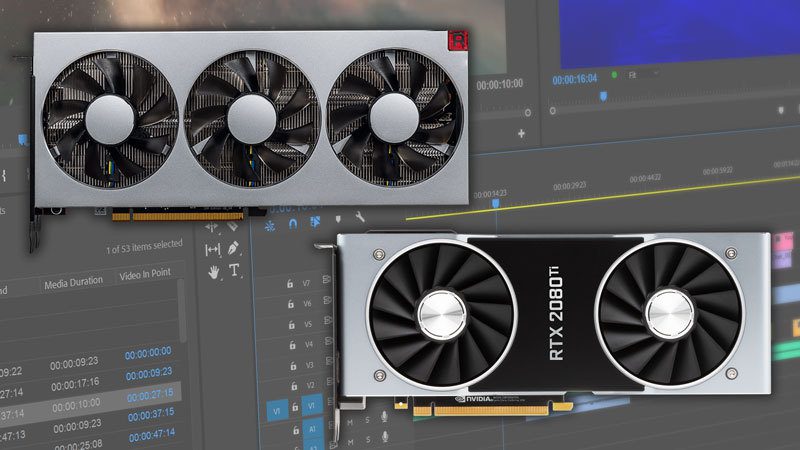
The Radeon VII is a very interesting card for DaVinci Resolve due to its 16GB of VRAM which is twice what you would get from a similarly priced NVIDIA GPU. But is it able to keep up in terms of raw performance?


The Radeon VII is a very interesting card for DaVinci Resolve due to its 16GB of VRAM which is twice what you would get from a similarly priced NVIDIA GPU. But is it able to keep up in terms of raw performance?

While After Effects is starting to utilize the GPU more and more, it currently is almost always limited by the performance of your CPU. So while AMD’s Radeon VII is an extremely robust card with twice the VRAM as a comparably priced NVIDIA GeForce card, will Ae actually be able to take advantage of its power?

AMD’s Radeon VII is an extremely robust card on paper, having twice the VRAM as a comparably priced NVIDIA GeForce card. However, while 16GB of video memory is nice, it is rarely required for Photoshop. Does the Radeon VII have a performance advantage in Photoshop as well, or is going with NVIDIA still a better option?

In the latest version of Lightroom Classic CC (8.2), Adobe has added a new featured called “Enhanced Details” which uses machine learning to improve the quality of the debayering process for RAW images. This is very GPU-intensive, so we wanted to see exactly how much faster it can be on a modern, high-end GPU.

Intel has recently released a pair of highly exclusive – and expensive – processors: the Core i9 9990XE and Xeon W-3175X. The question is: does either one make sense to use for Adobe Creative Cloud applications?

Intel recently released a pair of rather odd high-end processors: the 14-core Core i9 9990XE and the 28-core Xeon W-3175X. Both have higher clock speeds than other models with similar core count, run much hotter, and have other peculiarities. Because of that, neither of these processors will have a home in our product line at this time – but they are still interesting to test for insight into what current CPU designs are capable of when pushed beyond what is practical.

Dassault Systemes recently updated SOLIDWORKS 2019 with its first service pack (SP1), and we did a roundup of Intel CPUs looking at how they perform in this popular engineering application. We found that both core count and clock speed play a role different aspects of SOLIDWORKS performance, so when Intel released their new Core i9 9990XE with very high clock speeds and a respectable number of cores (14, plus Hyperthreading) this seemed like a good application to test on it.

Pix4D is an advanced photogrammetry application, suited to a wide range of uses, with a focus on handling images captured by drone cameras. Processing of those images into point clouds and 3D meshes/textures is time-consuming, heavily using a computer’s CPU and GPU. Both core count and clock speed play a role in Pix4D performance, so when Intel released their new Core i9 9990XE with very high clock speeds and a respectable number of cores (14, plus Hyperthreading) this seemed like a good application to test on it.

Dassault Systemes launched the initial version of SOLIDWORKS 2019 late last year, but with the recent release of SP1 we expect that customers will soon be using it in production environments. In preparation for that, we have tested the field of current Intel Core series processors to see how they compare across a wide variety of tasks within SOLIDWORKS.

The Intel Core i9 9990XE 14-core CPU is a special, OEM-only, no warranty processor that is only available to select system manufacturers like Puget Systems. While it is very hard to get, it has terrific performance for both lightly-threaded and highly-threaded tasks making it one of the fastest CPUs currently available.