Improving Autonomous Driving
A large automotive company approached us with a unique need: to deploy rack-mounted workstations into cars and trucks. These computers would gather and analyze data as their host vehicles drive autonomously on public roads. That data would help improve both safety and autonomous driving features that may show up in future vehicles.
Engineers at this company had been cobbling together a solution that worked well enough during the testing phase, but became time-consuming to scale as the project expanded across multiple car models. Offloading manufacturing of these workstations to a trusted system integrator became necessary. Support, both before and after the purchase, was also a factor in deciding to turn to Puget Systems. Given the unique situation, part of that support involved us sending an engineer on-site to learn more about how the rackstation would be tested and deployed in their vehicles.
The Challenges
The back seat of a truck or passenger car isn’t an ideal environment for running a computer. Space is limited, constant movement can pry components loose, heat builds up during summer months with little ventilation, and there are myriad unknowns that may happen while driving on city streets. Building a rackmount PC that could fit and function there presented a number of challenges:
- Form factor – Finding a chassis that would fit within their 20-inch limitation, while still holding all of the high-performance hardware they wanted, was not easy. Thankfully, our R&D team was up to the task!
- AC/DC – The rackstation had to be able to run on AC power for testing and DC power for in-car use. We brought in an HD-Plex DC unit and made modifications to the chassis in order to accommodate this unique layout.
- Vibration – Components had to be secured to withstand the bumps and bruises of operating inside a moving vehicle. We laser-cut a number of braces and attachments that held the largest components in place. We also used blue Loctite to secure each and every screw.
- Cooling – Summer sun could lead to higher-than-normal ambient temperatures. We added extra Noctua fans, strategically positioning them around the chassis to provide cooling for the hottest-running components.
- Accessible storage – Capacity was important, but so was quick access to that storage. We needed a front-accessible, hot-swap bay that would fit in the limited space available. Icy Dock makes a wide range of those, and we found a model that fit perfectly.
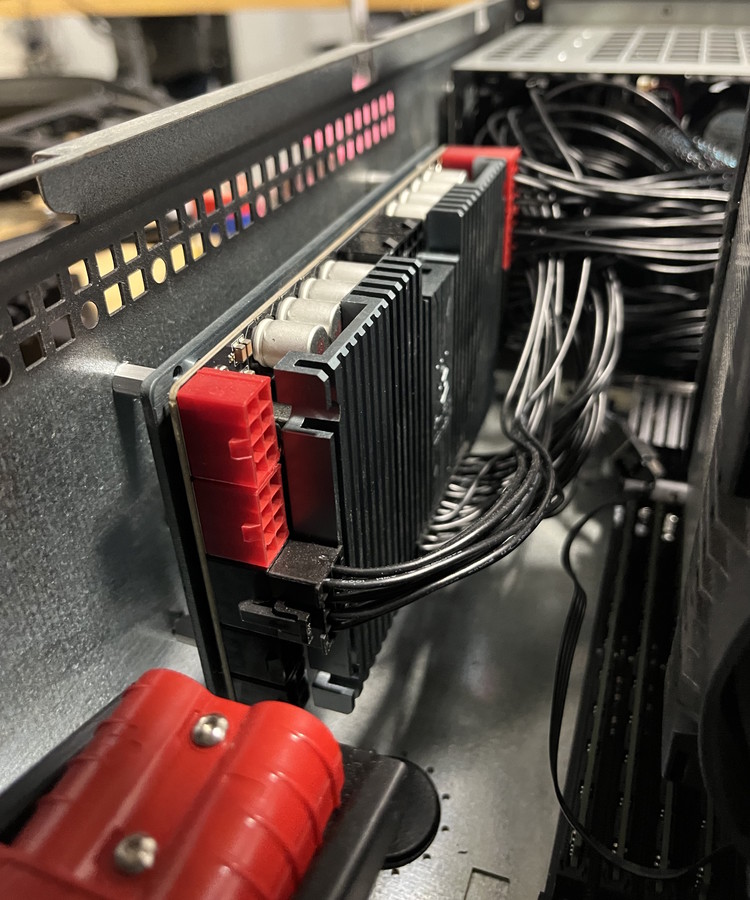
DC power supply in 4U chassis
The Solution
Starting with a Sliger 4U chassis, we added an ASUS motherboard, AMD Threadripper™ PRO CPU, and an NVIDIA RTX PRO™ 4000 Blackwell GPU. That base platform provided the processing power required to run data analysis locally. We rounded things out with 128GB of DDR5 RAM, two Intel® network adapters, and a few custom cables to make a tidy package that would work both in and outside of the vehicle.
Once we had the plan nailed down, we shipped a demo unit for the company to test. Their team provided our R&D department with feedback, which we implemented into the final version.
As with all Puget Systems computers, these rackstations went through a whole battery of tests before shipping to the customer. The systems are working so well that they’ve decided to utilize Puget Systems for all their autonomous driving workstations, with plans for ordering 50+ systems from us across 2026 and early 2027.
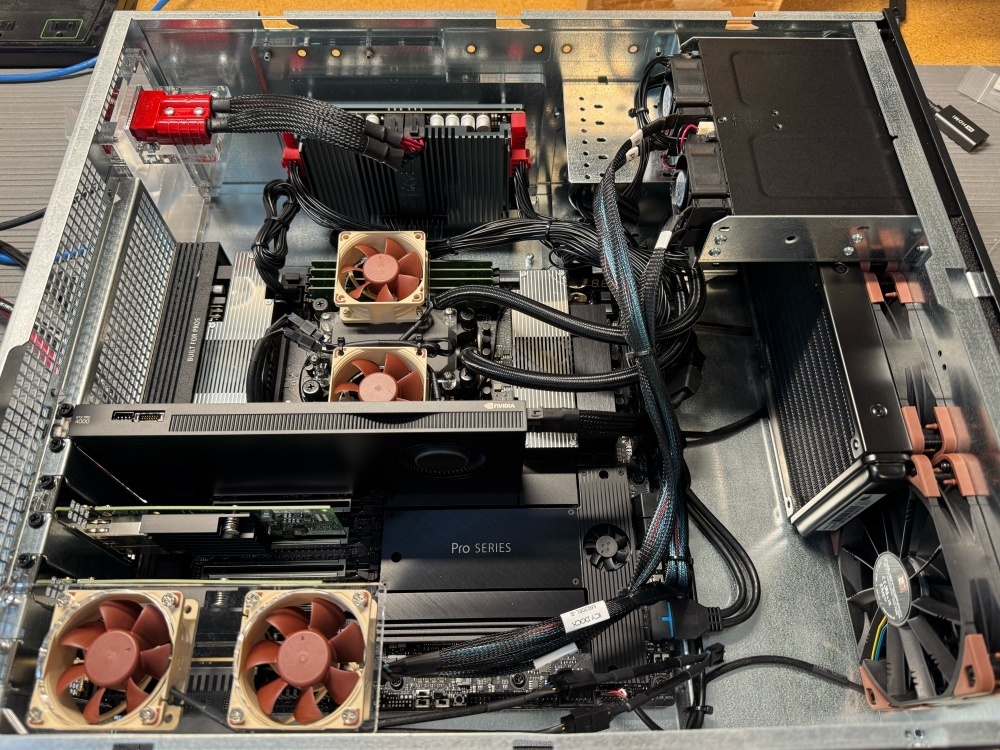
Internals of autonomous driving workstation with extra cooling fans and DC power supply

Looking for a new rackmount workstation?
We build computers tailor-made for your workflow.

Don’t know where to start?
We can help!
Get in touch with one of our technical consultants today.