Puget Systems Reviews the New NL-LC1-24 from Noctua
In November 2023, all-in-one liquid coolers (AIOs) returned to our product line. It was no coincidence that this happened in tandem with the launch of AMD’s Threadripper™ 7000 Series CPUs. For almost a decade, increasing power draw has been a trend across high-end computer hardware. This has enabled an increase in performance, but comes at the cost of generating more heat. An improvement in CPU cooling was required to keep up with this increase in power draw, to help mitigate thermal limitations and maximize performance.
More AIOs joined our lineup a year later, in November of 2024, alongside the launch of Intel’s Core™ Ultra Series 2. Both performance and temperatures saw an increase in that generation, as did AMD’s Ryzen™ 9000 Series.
While we had carried AIOs at Puget Systems before, we had been exclusively using air cooling in our workstations for several years heading into 2023. They were our preference due to the near-bulletproof nature of air coolers: the only moving parts are the fans mounted to heatsinks, leading to incredible longevity. Additionally, the Noctua models we relied on were perfectly capable of cooling the highest-end CPUs of the time, and did so with near-silent operation.
As we reintroduced liquid cooling in 2023 and 2024, for CPUs like AMD’s Threadripper 7995WX and Intel’s Core Ultra 9 285K, we selected OEM units that we could source directly from Asetek. These AIOs were not as quiet as the Noctua air coolers we had been using, like the NH-U12, but they provided much-needed cooling capability that let the newer, hotter-running CPUs operate without thermal throttling. Although they came with a slight noise floor increase from the integrated pump, we found these Asetek units to offer excellent reliability and a very good price-to-performance ratio. Sourcing them directly from the manufacturer reduced the cost of these coolers, enabling us to pass along those savings to our customers. It also meant that no fans were included, allowing us to use our preferred Noctua NF-A12x25 120mm fans on the radiator.
Asetek, meet Noctua
In November of 2025 we had the pleasure of hosting Roland Mossig, co-founder and CEO of Noctua, at our office here in the beautiful Pacific Northwest. In addition to touring our facility, sharing business trends, and discussing forecasts, Roland let us in on a secret: Noctua was developing its first AIO liquid cooler! We even got to see a technical drawing of the CPU block design, which let us in on Noctua’s plan to isolate vibrations from the pump. This was exciting to hear, but with the product still in the prototyping phase, we knew it would be some time before we could evaluate it.
Fast forward to April of 2026, and we learned there were sample NL-LC1 coolers headed our way! By this point we also knew that it was a collaboration between Noctua and Asetek.
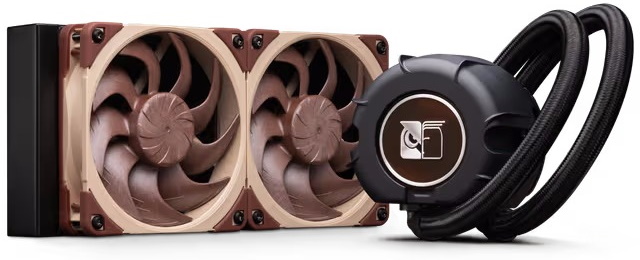
Asetek is a major player in the AIO space, with decades of experience in the segment as well as several key patents on pump design. They were the vendor we had chosen in 2023, so we had over two years of history selling their OEM designs. They had provided consistent supply, excellent per-unit pricing, and great reliability. While we had encountered some small issues, particularly on a batch level with things like pump noise, Asetek had proven a fantastic partner. They were receptive to our feedback and used it to improve their QC, which in turn led to a reduction in units being RMA’d for excessive noise.
We also had a ton of history with Noctua. We’ve been carrying their fans longer than we’ve had John Dinning, one of our R&D engineers with nearly 18 years of tenure. Sometime in 2021, those fans were no longer optional: if you wanted a Puget Systems workstation, it was going to be cooled by Noctua. For the majority of our desktop and rackmount solutions today, this remains true. Noctua’s engineering is unparalleled, offering incredible airflow and static pressure at impressively low noise levels. We have also carried Noctua CPU air coolers for well over a decade for similar reasons: the quality and performance of their heatsinks paired wonderfully with their world-class fans. Until our reintroduction of AIOs, almost all of our CPU cooling solutions were from Noctua.
Bringing Asetek and Noctua together to create an AIO was like a dream come true. Noctua having access to Asetek’s manufacturing and pump designs, and being able to combine that with their acoustic engineering expertise and legendary fans, led us to expect a substantial upgrade over the cooling and noise-level performance of existing AIOs.
What we actually found in our testing was astounding. With the Noctua NC-LC1-240, maximum temperatures during our harshest benchmark dropped as much as 10º Celsius compared to our Asetek unit.
It’s hard to put into words what this means to an engineer – maybe because engineers struggle with words sometimes – but we had to rerun these tests to make sure the numbers were real. They are.
Here are the test results from the first go-around:
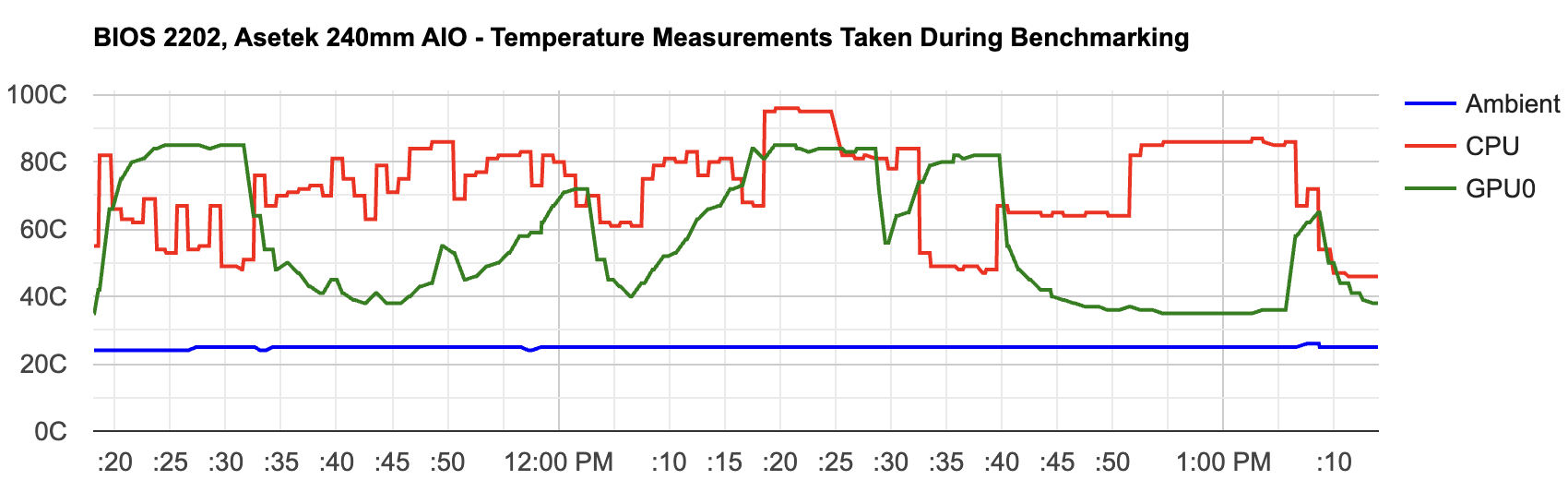
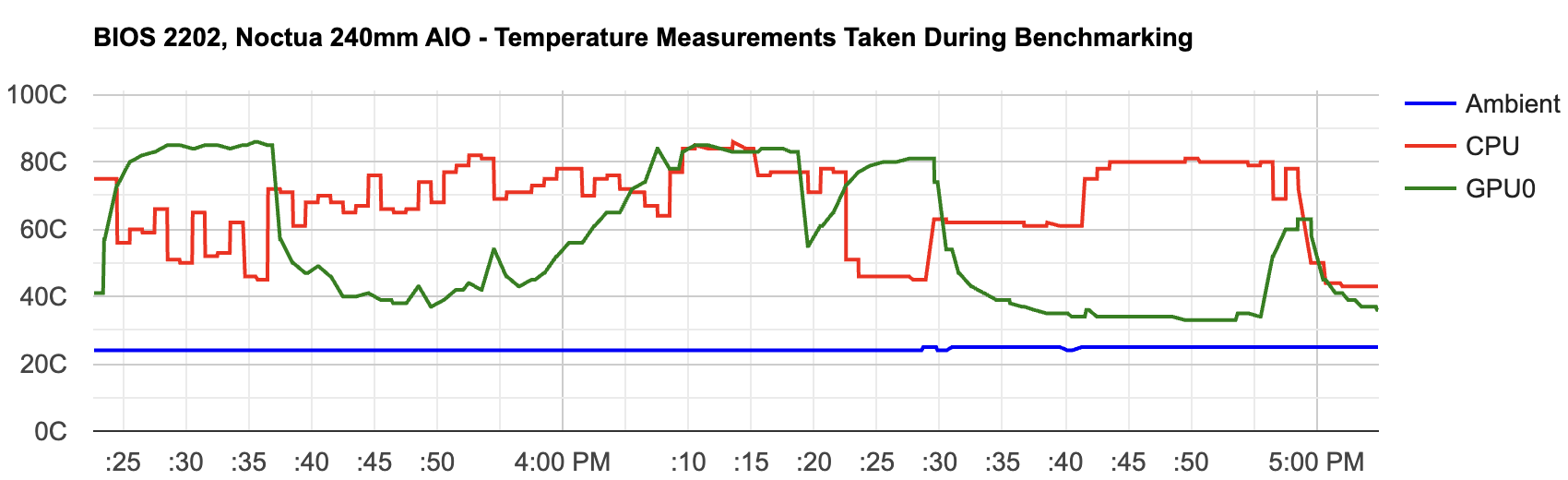
Let’s break these charts down a little bit. As part of our component qualification process, we run our full production benchmark suite – which places various types of load on the CPU, GPU, RAM, and storage. This includes Puget Bench, covering several Adobe programs, as well as other industry-standard benchmarks. For worst-case scenario testing, we run a combined-load test: Prime95 to stress the CPU and RAM, in tandem with a custom Python script utilizing CUDA 13.1 Toolkit to stress the GPU.
In the first graph, this takes place just past the halfway point. Around 12:18 PM on the time axis we can see the CPU temperature spike, indicating that the Prime95 stress test was initiated. The highest single-core CPU temperature recorded during this was 96ºC, with an Asetek cooler installed. In the second graph, the same computer ran through the same benchmarks, but with a Noctua AIO cooling the CPU instead. The combined stress test began just before 4:10 PM on the time axis, but the peak CPU temperature was only 86ºC this time – a full 10º drop on the hottest core!
Skeptical of this massive temperature change, we swapped the coolers around again and reran the same tests.
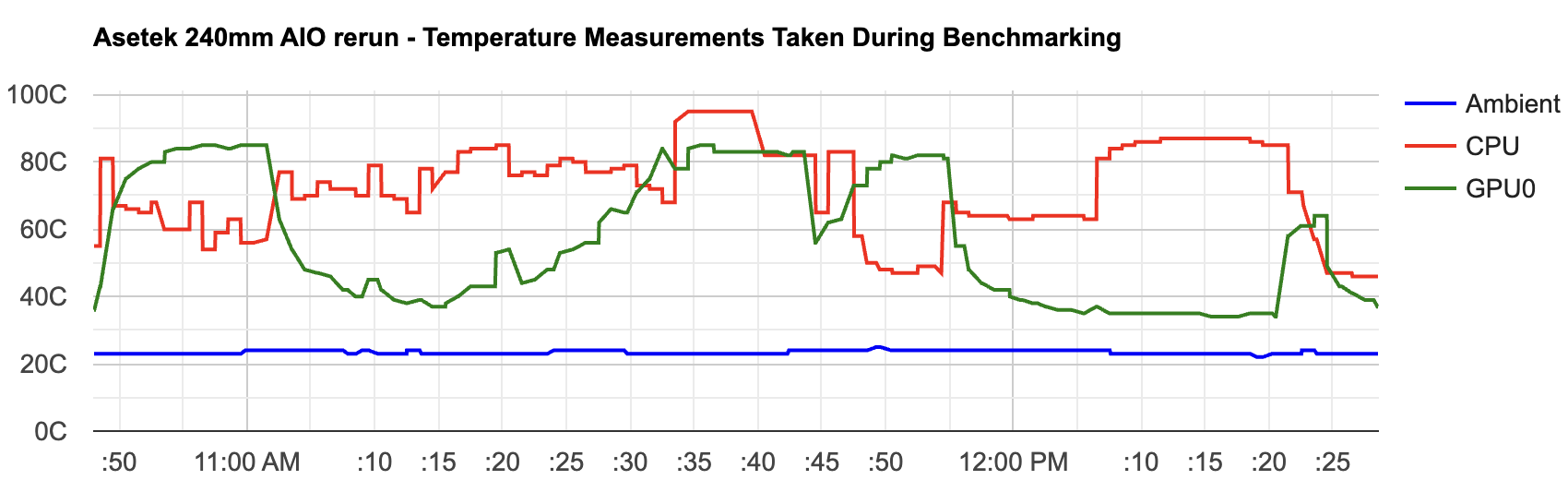
The Asetek rerun, above, looks very similar to the original. No surprise there: this is exactly the sort of reliable behavior we expect from the class of hardware we use.
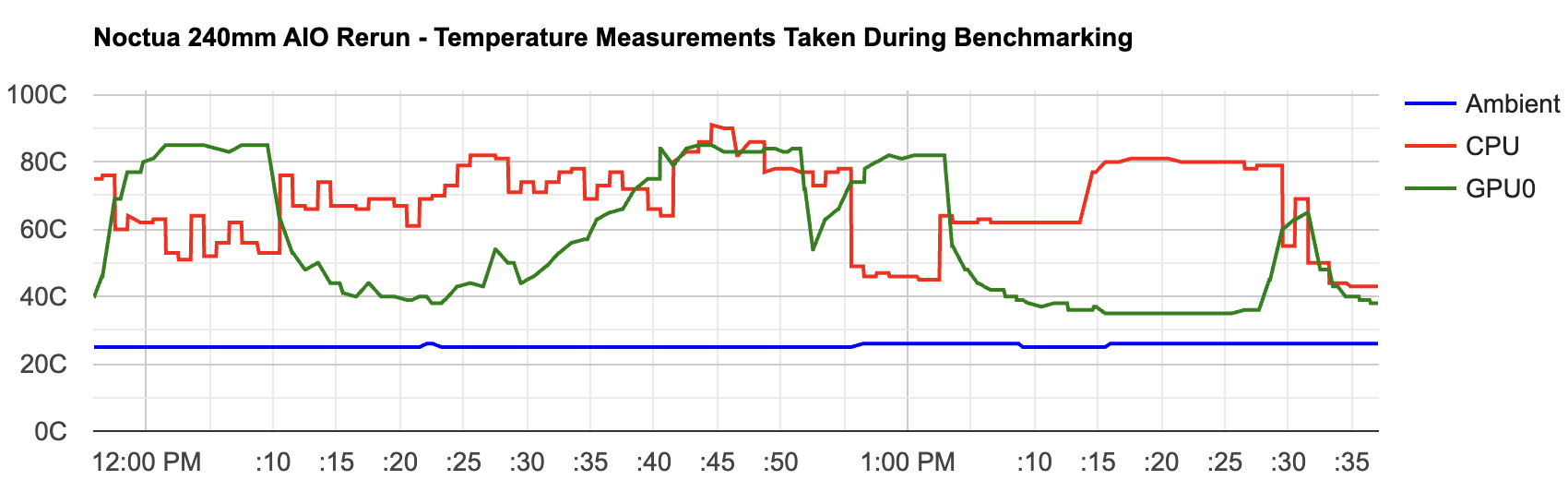
During the Noctua AIO rerun, the CPU temperature did get a little higher than the first time around, reaching 91ºC. That was recorded briefly, just before 12:45 PM, and proceeded to drop first to 90ºC, and then after a few minutes down to that same 86ºC we had seen the first time around. While the temperature graph shows a noticeable dip in the middle of that test, which the other runs didn’t seem to have, the component load (%), system power draw (W), and CPU frequency (MHz) data collected during this run all confirm that the Prime95 + Python CUDA stress test ran correctly, and that the CPU was under full load for the duration.
Noctua included an improved variant of their NF-A12x25 fans with the NC-LC1, so we swapped them over to the Asetek’s radiator to see if they were responsible for the improved cooling.
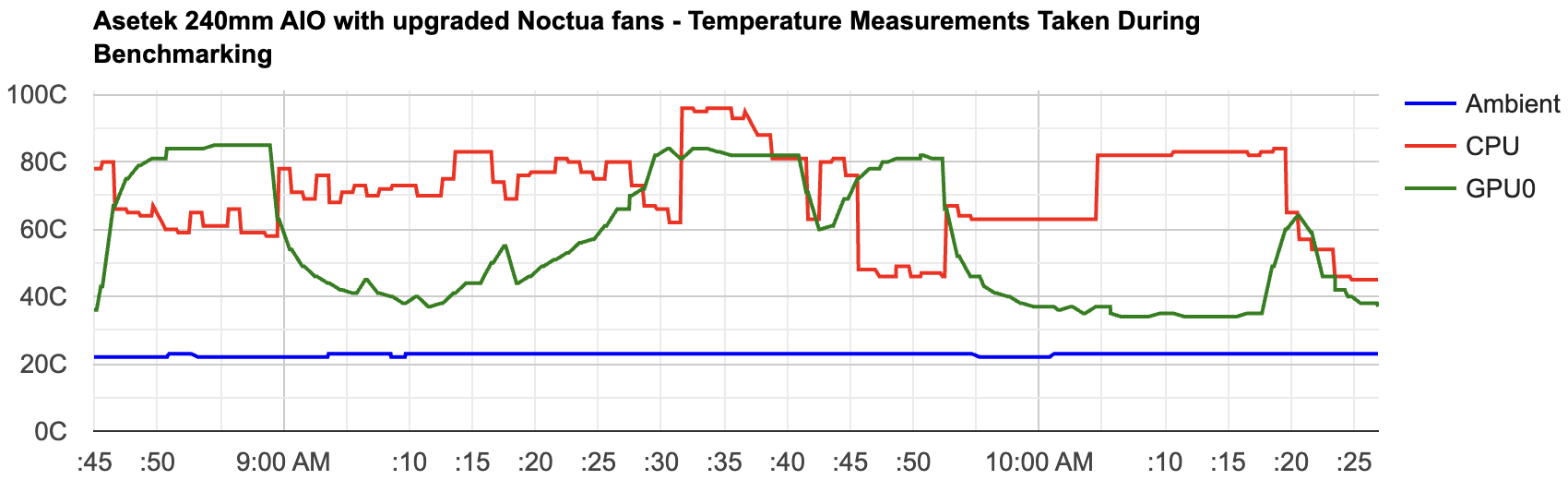
Even with upgraded fans, temperatures peaked at 96ºC and remained in the 93º-96ºC range for a large portion of the test with the Asetek AIO. That means other improvements, likely in the cold plate and/or radiator, are responsible for the bulk of the NL-LC1’s thermal gains.
With improvements ranging from 3ºC to a whopping 10ºC, it was clear we had an excellent product on our hands. What these graphs don’t show you is the acoustic engineering that went into the NL-LC1. Noctua has their own resources explaining the design of the NL-PNA1 pump noise absorber. In short, they are leveraging both acoustic soundproofing and a tuned-mass damper to isolate the vibrations generated by the pump.
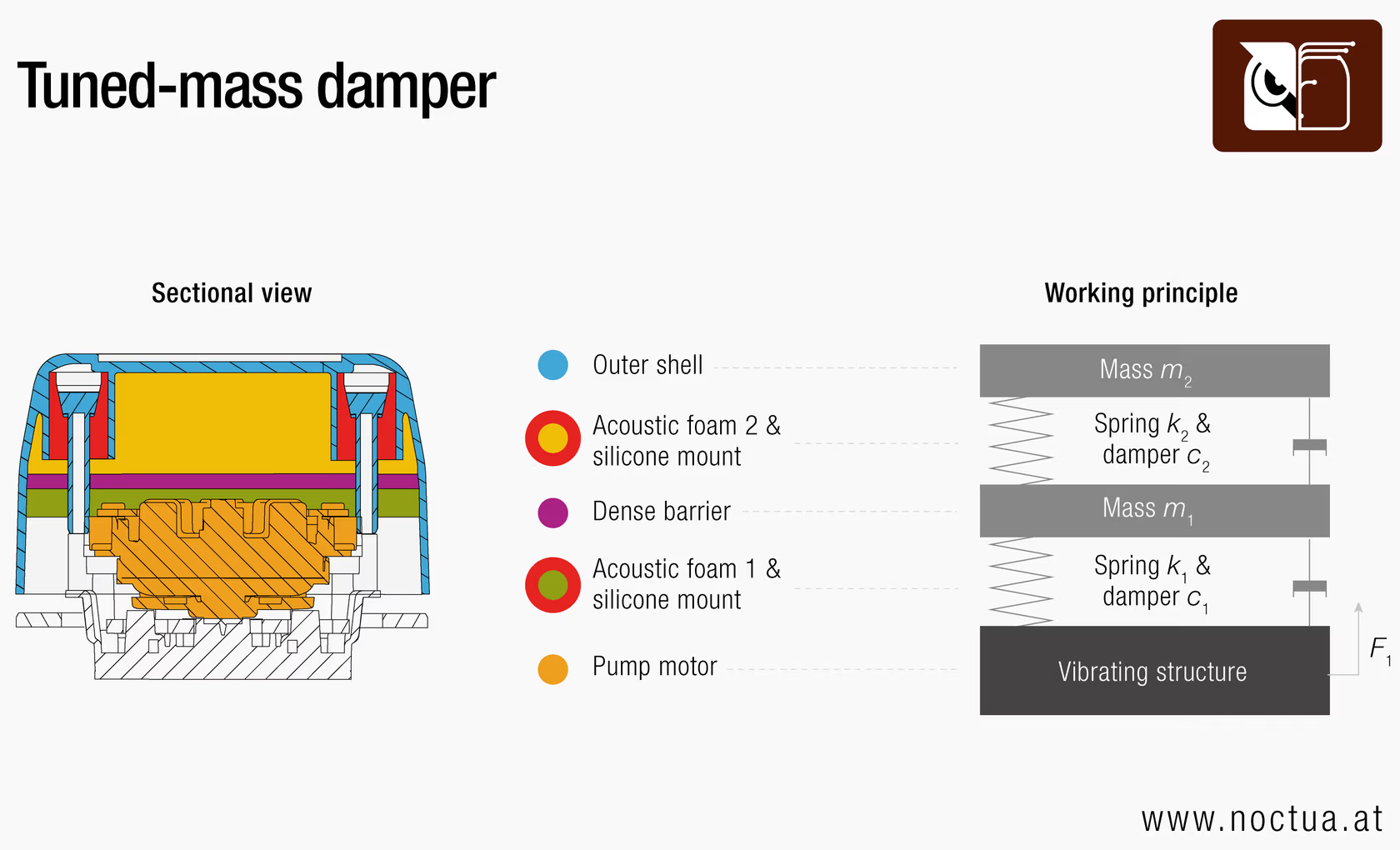
Diagram from Noctua of their tuned-mass damper
The pumps on both the Asetek OEM cooler and the Noctua NL-LC1 operate below the threshold of our audio measuring equipment – an area in which we would like to improve our testing capabilities – but can still be differentiated by the naked ear. The NL-LC1 absolutely passes the ear check. At idle, our previous Asetek model was audible with the chassis side panel removed, albeit only faintly. The NL-LC1 is barely audible at idle with your ear right up against it, and completely drowned out by chassis and GPU fans when the system is under load. Given the impressive thermal improvements, the added benefit of lowering the noise floor of our systems is a welcome feature in a world where computers are getting hotter and louder.
All in all, we were very impressed with the NL-LC1-240 during our initial evaluation. Even considering Noctua’s stellar reputation, this level of performance – both thermally and acoustically – is impressive for their first foray into the liquid cooling space. It has fully replaced our previous AIO offerings for Core Ultra and Ryzen-based PCs and is available for purchase in a Puget Systems workstation now!
The data in this article was collected from an X870E-based system with an AMD Ryzen 9 9950X. The NL-LC1-240 was also qualified for use on Z890-based Intel Core Ultra systems. Fitment and performance was validated in the Fractal Design Define 7 and Define 7 XL tower cases, the SilverStone SUGO 17 compact chassis, and the SilverStone RM44 4U rackmount case.

Looking for a new desktop workstation?
We build computers tailor-made for your workflow.

Don’t know where to start?
We can help!
Get in touch with one of our technical consultants today.