The new RTX series from NVIDIA may not be great for Adobe applications, but they are great for DaVinci Resolve and are very interesting cards for the future due to two major new features: Tensor cores and RT cores.
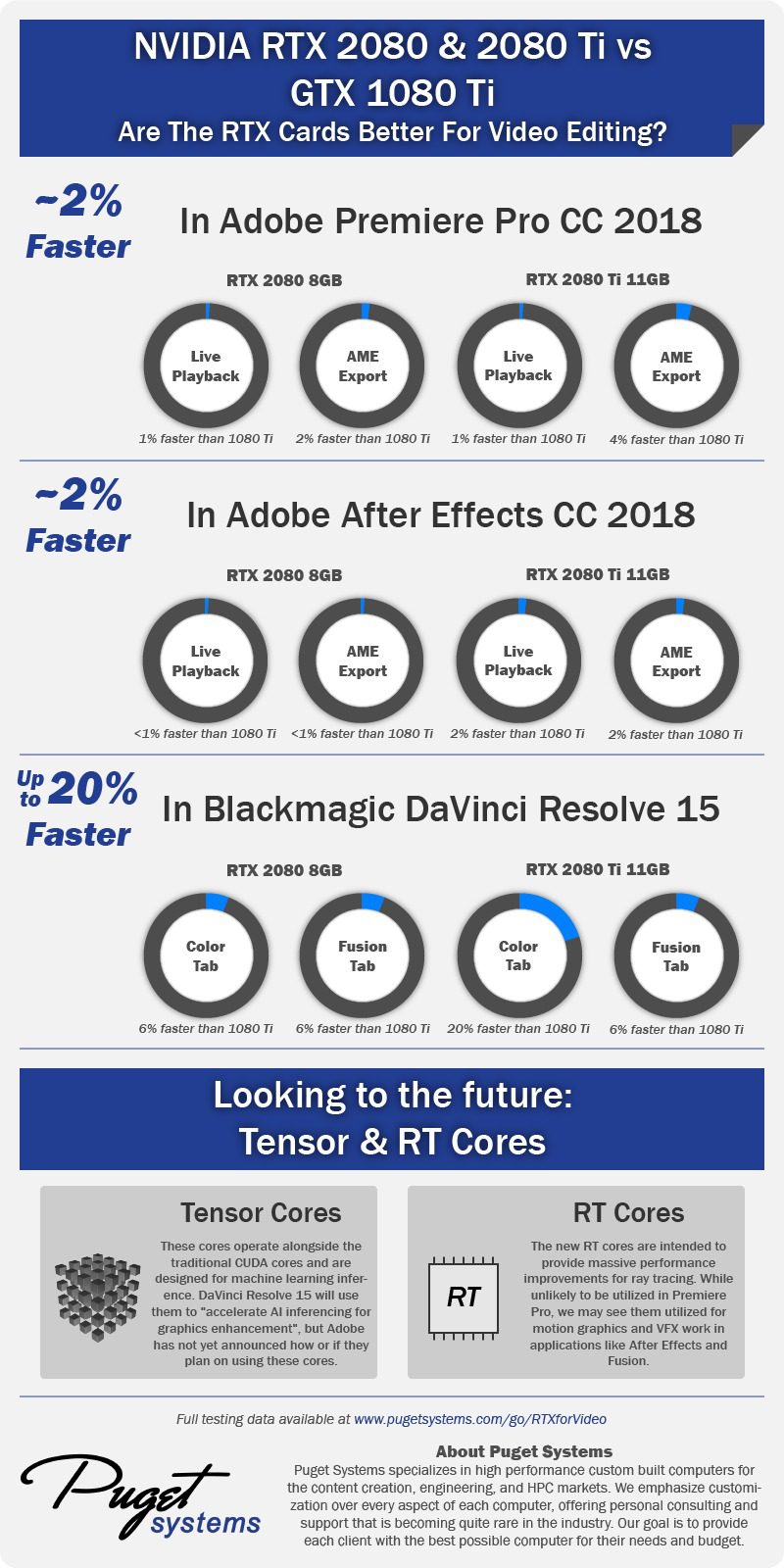
The new RTX series from NVIDIA may not be great for Adobe applications, but they are great for DaVinci Resolve and are very interesting cards for the future due to two major new features: Tensor cores and RT cores.
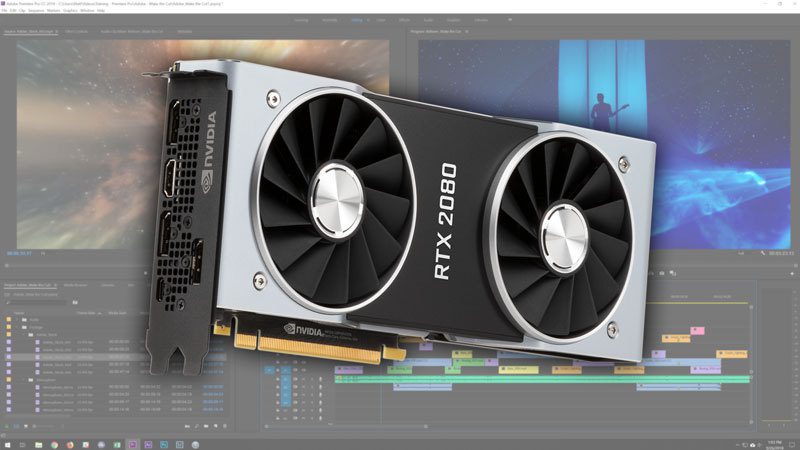
Premiere Pro CC utilizes the GPU to enhance performance for a number of tasks but it is often more important to get the right CPU than it is to get a faster GPU. NVIDIA’s new RTX series cards have general performance increases like you would expect, but much of what makes these cards interesting are the addition of two new features: Tensor cores and RT cores.
OctaneRender is a GPU-based rendering engine, and as of version 3.08 is compatible with NVIDIA’s Turing graphics architecture in the GeForce RTX 2080 and 2080 Ti cards. Let’s take a look at how these new GeForce models compare to the previous generation.

Redshift is a GPU-based rendering engine, and the latest version 2.6.22 is compatible with NVIDIA’s Turing graphics architecture in the GeForce RTX 2080 and 2080 Ti cards. Let’s take a look at how these new GeForce models compare to the previous generation.
The new GeForce RTX series cards perform well in GPU based rendering, as individual cards, and have great potential for the future thanks to their new RT cores. However, when stacking them together to measure multi-GPU scaling we ran into some serious problems.
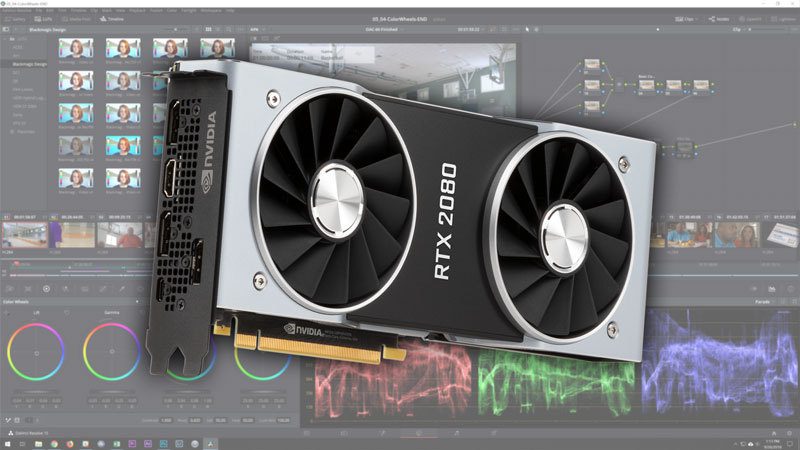
DaVinci Resolve heavily leverages the GPU to improve performance which means that the new RTX cards should give excellent performance. What makes these cards even more interesting is the fact that Blackmagic has already stated that they will be using the new turing cores on these cards to “accelerate AI inferencing for graphics enhancement”.
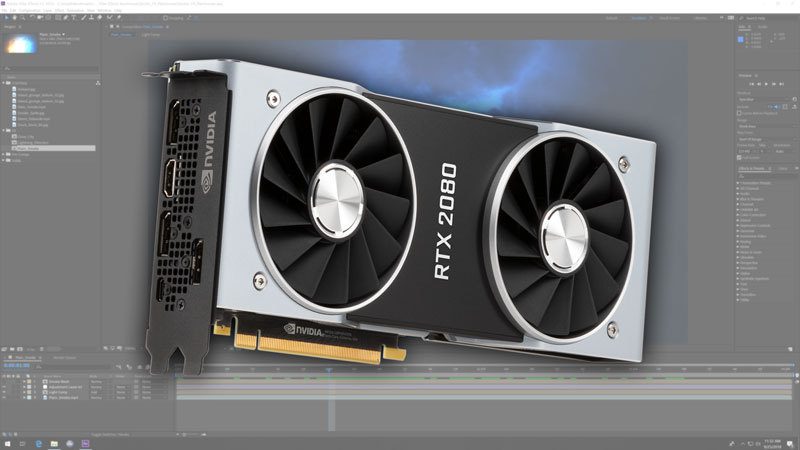
After Effects has had a bit of a rocky relationship with video cards ever since GPU acceleration was added back in 2015 with little reason to use more than a mid-range video card. However, NVIDIA’s new RTX series cards are here and they bring to the table two new features that may finally give you a reason to invest in a high-end GPU for After Effects: Tensor cores and RT cores.
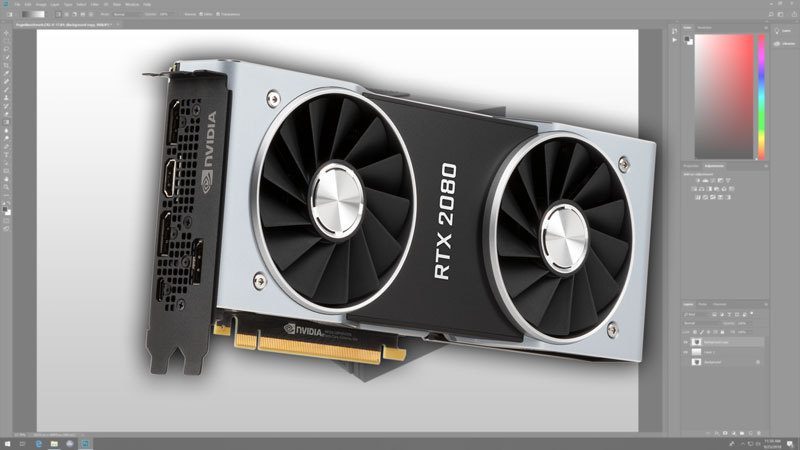
Photoshop does utilize the video card to accelerate a number of tasks, but a high end GPU is rarely necessary to get great performance. Do the RTX cards follow this trend, or do the new RT and tensor cores give them a performance advantage?

NVIDIA recently released version 10.0 of CUDA. This is an upgrade from the 9.x series and has support for the new Turing GPU architecture. This CUDA version has full support for Ubuntu 18.4 as well as 16.04 and 14.04. The CUDA 10.0 release is bundled with the new 410.x display driver for Linux which will be needed for the 20xx Turing GPU’s. If you are doing development work with CUDA or running packages that require you to have the CUDA toolkit installed then you will probably want to upgrade to this. I’ll go though how to do the install of CUDA 10.0 either by itself or along with an existing CUDA 9.2 install.

We currently know of at least two actions in Photoshop CC 2018 that cause image artifacts with the new RTX 2080 series video cards.
Puget Systems builds custom workstations, servers and storage solutions tailored for your work.
We provide:
Extensive performance testing
making you more productive and giving better value for your money
Reliable computers
with fewer crashes means more time working & less time waiting
Support that understands
your complex workflows and can get you back up & running ASAP
A proven track record
as shown by our case studies and customer testimonials