With the initial launches in NVIDIA’s GeForce RTX 30 Series complete, and availability getting better, it is time to look at how well these cards scale in multi-GPU configurations for rendering within Redshift, OctaneRender, and V-Ray.
With the initial launches in NVIDIA’s GeForce RTX 30 Series complete, and availability getting better, it is time to look at how well these cards scale in multi-GPU configurations for rendering within Redshift, OctaneRender, and V-Ray.
AMD is giving us the first taste of their new Zen 3 microarchitecture in the form of four Ryzen 5000 Series CPUs. This generation is supposed to have dramatically faster per-core performance than previous AMD processors, so what sort of impact does that have on CPU-based rendering engines like Chaos Group’s V-Ray? And how do these new models fare against other AMD and Intel processor families?
AMD’s has launched the Ryzen 5000 Series, bringing with it the updated Zen 3 microarchitecture and substantial performance improvements over the previous generation. How much of an impact do those changes have on rendering in Cinema 4D? And what can we expect with regard to modeling and animation performance in the viewport?
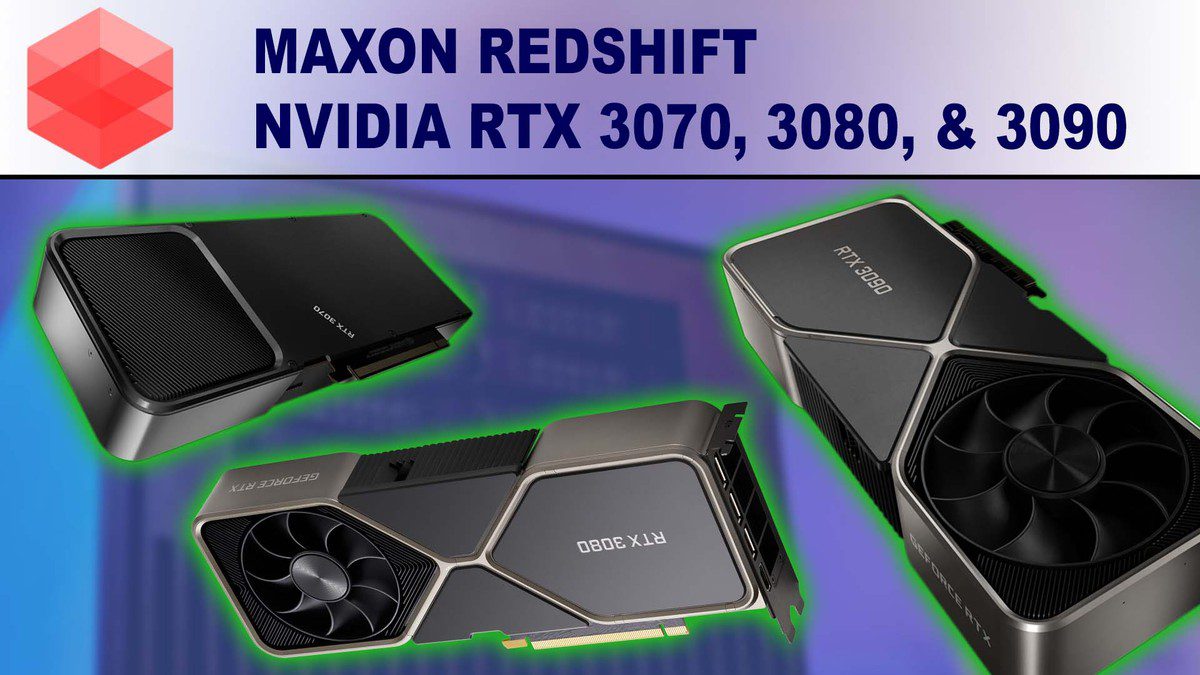
NVIDIA’s GeForce RTX 3080 and 3090 launched earlier this fall, and now the RTX 3070 has joined its siblings. How does it compare to the bigger RTX 30 Series cards? And how do they all stack up against the previous generation? In this article we take a look at how well they all fare in GPU based rendering engines like Maxon Redshift.
With the first three models in NVIDIA’s GeForce RTX 30 Series now available, how do the RTX 3070, 3080, and 3090 stack up? In this article we take a look at how they compare to each other as well as the previous generation of GeForce and Titan cards in OTOY’s OctaneRender.
NVIDIA’s latest generation of GPUs, the GeForce RTX 30 Series, has steadily rolled out over the course of the last several weeks. With the RTX 3070 launched most recently, how do all three models compare – both to each other, and to the previous GeForce and Titan cards? In this article we take a look at how they all stack up in Chaos Group’s V-Ray & V-Ray Next rendering engines.
NVIDIA’s GeForce RTX 30 Series cards are here, with NVIDIA boasting significant performance gains over the previous generation. The RTX 3080 launched last week, and now with the RTX 3090 released today we can compare these models to each other as well as the older 20 Series to see how they stack up in GPU based rendering engines like Maxon Redshift.
NVIDIA’s GeForce RTX 30 Series cards are here, with NVIDIA boasting significant performance gains over the previous generation. The RTX 3080 launched last week, and now with the RTX 3090 released today we can compare these models to each other as well as the older 20 Series to see how they stack up in GPU based rendering engines like OTOY’s OctaneRender.
NVIDIA’s GeForce RTX 30 Series cards are here, with NVIDIA boasting significant performance gains over the previous generation. The RTX 3080 launched last week, and now with the RTX 3090 released today we can compare these models to each other as well as the older 20 Series to see how they stack up in GPU based rendering engines like Chaos Group’s V-Ray & V-Ray Next.
The RTX 3000 series cards are here, with NVIDIA boasting significant performance gains over the previous generation. With the RTX 3080 now launched, we can find out how large those gains are in GPU based renderers like Maxon Redshift.
Puget Systems builds custom workstations, servers and storage solutions tailored for your work.
We provide:
Extensive performance testing
making you more productive and giving better value for your money
Reliable computers
with fewer crashes means more time working & less time waiting
Support that understands
your complex workflows and can get you back up & running ASAP
A proven track record
as shown by our case studies and customer testimonials