Table of Contents
What is Puget Bench?
While gaming or synthetic benchmarks can offer general insights, they fall short when it comes to measuring performance in the actual workflows that matter to content creators. That’s where Puget Bench comes in. Puget Bench is a suite of performance benchmarks developed by Puget Systems, designed to evaluate hardware using the same real-world creative applications professionals rely on every day.
We built these benchmarks out of necessity. There simply wasn’t a reliable way to test hardware using real creative applications in realistic scenarios. And so, we began the process of turning our knowledge of both computer hardware and creative workloads like video editing, motion graphics, and photography into a series of benchmarks to help guide users into making the most informed workstation purchasing decisions possible.
At the moment, our Puget Bench for Creators suite includes benchmarks for the following applications:
- Adobe Premiere Pro
- Adobe After Effects
- Adobe Photoshop
- Adobe Lightroom Classic (currently in beta)
- Blackmagic DaVinci Resolve
Image
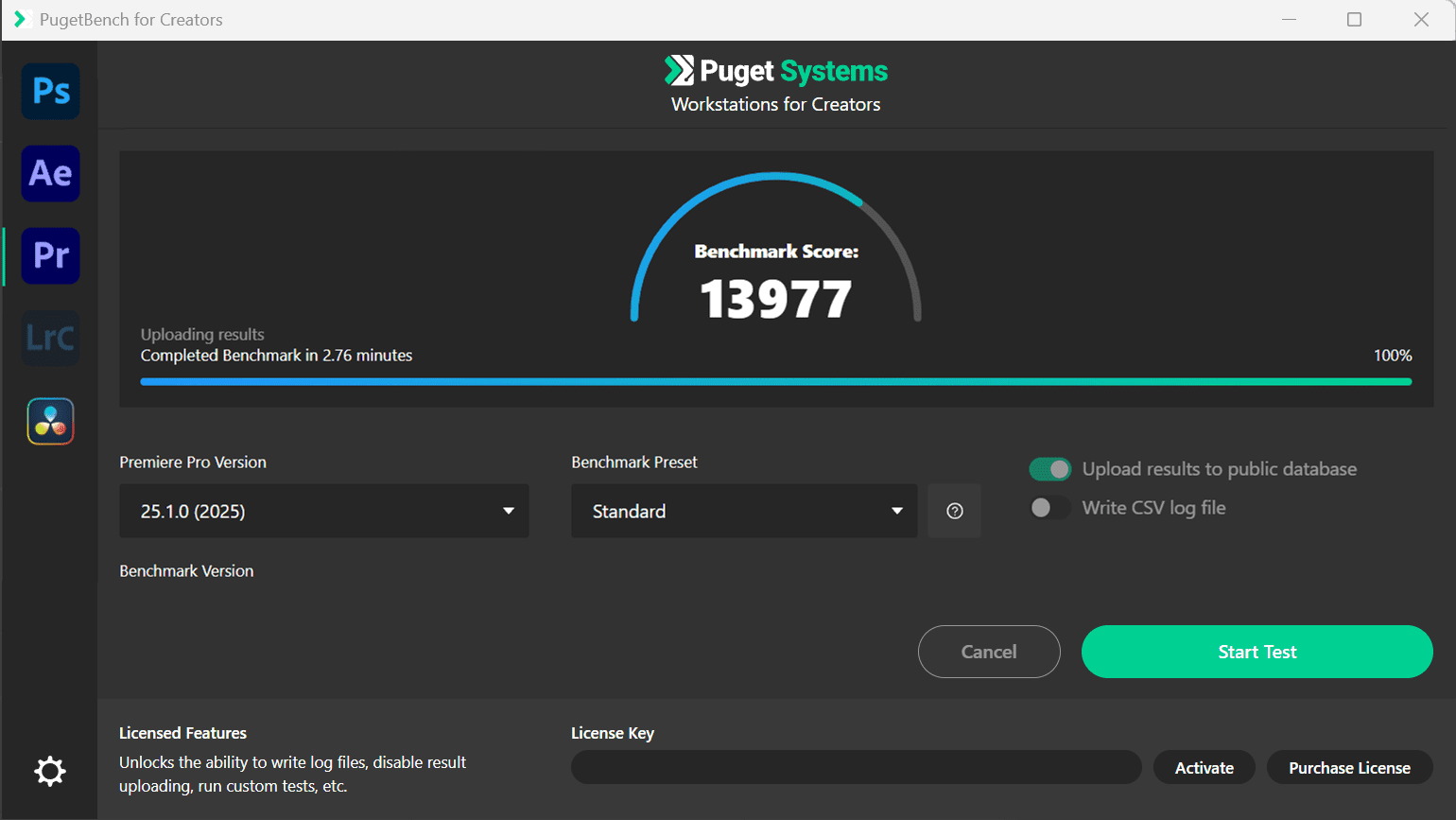
What sets Puget Bench apart is that it runs directly on top of the actual application being tested. Instead of approximating workloads with synthetic methods, we use real projects and real media within the software you use every day. This gives relevant, accurate results and reflects how your system will perform in production.
This approach also means Puget Bench automatically accounts for software updates—whether it is new hardware support, performance optimizations, or even regressions due to bugs. Our benchmarks aren’t just useful for performance analysis, they are also powerful troubleshooting tools.
Results from our benchmarks are a core feature in many of the hardware articles we publish, but are also available for anyone to download and run. They are free for personal use, with paid licenses available if you plan to use them for commercial purposes or are looking for more advanced features like CLI automation, local logging, and beta access.
Recent Improvements to Puget Bench
In addition to standard updates to support new versions of the host applications and to fix bugs, we are continually working on improvements and additions to Puget Bench. Over the last year, our major milestones included:
Launch of Puget Bench for After Effects 1.0 (April 2025)
After extensive development, our Puget Bench for After Effects benchmark launched in the full “1.0” state, meaning that it is suitable for public use and that the tests/scoring should be stable for at least a few years (barring major application changes by Adobe).
Overhaul of the Puget Bench Public Results Database (April 2025)
Our database of results currently has approximately 250,000 entries, and our new result analysis pages make it easier than ever to make use of all that data. This includes the ability to easily compare different CPUs and GPUs, but also adds a quick overview of the top CPUs and GPUs for Premiere Pro, Photoshop, DaVinci Resolve, and other benchmarks. Lastly, new analysis tools give you insights on how your system compares to a modern workstation when you run the benchmark, and how it performs relative to other systems with the same CPU or GPU (example).
Launch of Puget Bench for DaVinci Resolve 1.0 (July 2024)
The “1.0” launch of Puget Bench for DaVinci Resolve completely overhauled our tests, adding support for new codecs, tests for AI features, support for MacOS, and more.
In addition to the above, we have a number of changes coming in the near future. These include a completely overhauled “1.0” version of our Lightroom Classic benchmark and a feature pass to bring a number of quality-of-life improvements to the benchmark utility.
Adoption by the Public
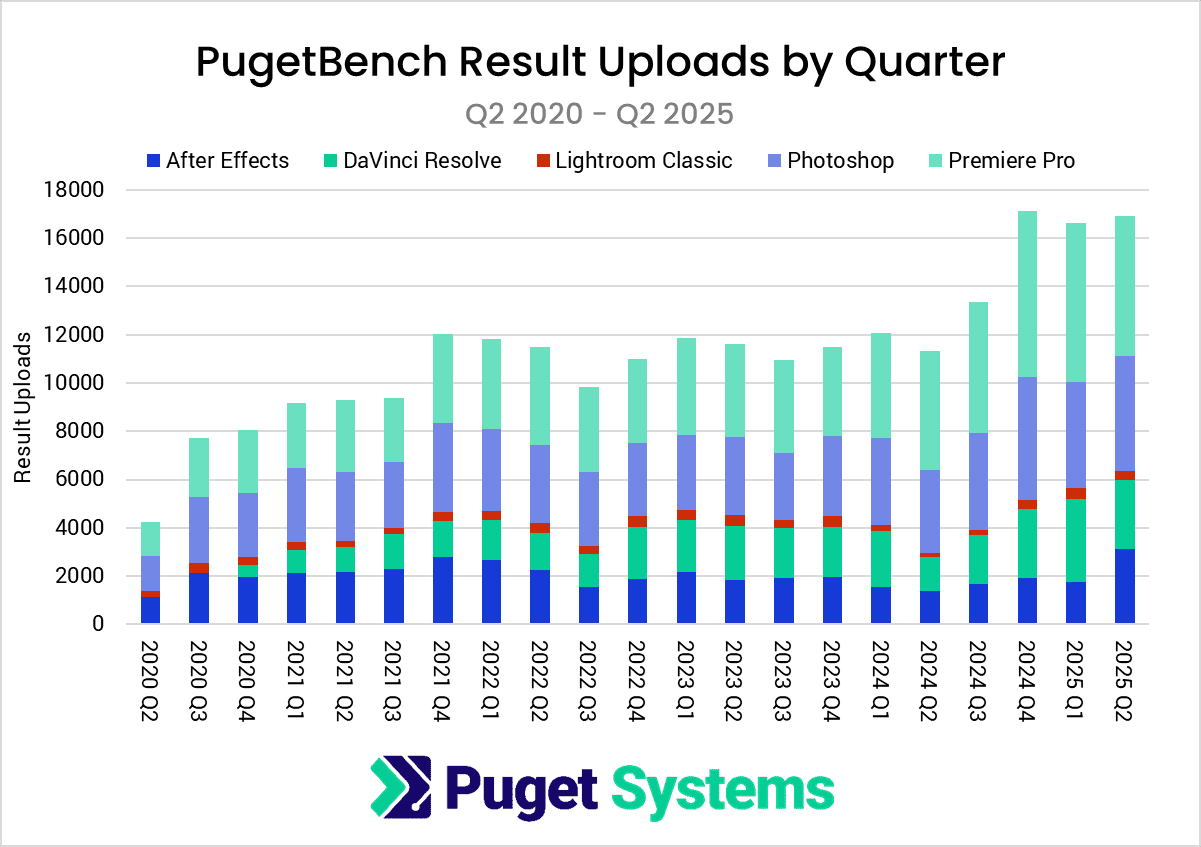
Since we first allowed the public to download and run our benchmarks in 2020, adoption has been steadily on the rise. At the moment, we average around 5,500 new result profiles uploaded to our database every month. Approximately a third of those are gathered from the benchmarking and testing of the workstations we manufacture here at Puget Systems, which are flagged with a special designator since we know that they are not overclocked or thermal throttled. The majority of results, however, come from the public with an incredibly wide range of system configurations.
The popularity of each benchmark is closely tied to its length in a “1.0” state, with Premiere Pro and Photoshop being the most popular, followed by After Effects and DaVinci Resolve.
Image
As of July 2025, we have access to just shy of 250,000 benchmark profiles that cover over 70,000 different combinations of hardware, software, drivers, and BIOS. This provides a massive wealth of data that we are only scratching the surface of right now, and we plan to do a lot more with it in the future!
Use of Puget Bench by the Press
In addition to the general public, one of the key demographics for our benchmarks is members of the press, who use them to evaluate the performance of a range of hardware. We have provided a plethora of press licenses over the years, and the adoption rate of our benchmarks has been extremely high.
While this list is by no means exhaustive, we recently completed a discovery project to investigate use of our benchmarks and compiled a list of articles and videos that utilized one or more of our benchmarks in the last few months. If you are aware of a reviewer who uses our benchmarks that is not on this list, let us know so we can provide them with a press license!
Puget Bench as a Part of Hardware Launches
In addition to third-party reviews, several hardware manufacturers have used our benchmarks as a part of their product launches. The most recent examples of this are:
AMD’s Ryzen 9 9950X3D Announcement at CES 2025
As part of the on-stage announcement of the AMD Ryzen 9 9950X3D at CES 2025, Puget Bench for DaVinci Resolve, Premiere Pro, and Photoshop were used to compare performance against the previous generation AMD Ryzen 9 7950X3D and the Intel Core Ultra 9 285K. Performance data and messaging derived from Puget Bench results can also be found on the landing pages for many of AMD’s products, including the new AMD Ryzen Threadripper PRO 9000WX processors.
Intel Core Ultra Desktop Processors Launch Briefing
Image
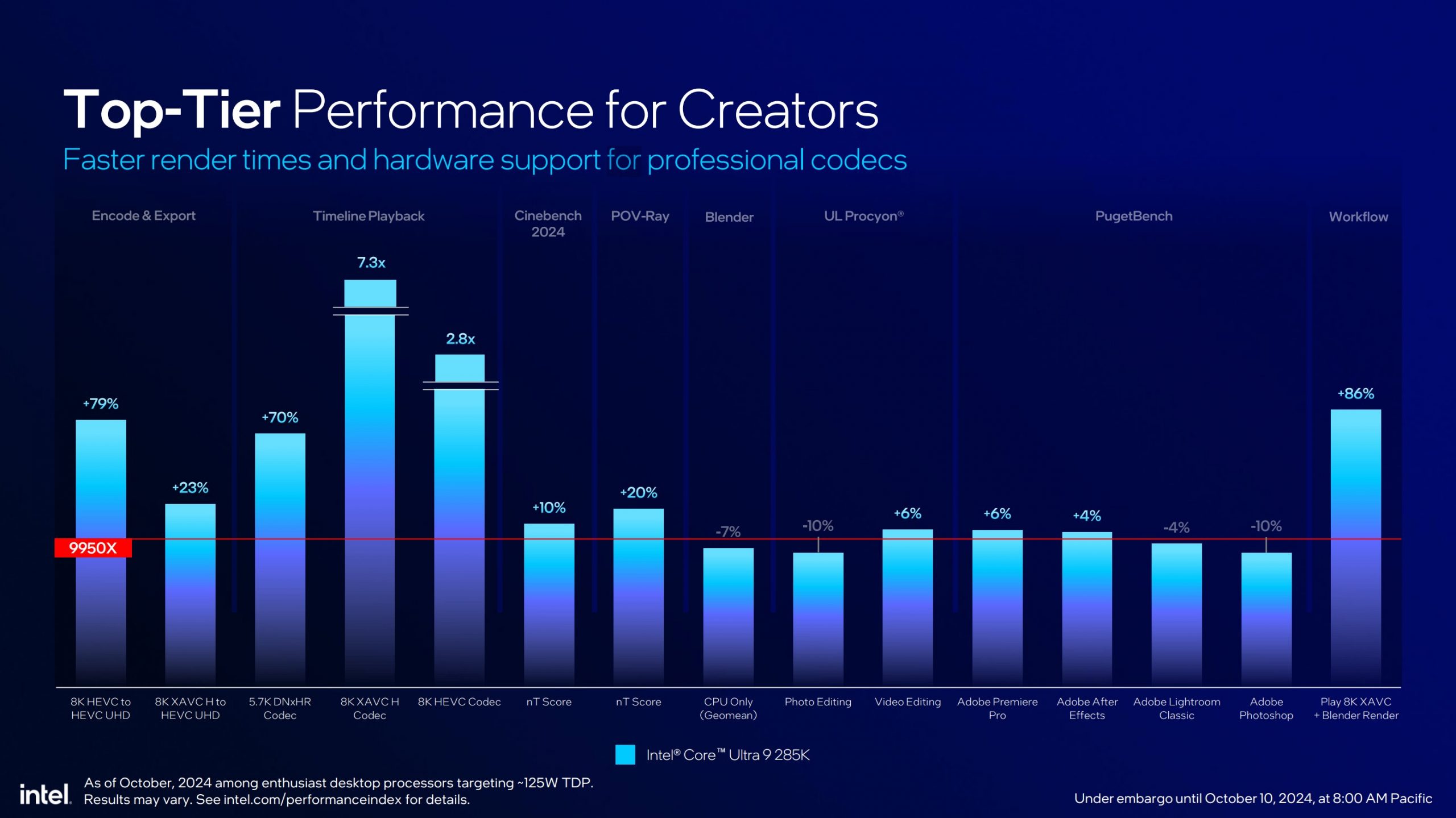
Alongside the launch of the Intel Core Ultra Desktop Processors, Intel provided a PDF highlighting the new technology and examples of performance for gaming and productivity workflows. Results from Puget Bench for Premiere Pro, After Effects, Photoshop, and Lightroom Classic were used in multiple instances to highlight performance compared to the competition.
Looking to the Future
Of course, we are not done yet! There is a lot we still want to do, and multiple projects are already in the works. In addition to the normal benchmark updates to add ongoing application support, keep an eye out for further improved analysis and search tools for results in our public database. In addition, we are actively working on benchmarks for new applications and workflows, including an overhaul to our Lightroom Classic and Premiere Pro benchmarks, as well as a range of benchmark tests for Unreal Engine to cover game dev, virtual production, and more!
If you want to stay informed of upcoming changes to Puget Bench, you can sign up for our newsletter below:

Looking for a Content Creation workstation?
We build computers tailor-made for your workflow.

Don’t know where to start?
We can help!
Get in touch with one of our technical consultants today.