Smarter Every Day generates huge amounts of 4K and high speed footage content, and needed a high performance workstation that could keep up with their work. With a new workstation from Puget Systems, their post-production workflow is 4.4X faster!

Smarter Every Day generates huge amounts of 4K and high speed footage content, and needed a high performance workstation that could keep up with their work. With a new workstation from Puget Systems, their post-production workflow is 4.4X faster!

PhotoScan makes use of the video cards in a computer to assist with the computation of certain steps. As such, the model of video card used can have an impact on the amount of time those steps take. In this article, we take a look at the GeForce RTX 2000-series – based on NVIDIA’s Turing GPU architecture – to see how they compare to each other.

PhotoScan makes heavy use of the central processor (CPU) in a computer to run many of the calculations involved in turning still images into a 3D model or map. Different steps in that process utilize the CPU in various ways, though, with both clock speed and core count coming into play. Let’s see how the new 9th Gen Intel Core processors perform compared to existing Intel and AMD chips.

Intel just released their 9th Gen Core Series processors, which have both higher clock speed and more cores than the previous mainstream generation. Cinema 4D uses a blend of CPU factors: clock speed is important for modeling, animation, and physics simulation – but core count is king when it comes to rendering. Let’s see how these new chips compare to other options from both Intel and AMD.

Intel’s mainstream processors are not built specifically for CPU based rendering, and both Intel and AMD offer models with far more cores which will perform better in this application, but it is still worth testing each generation of these chips because they are ideal for 3D design, motion graphics, and animation – which are often used in workflows alongside rendering.
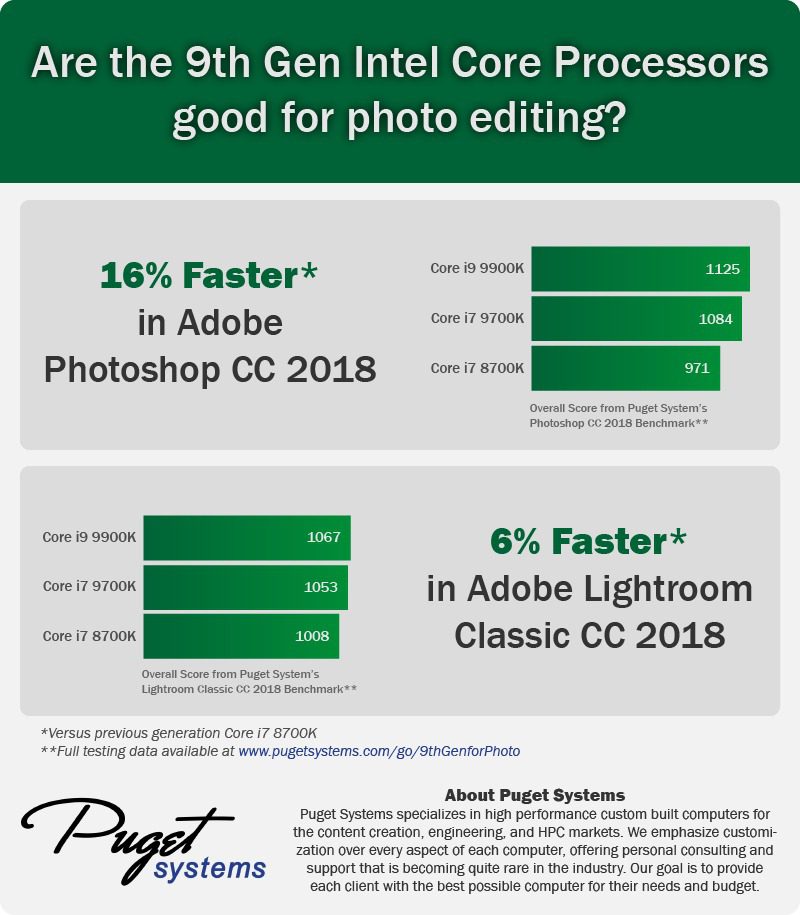
Most photo editing applications prefer a higher clocked CPU over one with more cores, but Intel’s new 9th Gen Core Processors feature not only an increase in core count, but also a small bump in frequency. These improvements make these new CPUs some of the fastest currently available for photo editing.
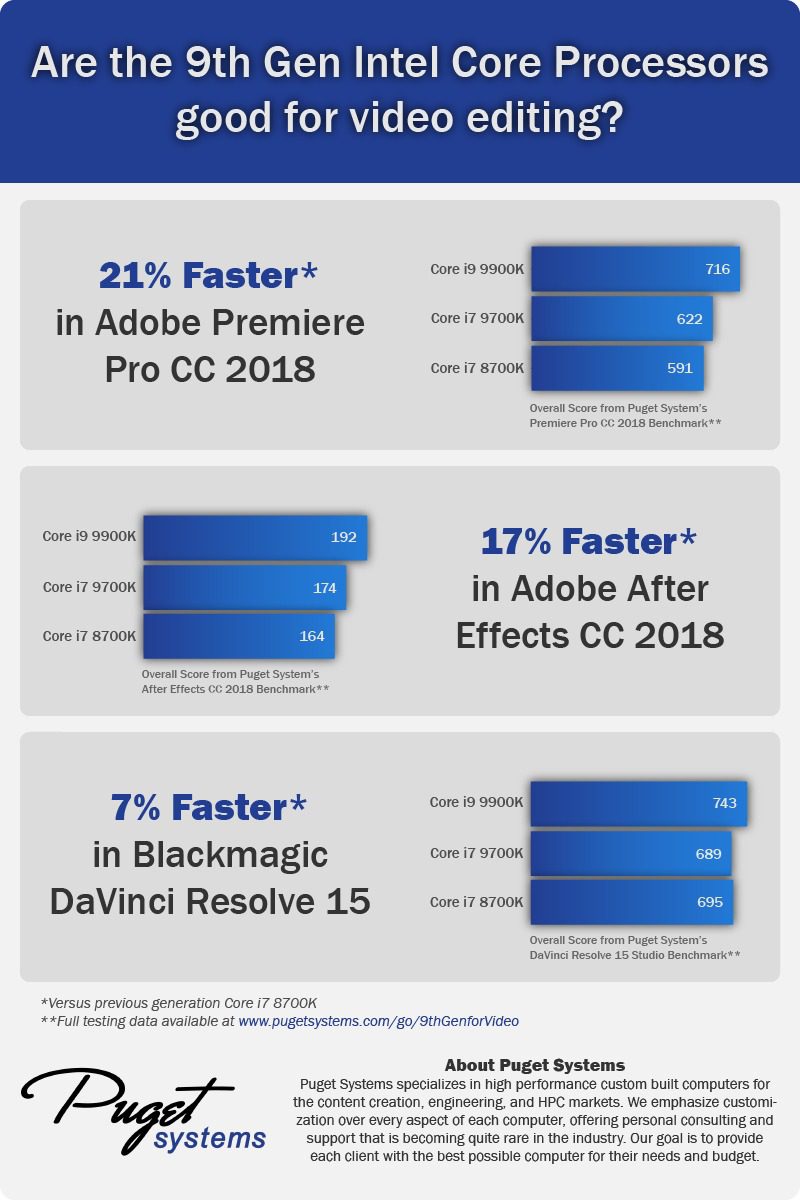
Intel’s new 9th Gen Core Processors include both a small frequency bump and an increase in core count. Due to these improvements, these CPUs fare extremely well in video editing applications, performing close to 20% faster than the i7 8700K in many Adobe applications.
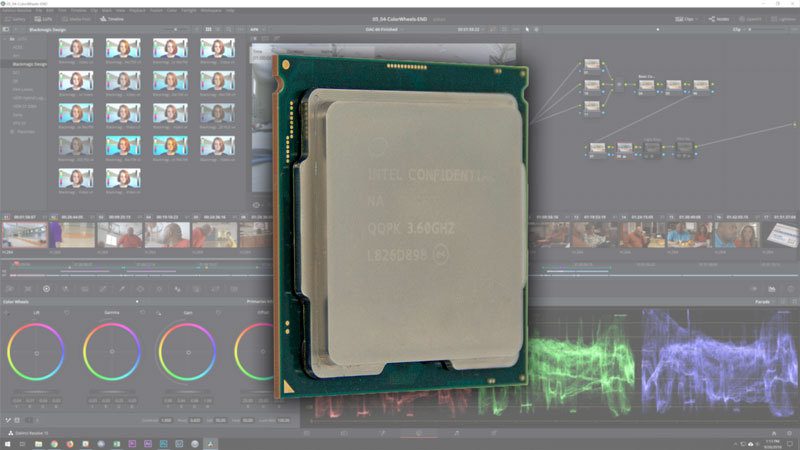
DaVinci Resolve is a very GPU-intensive program, but that doesn’t mean that the CPU doesn’t matter. Depending on the amount of GPU power you have, even a mid-range CPU could perform the same as a more expensive CPU which makes the new 9th Gen CPUs from Intel very interesting for Resolve workstations with only a few GPUs.
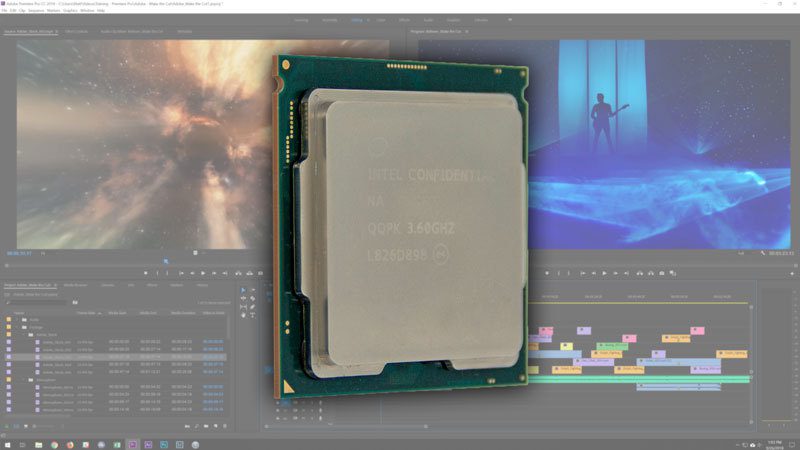
We tend to use either Intel’s X-series or AMD’s Threadripper CPUs for Premiere Pro due to their higher performance, but with Intel’s new 9th Gen CPUs sporting up to 8 cores, it will be very interesting to see how they fare in Premiere Pro.
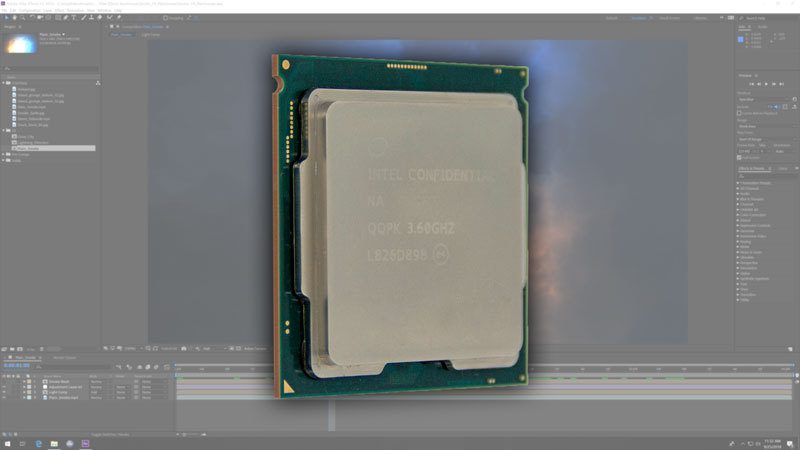
After Effects may not be quite as well threaded as it used to be, but there is still some performance gains to be had with higher core counts. Since the new 9th Gen CPUs from Intel include both a higher core count and a higher operating frequency, they should perform great in After Effects.
Puget Systems builds custom workstations, servers and storage solutions tailored for your work.
We provide:
Extensive performance testing
making you more productive and giving better value for your money
Reliable computers
with fewer crashes means more time working & less time waiting
Support that understands
your complex workflows and can get you back up & running ASAP
A proven track record
as shown by our case studies and customer testimonials