We take a look at the differences between the Intel Z370 chipset, launched in 2017, and the updated Z390 that launched in 2018. What features does the newer version add?

We take a look at the differences between the Intel Z370 chipset, launched in 2017, and the updated Z390 that launched in 2018. What features does the newer version add?

Today Intel has officially announced the launch of new mainstream desktop processors, including the first Core i9 branded chip for this market segment. We are testing these processors now, and are excited about what we have found so far, but cannot publish performance data until October 19th.
There was a lot of excitement when it was first announced that GeForce RTX 2080 and 2080 Ti cards would have NVLink connectors, because of the assumption that it would allow them to pool graphics memory when used in pairs. Digging into the functionality of the NVLink connection on these cards, however, things are not as straightforward as folks may have hoped.

Lighroom Classic CC saw dramatic performance improvements with higher core count CPUs, but the 2990WX in particular has a staggering 32 cores. Will Lightroom Classic be able to take advantage of these extremely high core counts, or we have reached the point of diminishing returns?

After choosing a 10-bit per channel graphics card (AMD Radeon Pro / Nvidia Quadro), and connecting it to a 10-bit per channel monitor, there is a setting in Photoshop you should enable to create a 30 bit workflow.

Are the NVIDIA RTX 2080 and 2080Ti good for machine learning?
Yes, they are great! The RTX 2080 Ti rivals the Titan V for performance with TensorFlow. The RTX 2080 seems to perform as well as the GTX 1080 Ti (although the RTX 2080 only has 8GB of memory). I’ve done some testing using **TensorFlow 1.10** built against **CUDA 10.0** running on **Ubuntu 18.04** with the **NVIDIA 410.48 driver**.
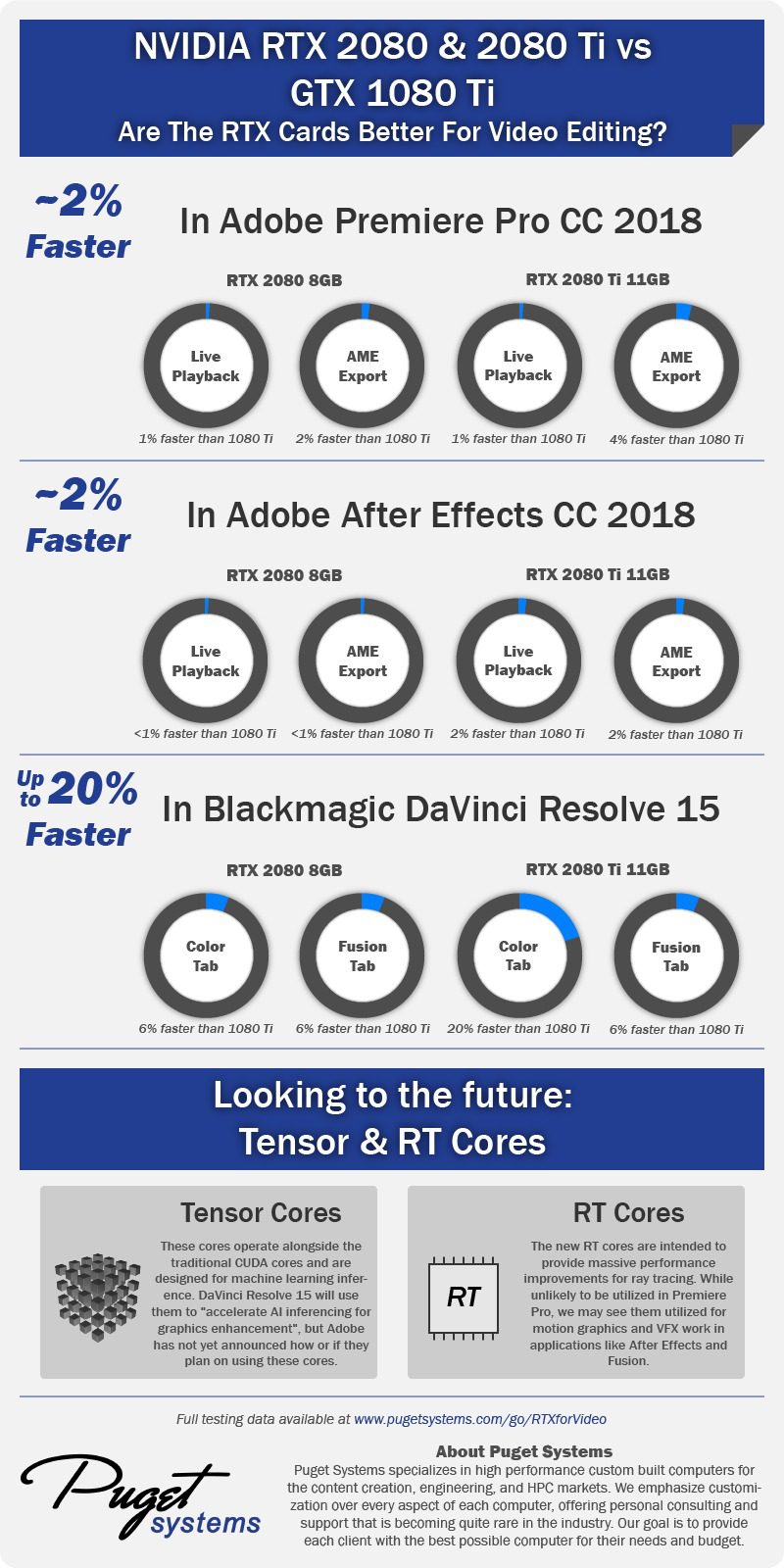
The new RTX series from NVIDIA may not be great for Adobe applications, but they are great for DaVinci Resolve and are very interesting cards for the future due to two major new features: Tensor cores and RT cores.
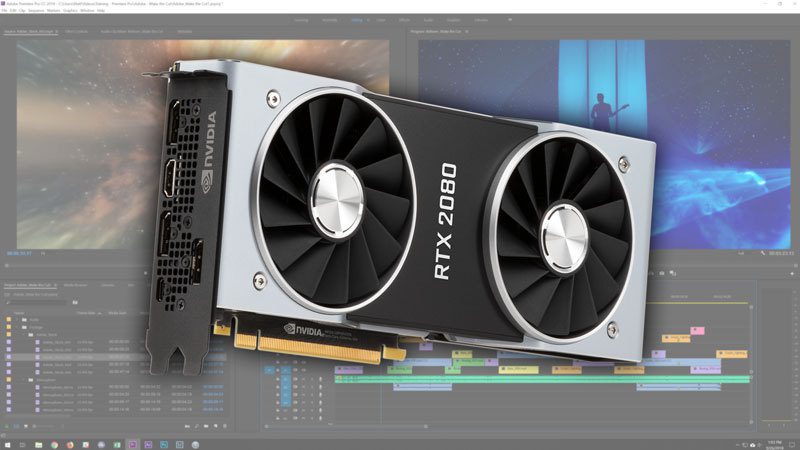
Premiere Pro CC utilizes the GPU to enhance performance for a number of tasks but it is often more important to get the right CPU than it is to get a faster GPU. NVIDIA’s new RTX series cards have general performance increases like you would expect, but much of what makes these cards interesting are the addition of two new features: Tensor cores and RT cores.
OctaneRender is a GPU-based rendering engine, and as of version 3.08 is compatible with NVIDIA’s Turing graphics architecture in the GeForce RTX 2080 and 2080 Ti cards. Let’s take a look at how these new GeForce models compare to the previous generation.

Redshift is a GPU-based rendering engine, and the latest version 2.6.22 is compatible with NVIDIA’s Turing graphics architecture in the GeForce RTX 2080 and 2080 Ti cards. Let’s take a look at how these new GeForce models compare to the previous generation.
Puget Systems builds custom workstations, servers and storage solutions tailored for your work.
We provide:
Extensive performance testing
making you more productive and giving better value for your money
Reliable computers
with fewer crashes means more time working & less time waiting
Support that understands
your complex workflows and can get you back up & running ASAP
A proven track record
as shown by our case studies and customer testimonials