Microsoft generously wrote in the ability to install a FEW Linux distros but unfortunately, it doesn’t work right out of the box. In the guide I will discuss how to install the WSL and get the distros installed.
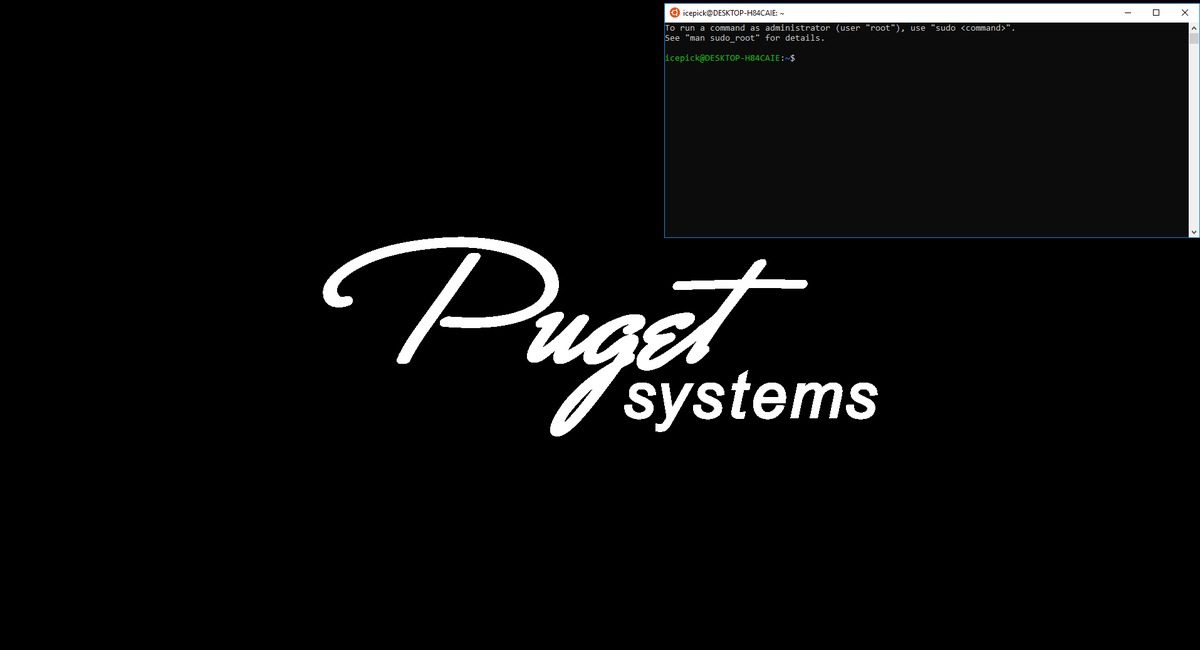
Microsoft generously wrote in the ability to install a FEW Linux distros but unfortunately, it doesn’t work right out of the box. In the guide I will discuss how to install the WSL and get the distros installed.

Batch size is an important hyper-parameter for Deep Learning model training. When using GPU accelerated frameworks for your models the amount of memory available on the GPU is a limiting factor. In this post I look at the effect of setting the batch size for a few CNN’s running with TensorFlow on 1080Ti and Titan V with 12GB memory, and GV100 with 32GB memory.

PhotoScan makes use of the video cards in a computer to assist with the computation of certain steps. As such, the model of video card used can have an impact on the amount of time those steps take. In this article, we take a look at the GeForce 1000-series – based on NVIDIA’s Pascal GPU architecture – to see how they compare to each other.

Designer, Kevin Airgid, uses a Recommended System for Adobe After Effects CC to create large-venue motion graphics.

PhotoScan makes use of the video cards in a computer to assist with the computation of certain steps. The performance of an individual video card, or GPU, is known to impact the processing speed – but what about the connection between the video card and the rest of the computer? This interconnect is called PCI Express and comes in a variety of speeds. In this article, we will look at how PhotoScan performance scales across PCI-E 3.0 x4, x8, and x16.
Tensor-cores are one of the compelling new features of the NVIDIA Volta architecture. In this post I discuss the some thought on mixed precision and FP16 related to Tensor-cores. I have some performance results for large convolution neural network training that makes a good argument for trying to use them. Performance looks very good.

PhotoScan is a photogrammetry program: an application that takes a set of images and combines them to create a 3D model. A combination of CPU and GPU processing is used in this process. It has been a couple years (and several version updates) since we last tested PhotoScan, so we are revisiting it to see what has changed and how it performs on modern computer hardware.

Adobe has been leveraging the power of the GPU in their software more and more, but is there any reason to spend money on an expensive video card for Photoshop?

Intel has long been the performance king for After Effects, but AMDs new 2nd generation Ryzen CPUs have shown some great performance gains. Is it enough to let AMD overtake Intel?

AMD has made great improvements with the new 2nd generation Ryzen CPUs that really closes the gap between AMD and Intel for Photoshop users. But is it enough to put them above Intel’s 8th Gen CPUs?
Puget Systems builds custom workstations, servers and storage solutions tailored for your work.
We provide:
Extensive performance testing
making you more productive and giving better value for your money
Reliable computers
with fewer crashes means more time working & less time waiting
Support that understands
your complex workflows and can get you back up & running ASAP
A proven track record
as shown by our case studies and customer testimonials