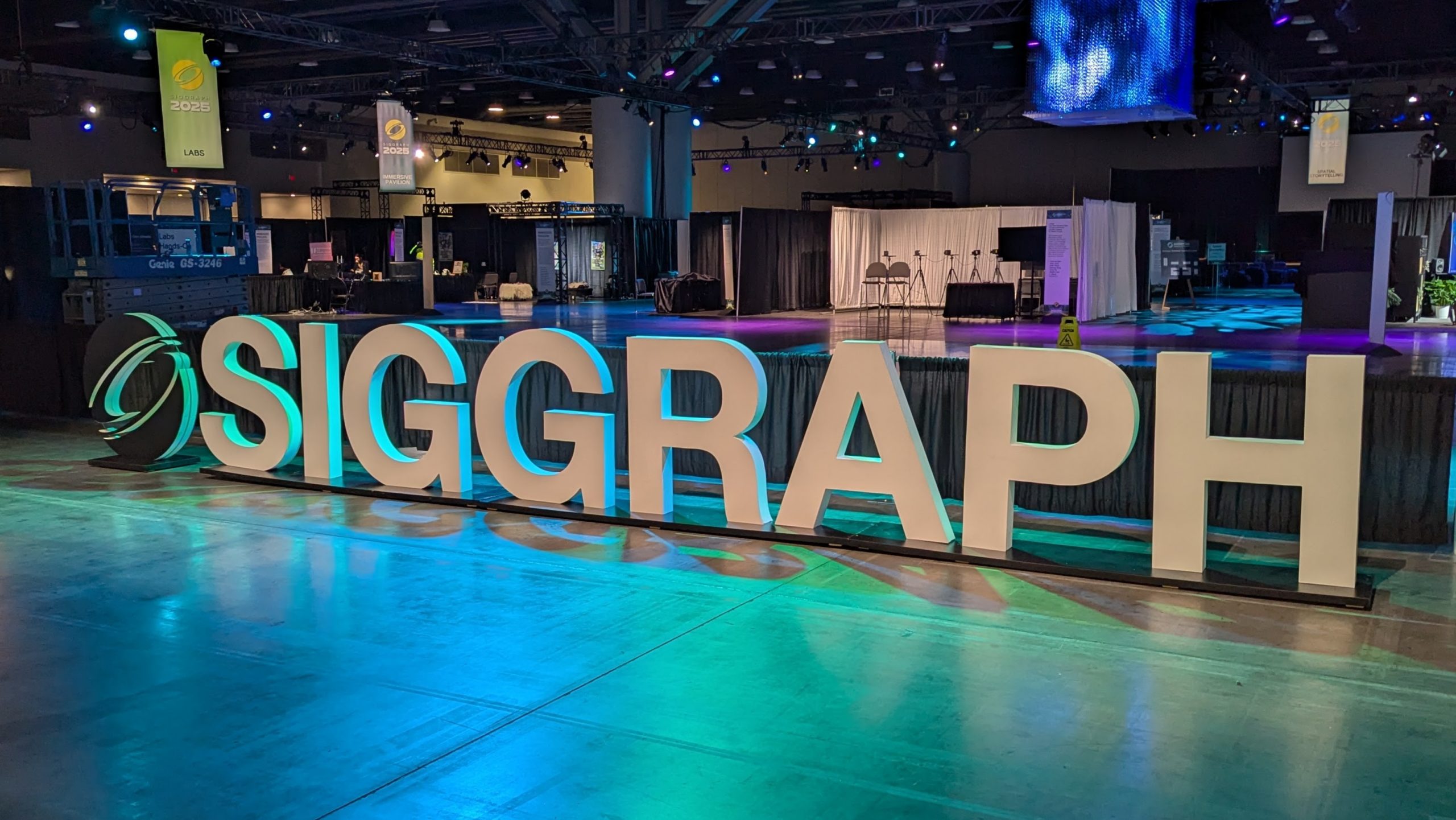
Every summer, SIGGRAPH brings together thousands of artists, researchers, developers, and hardware manufacturers from around the world to share the latest innovations in computer graphics and interactive technologies. From cutting-edge film VFX and immersive VR experiences to real-time rendering breakthroughs and academic research, it’s a place where the future of digital creation takes shape. It’s a unique mix of science and artistry – part trade show, part research symposium, part creative playground – and for anyone working at the intersection of technology and creativity, it’s an event worth paying close attention to.
Image
For us at Puget Systems, SIGGRAPH is more than just a chance to see cool demos. It’s an opportunity to connect directly with the people who push hardware and software to their limits: film studios, game developers, visual effects artists, researchers, and educators. This year, we were right in the middle of the action with our own booth, where we showcased a few standout demos that really captured the spirit of the event.
One side of our booth was in partnership with Form Studios, who brought an interactive experience that stopped plenty of attendees in their tracks. Using markerless motion capture, anyone could step up and instantly control an Unreal Engine Metahuman inside a virtual “rage room.” Participants could swing virtual bats, throw objects, and let loose in the simulated space, all while their movements were mirrored in real time. To top it off, the system recorded the session and allowed guests to download their own personalized video – a perfect digital souvenir.
On the other side, we demonstrated Chaos Vantage, taking full advantage of two NVIDIA RTX PRO™ 6000 Blackwell Max-Q GPUs to show off real-time ray-traced rendering at a professional level. This side of the booth also gave us a chance to talk with attendees about Puget Bench, our benchmarking suite, and how we use it to evaluate and recommend hardware for demanding creative workflows. Together, these demos sparked countless conversations – not just about hardware specs, but about how the right tools can unlock entirely new ways of creating. In the next section, we’ll share a few personal highlights from the show floor and sessions, and how they left us both inspired and full of ideas.
Kelly’s Takeaways
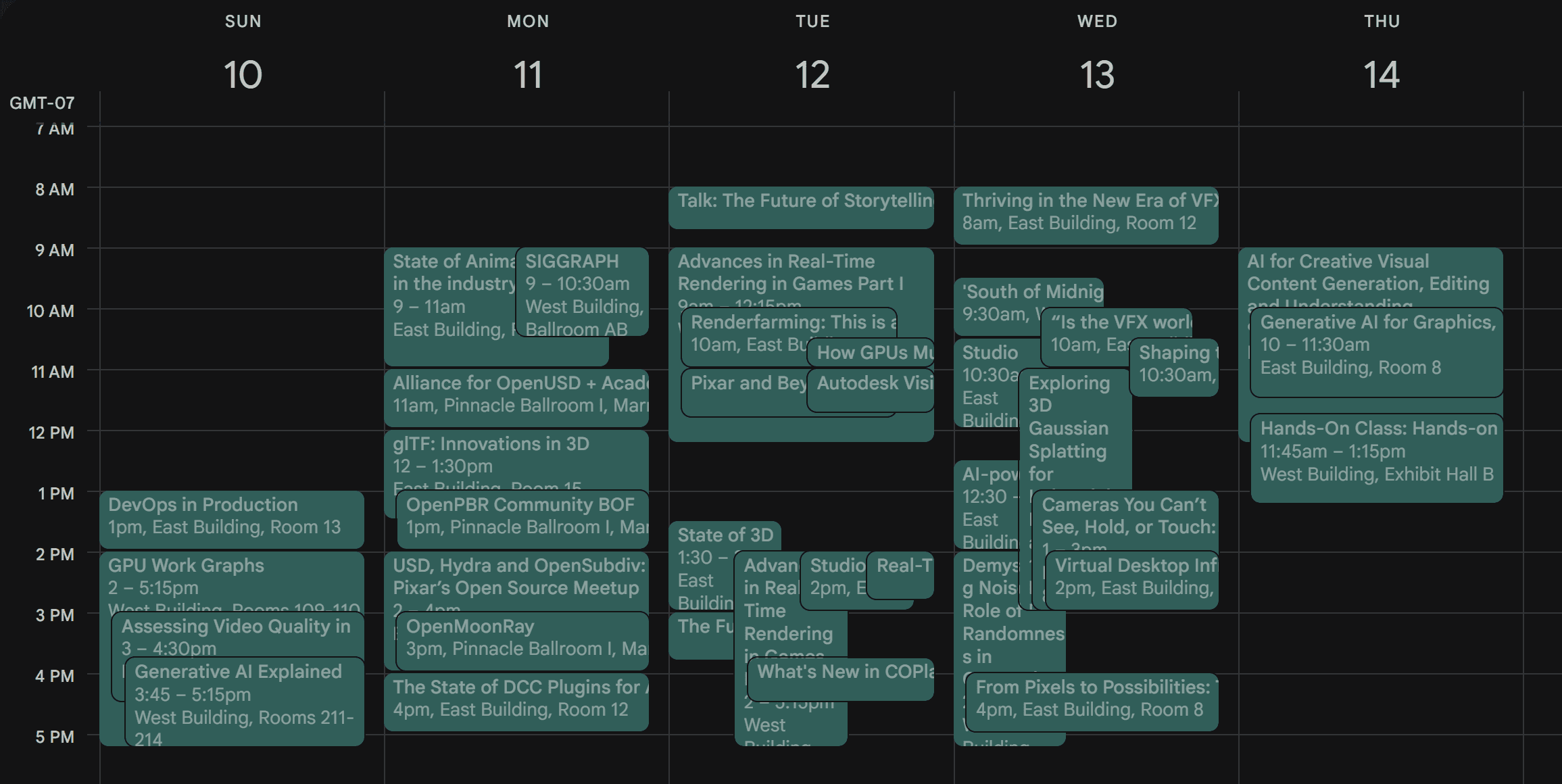
One of the highlights of SIGGRAPH for me each year is attending the “Birds of a Feather” sessions. If you’ve never been to one, these are informal meetups centered around a specific topic, less of a lecture and more of a conversation among people working in the same space. I made sure to attend two that have become annual must-visits for me: one on render farms and another on studio storage. These rooms are full of the folks who keep the lights on at some of the biggest studios in the world: Pixar, DreamWorks, ILM, and many others.
The conversations were as fascinating as ever. Even in an industry full of cutting-edge tools, many studios are still heavily reliant on CPU rendering. Cooling is becoming an increasing challenge as newer, more powerful hardware also demands more energy. And when it comes to GPUs, there’s an ongoing frustration: AI companies are buying them up in massive quantities, making it harder for studios to get what they need. I came away with a notebook full of ideas about how Puget Systems could help address some of these challenges, whether that’s designing more efficient systems for thermal management or finding creative solutions for GPU availability.
Of course, AI was everywhere at SIGGRAPH, sometimes as the headline, sometimes quietly baked into tools. I saw solid, production-ready uses like AI denoising, upscaling, de-aging, and face replacement; these are already showing up in major projects. But when it comes to generative AI, especially text-to-video, the technology just isn’t there yet for the demands of Hollywood. The results can be fun to experiment with, but the consistency, control, and trustworthiness needed for real production work still feel a long way off. Personally, I’m a bit skeptical about when (or if) GenAI will have its “big break” moment in this industry. That said, the tools that are working well rely heavily on strong hardware, and that’s where Puget Systems can play a role, building the workstations and servers that make these AI-assisted workflows practical and reliable for the people creating the stories we all love.
Image
Matt’s Takeaways
My biggest takeaway from SIGGRAPH 2025 is that AI isn’t just a buzzword anymore – it’s already embedded in the workflows, tools, and conversations shaping the industry. But instead of the fear I’ve seen at other shows, the tone here was one of excitement and curiosity. AI is being explored as a way to speed iteration, offload tedious work, and open creative possibilities, not replace artists. The real challenge is improving quality and making AI a collaborative part of the process, rather than letting it run the process. A big theme was how to make AI iterative and predictable instead of just a series of trial-and-error experiments.
Hardware talk was everywhere. Unlike other creative shows, people at SIGGRAPH care about what’s under the hood. That doesn’t mean everyone’s chasing the latest and greatest, however, especially larger studios that wrestle with the complexity of integrating new tech into legacy infrastructure. Across the board, I kept hearing calls for accurate, representative hardware benchmarking. Even in big-name sessions, too much performance data was outdated or misleading, and people noticed.
Real-time tools like Unreal Engine are also shifting expectations. Directors are starting to expect on-set changes, especially for previz, pushing teams toward faster, more flexible pipelines, often with AI in the mix just to keep pace. As one session put it: “AI won’t replace you, but someone using AI will.” While the ethical and practical rules for AI are still being worked out, it’s no longer something anyone in this industry can afford to ignore.
Conclusion
SIGGRAPH 2025 reminded us why this event continues to be such a cornerstone for our industry. The conversations, demos, and sessions all pointed toward a future where creativity and technology are more tightly intertwined than ever. We see this happening through advances in real-time rendering, smarter use of AI, and even the infrastructure challenges of scaling it all up. For us at Puget Systems, being there in person means we don’t just hear about these trends secondhand; we see them, experience them, and bring those insights back to shape the systems we build for our customers.
As we look ahead, our goal remains the same: to design workstations and servers that empower artists, engineers, and researchers to do their best work, without getting held back by hardware limitations. Events like SIGGRAPH fuel that mission by giving us a direct line to the community and a front-row seat to where the industry is heading. If you’re curious about how these trends might affect your own workflow, or if you just want to keep up with what we’re learning, we invite you to follow our content, explore Puget Bench, or reach out to our team. We’d love to continue the conversation.

Looking for a Content Creation workstation?
We build computers tailor-made for your workflow.

Don’t know where to start?
We can help!
Get in touch with one of our technical consultants today.