How quickly a computer boots up doesn’t always correspond to how much processing power the system has, or how fast the system drive is. This blog talks a little about what contributes to both faster and slower boot times, with a video comparison.

How quickly a computer boots up doesn’t always correspond to how much processing power the system has, or how fast the system drive is. This blog talks a little about what contributes to both faster and slower boot times, with a video comparison.
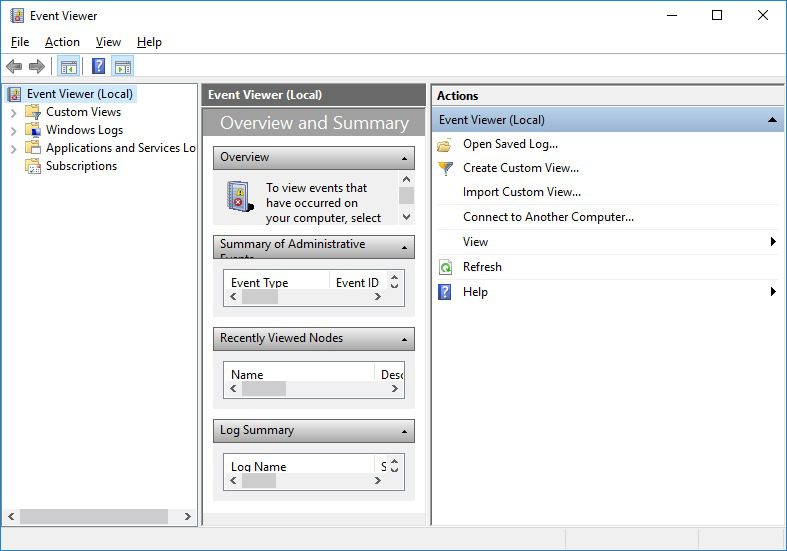
This guide discusses how to save the System Event Viewer log in Windows 7 and Windows 10 for use in troubleshooting.

Intel E5 v3 processors will run at “All Core Turbo” under load if properly cooled. This “clock” measurement is a better predictor of theoretical performance than base clock. We present a table of CPU performance at “all-core-turbo” using different parallel scaling factors from Amdhal’s Law. We have a dynamic graph that will show how much performance you lose when your parallel scaling is less than perfect. Just because your dual socket 16-core system shows all 32 cores at 100% doesn’t mean your problem is running 32 times faster!
Machine Learning is getting a lot of attention these days and with good reason. There are mountains of data to work with and computing resources to handle the problems are easily attainable. Even a single GPU accelerated workstation is capable of serious work.

GeForce GTX graphics cards provide a powerful next-generation platform for the ultimate immersive virtual reality experience. Rigs and cards marked with “GeForce GTX VR Ready” ensure that your VR games will be optimized with a best-in-class GPU.

Intel has a number of different CPU product lines available which are currently primarily using one of two different CPU architectures. In this article we will be looking at how much of a difference the architecture makes to help determine if there is a performance advantage to using one line over another.

If you have a subscription to Solidworks, you have access to a feature called network rendering which allows you to split up a render across multiple machines. In this article we will be examining how effective this is and comparing the performance to a dedicated Dual Xeon workstation that has been optimized for rendering.

A little over a year ago, I wrote an article titled, “What I Wish I Had Known” that included specific feedback customers shared with me shortly after taking delivery of a new Puget Systems computer. Since that time I’ve talked to hundreds, if not thousands of customers, who have passed along more feedback that might be valuable to those who are configuring or considering a new computer.
With that in mind, here are a few more items our customers would change, if they could go back in time:

The batteries in our Puget Traverse Pro are lithium-ion (Li-ion) batteries.
Throw out everything that you thought you knew about battery charging. Lithium-ion batteries are a completely different animal from how other types of batteries work and are charged, maintained, and stored.
At Puget Systems, we track a lot of data but one of the most important things we track is the failure rates of individual components. Reliability is of our primary values, so this data is invaluable for tracking both individual component, product line, and overall brand failure rates. With 2015 coming to a close, we thought we make public a bit of this data to let you know what hardware we found to be the most reliable in 2015.
Puget Systems builds custom workstations, servers and storage solutions tailored for your work.
We provide:
Extensive performance testing
making you more productive and giving better value for your money
Reliable computers
with fewer crashes means more time working & less time waiting
Support that understands
your complex workflows and can get you back up & running ASAP
A proven track record
as shown by our case studies and customer testimonials