Table of Contents
Introduction
Every software update can bring new tools, performance improvements, and refinements. That’s why our Puget Labs team constantly tests and reviews hardware to see what new information we can share with our readers and the creative community.
Recently, Adobe released After Effects version 25.4, and we ran our usual suite of tests using PugetBench for Creators to see if there were any undocumented performance changes. We do this often, and usually nothing comes up. This time, however, we noticed that AMD Radeon video cards saw a significant performance improvement in 2D scores. We backtracked our testing to determine when this occurred and found the performance boost in version 25.3.2. While we did not test 25.3 or 25.3.1, we are highly confident this update occurred in one of the 25.3 releases and carried through to 25.4.
However, no public notes that clarify the cause of the performance uplift or its relationship to any recent fixes are available. Based on this limited information, we believe Adobe either added performance optimizations for AMD GPUs or fixed a separate performance bug between versions 25.2.2 and 25.4. Regardless of the cause, this is great news for all Radeon users!
Image
Testing
All tests were conducted on a single system featuring the AMD Ryzen™ Threadripper™ 9980X 64-core processor. We ran our benchmarks on After Effects versions 25.2.2, 25.3.2, and 25.4. Results from version 25.4 were omitted, as the performance difference was negligible and within the range of testing variability from 25.3.2.
Listed below are the specifications of the system we used for testing:
Test Platform
| CPUs: AMD Ryzen™ Threadripper™ 9980X |
| CPU Cooler: Asetek 836S 360mm AIO Cooler |
| Motherboard: ASUS Pro WS TRX50-SAGE BIOS Version: 1203 |
| RAM: 4x DDR5-6400 32GB (128 GB total) |
| PSU: EVGA SuperNOVA 1200W P2 |
| Storage: Samsung 980 Pro 2TB |
| OS: Windows 11 Pro 64-bit (26100) Power Profile: Balanced |
Benchmark Software
| After Effects 25.2.2 – PugetBench for After Effects 1.0 |
| After Effects 25.3.2 – PugetBench for After Effects 1.0 |
| After Effects 25.4 – PugetBench for After Effects 1.0 |
AMD GPUs
| AMD Radeon™ RX 9070 XT Driver: Adrenaline 25.8.1 ASUS Prime Radeon™ RX 9060 XT OC Edition (16GB) Driver: Adrenaline 25.8.1 |
NVIDIA GPUs
| ASUS Prime GeForce RTX™ 5070 Ti OC Edition Driver: 580.97 PNY GeForce RTX™ 5060 Ti (16GB) Driver: 580.97 |
Intel GPUs
| Intel® Arc™ B580 Driver: 101.7028 |
For video cards, we tested AMD’s Radeon™ RX 9070 XT and 9060 XT, Intel’s Arc™ B580, and NVIDIA’s GeForce RTX™ 5070 Ti and 5060 Ti. We included this range of cards for two reasons: to determine if the 2D score performance boost was an AMD-specific fix or a broader update related to OpenCL (for Intel) and CUDA (for NVIDIA), and to see if the findings were consistent across more than one model of AMD GPU.
Results
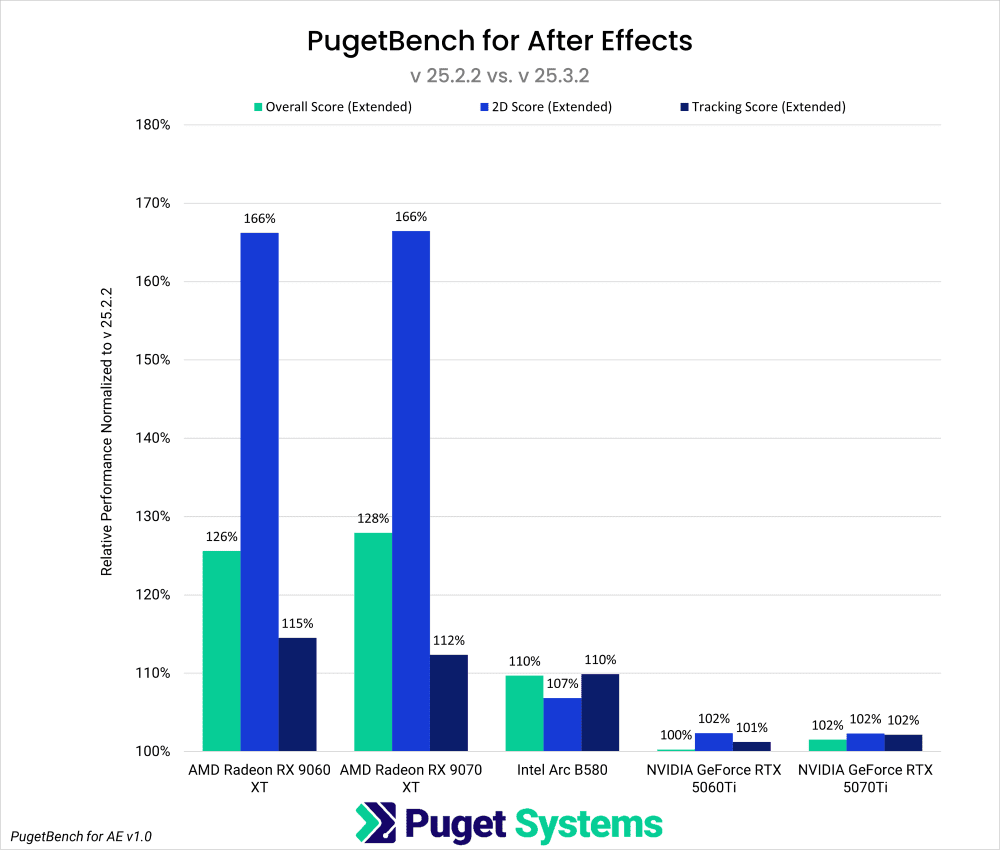
The chart below shows the relative performance of each GPU between After Effects versions 25.2.2 and 25.3.2. It’s important to note that the chart does not compare the GPUs against one another; instead, it compares the performance of each GPU to its own baseline in version 25.2.2. The horizontal axis shows the different GPUs we tested, while the vertical axis shows the relative performance, where version 25.2.2 is indexed to 100%. A score above 100% indicates a performance gain—for example, a score of 166% means a 66% performance increase. The different colored bars for each card represent the Overall Score, 2D Score, and Tracking Score, as measured by our PugetBench for After Effects version 1.0 benchmark.
Image
While the AMD Radeon cards showed the largest improvements in 2D and tracking scores across After Effects versions, the Intel Arc B580 also benefited from the update, showing a slight but statistically significant uplift. This suggests that After Effects 25.3.2 included some general optimizations that benefit Intel Arc GPUs, separate from the specific fix for AMD. Meanwhile, the performance changes for NVIDIA GPUs were negligible, showing only minor fluctuations in 2D and Tracking scores, likely due to normal test-to-test variation. Because neither the Intel Arc B580 nor the NVIDIA GeForce RTX 50-series GPUs saw the same significant performance increases we found in the AMD cards, we are confident that the change implemented by Adobe is specific to AMD GPUs and not OpenCL or CUDA.
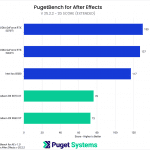
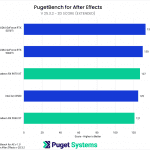
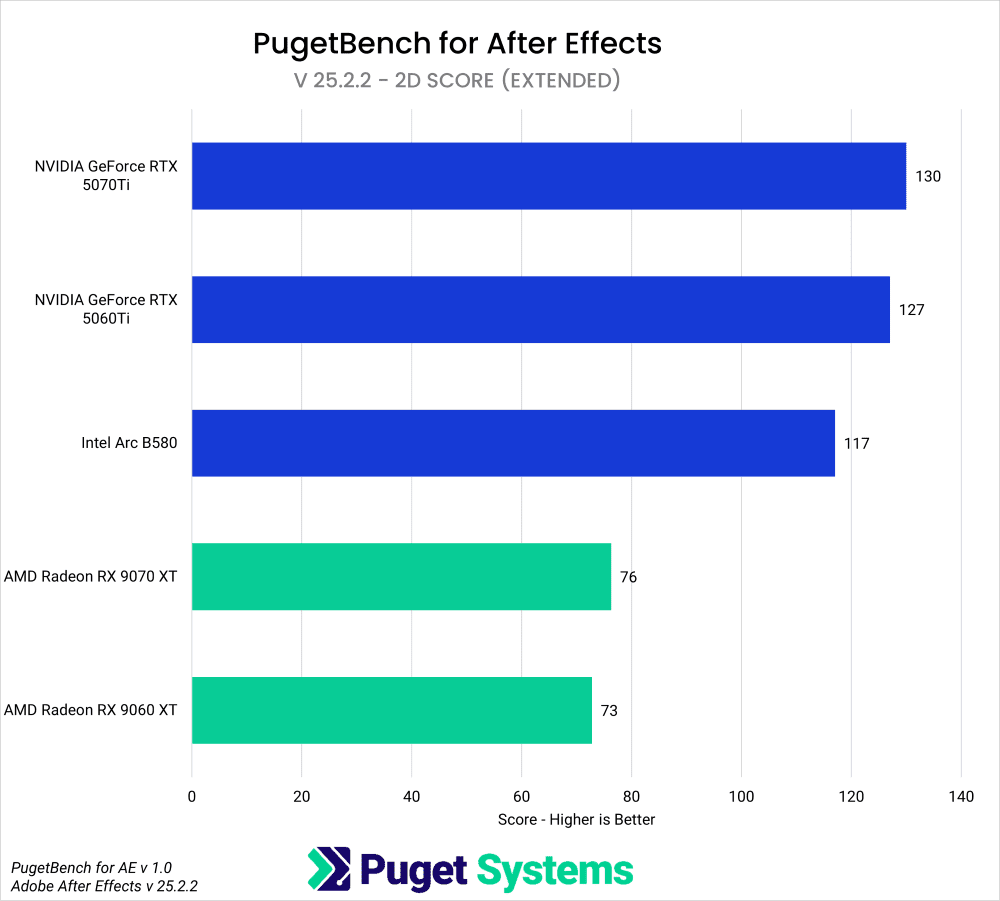
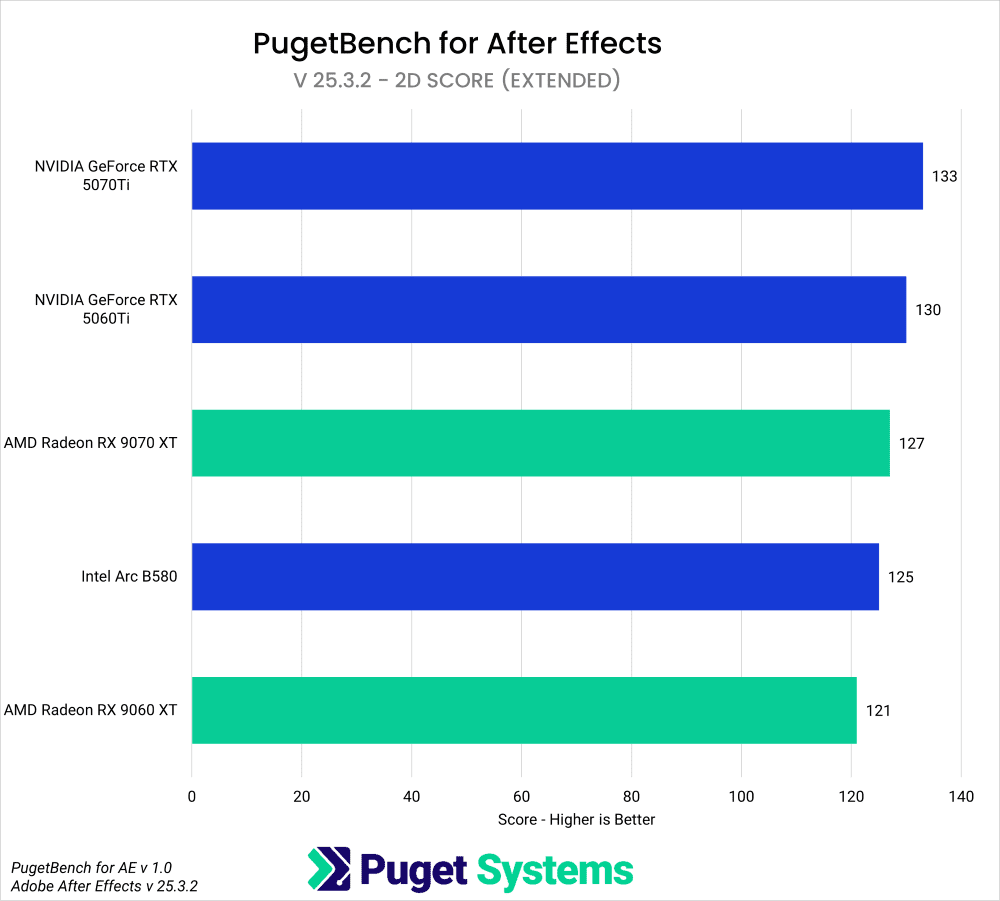
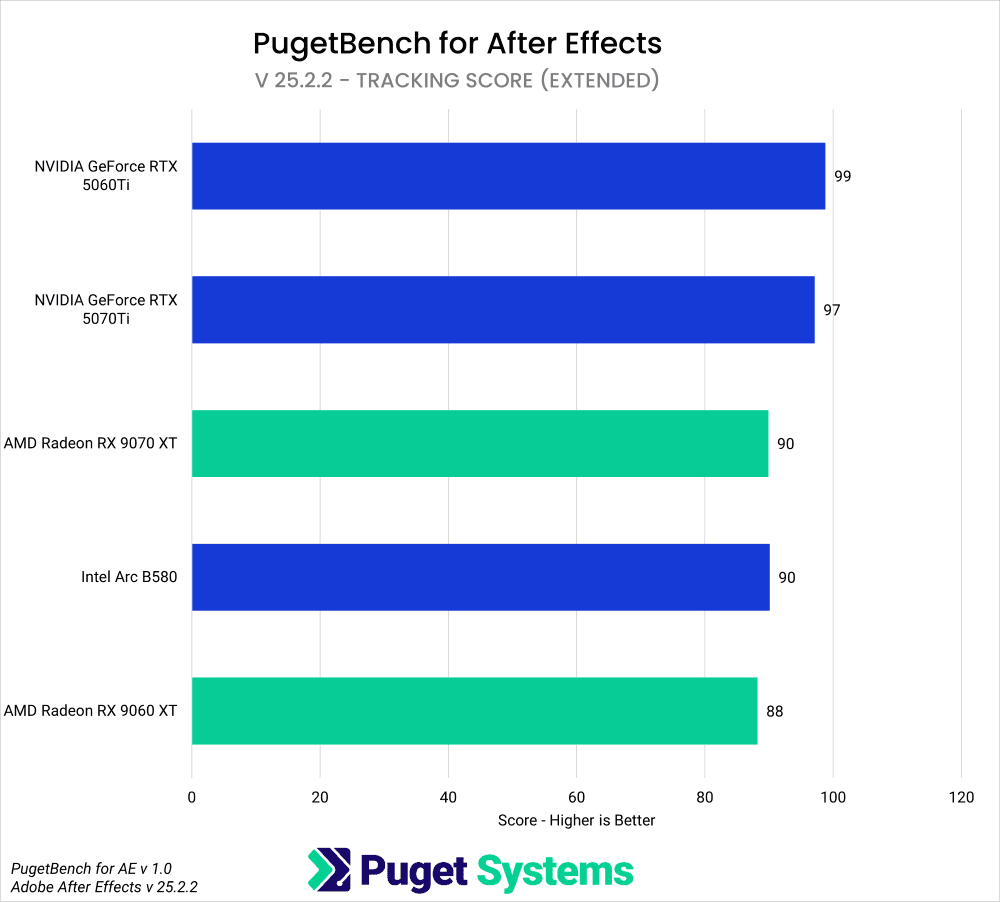
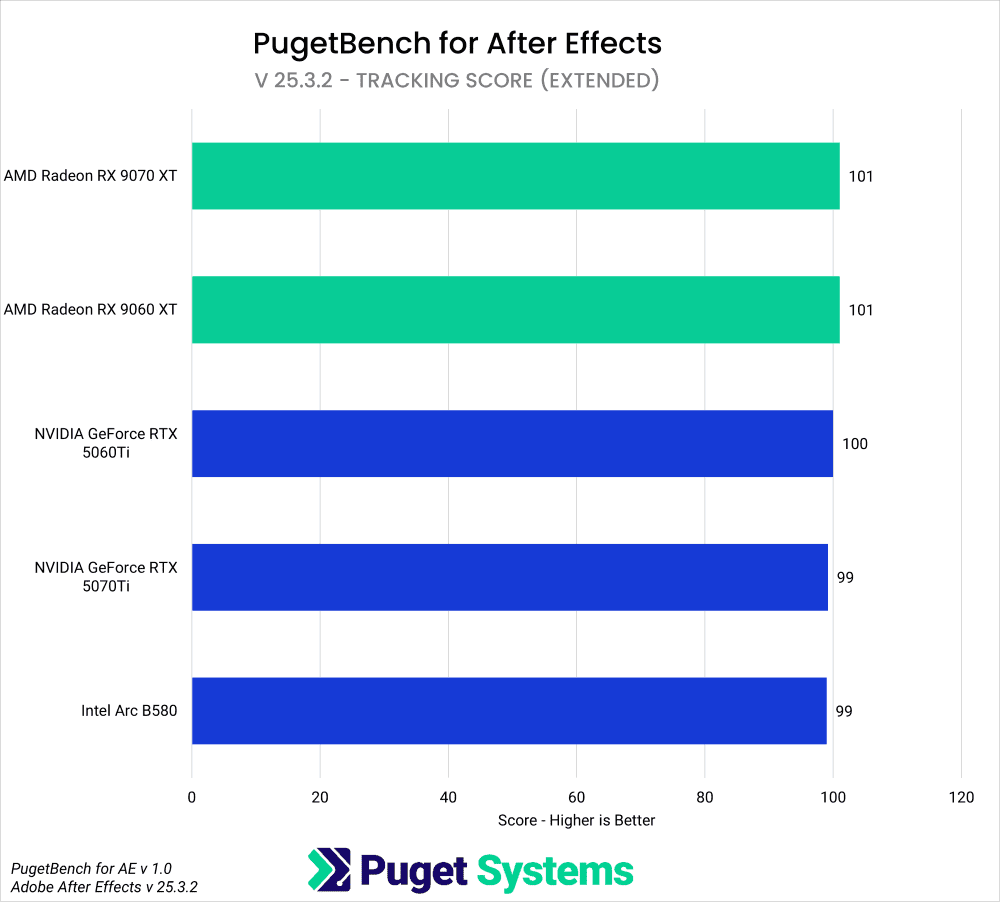
The charts below focus on 2D and Tracking scores. While we also tested 3D scores, we found minimal performance changes across all GPUs and software versions, so we did not include them.
System Image
The difference in 2D scores for AMD Radeon GPUs is pretty significant. The RX 9070 XT and RX 9060 XT see a 66% performance improvement in version 25.3.2 relative to version 25.2.2! What is even more impressive is that this update has narrowed the performance gap between NVIDIA GeForce RTX 50-series and AMD Radeon RX 9000 series cards from over 52% to just 7%. This means Radeon owners working in traditional 2D workflows should update their After Effects software to optimize performance.
System Image
Even though Tracking scores are primarily CPU-bound, we still see improvements for AMD Radeon GPUs. The RX 9060 XT sees a 15% increase and the RX 9070 XT a 12% improvement in version 25.3.2 relative to 25.2.2, which indicates that these cards are contributing to some of the processing for tools like Roto Brush, Warp Stabilization, and the 3D Camera Tracker, which are typically processed by a single CPU core.
Conclusion
For AMD Radeon RX 9000 Series owners, the performance uplift for 2D compositions in After Effects 25.3.2 is great news! Thanks to software optimizations in the latest update, video cards like the RX 9070 XT and RX 9060 XT perform 66% faster than in previous versions. This means you can get a significant performance boost for your 2D projects without buying a new GPU, as long as you update to the latest version of AE (25.3.2 or later, as far as we can tell).
While we didn’t test older generation AMD Radeon cards, we invite you to run PugetBench for After Effects to see if you get similar uplifts when comparing version 25.2.2 to the latest After Effects version. Let us know your results in the comments below!
Beyond the direct gains for users, this development signals a more competitive landscape in the mid-tier GPU market. With the Intel Arc B580, Radeon RX 9060 XT & 9070 XT, and GeForce RTX 5060 Ti & 5070 Ti now having a performance gap of only 12.5%, consumers who need an affordable GPU that still gives good results for the cost will have more options to choose from.
For those looking into a new video card for After Effects, we recommend reviewing our other content creation articles and doing more research to find the best fit for your specific workflow. Those who work in 2D will have different requirements than those who work with 3D compositions, and for video editors who utilize other tools alongside AE, your GPU choice may differ as well. Regardless, Adobe deserves credit for the latest After Effects version that significantly improves AMD Radeon GPU performance. We hope to see more optimization like this moving forward!
If you need a powerful workstation to tackle the applications we’ve tested, the Puget Systems workstations on our solutions page are tailored to excel in various software packages. If you prefer to take a more hands-on approach, our custom configuration page helps you to configure a workstation that matches your exact needs. Otherwise, if you would like more guidance in configuring a workstation that aligns with your unique workflow, our knowledgeable technology consultants are here to lend their expertise.

Looking for an After Effects workstation?
We build computers tailor-made for your workflow.

Don’t know where to start?
We can help!
Get in touch with one of our technical consultants today.