Table of Contents
Introduction
Enhancing video footage can be a hardware-intensive process, with some applications offering both cloud-based processing on remote servers and local processing on a system’s GPU. Whether it’s for restoring and repurposing archival media or interpolating cinematic footage into a different frame rate for an editorial project, the time required to process these tasks – especially those that utilize AI models – depends heavily on the hardware.
One popular tool used in video post-production workflows is Topaz Video, an AI-powered video enhancement application with its own proprietary set of models for restoration, upscaling, and interpolation. Each model is trained to specialize in a specific task. Depending on the footage, that might mean denoising to remove grain and artifacts from low-light or compressed sources, stabilizing shaky footage, converting SDR video to HDR, or creating smooth slow-motion effects. Some models are available for local processing on a GPU, and like many AI solutions, performance can vary depending on the video card and the specific model used for export.
There are two types of GPUs that Topaz Video users can utilize for local processing: consumer and professional. Consumer-grade GPUs are typically more affordable and widely available, while professional-grade cards often have larger VRAM capacities and are more expensive for the same compute capability. While most users will opt for a consumer GPU for Topaz Video, there can be advantages to using a professional GPU – particularly when it is needed for another part of a user’s workflow.
Topaz has changed significantly since we published our last professional GPU round-up in December 2025. That article used benchmarks included in Topaz Video AI, which was a perpetual-license version that has since become a legacy product. Topaz Video is the current subscription-based service, and we wanted to see whether there were any performance differences since our last round of testing. New models have been added to the built-in benchmark, and the software continually receives optimizations. It’s worth noting that the latest version of Topaz Video is now 1.7, but it was still in beta at the time we began this testing. The Topaz team has stated that version 1.7 includes further performance improvements, but re-running all of our tests on this version was outside the scope of this article, so the results presented here are from version 1.6.1.
This testing methodology is identical to our recent consumer GPU article, so the results can be compared directly to see how current-generation consumer and professional GPUs perform relative to each other. However, we do want to point out that for professional GPUs, price-to-performance is not the primary reason to use these cards. If pure performance is your main concern, a consumer-grade GPU will, in most cases, be a better fit. However, for those who need higher VRAM capacity, multi-GPU configurations, and greater reliability from drivers and hardware, professional graphics cards are designed to better meet these needs.
Test Setup (Expandable)
Test Platform
| CPU: AMD Ryzen™ Threadripper™ PRO 9965WX |
| CPU Cooler: Asetek 836S-M1A 360mm |
| Motherboard: ASUS Pro WS WRX90E-SAGE SE BIOS Version: 1317 |
| RAM: 2x DDR5-6400 ECC Reg. 16 GB (128 GB total) |
| PSU: EVGA SuperNOVA 1600W P2 |
| Storage: Samsung 980 Pro 2TB |
| OS: Windows 11 Pro 64-bit (26200) |
AMD GPU
| AMD Radeon™ AI PRO R9700 Driver: 26.7.1 |
NVIDIA GPUs
Intel GPU
| Intel® Arc™ Pro B70 Driver: 101.8805 |
Benchmark Software
| Topaz Video 1.6.1 |
Our test was conducted on an AMD Ryzen™ Threadripper™ PRO 9965WX-based platform. Before we chose the 9965WX, we tested a small set of CPUs to determine which platform would be best suited for this testing. We found that AMD’s Threadripper processor performed 10% faster than consumer-class models such as the Intel Core™ Ultra 7 270K Plus and AMD Ryzen™ 9 9950X3D2 Dual Edition. A consumer-class CPU is certainly acceptable for Topaz Video, as it’s mainly a GPU-intensive application, but we wanted to eliminate potential bottlenecks insofar as possible. Those looking to get the most out of Topaz should consider a Threadripper-based workstation for both its performance and the additional PCIe bandwidth it provides.
Further, we chose the workstation-class Threadripper PRO over the standard Threadripper because the motherboard’s additional PCIe bandwidth allows us to test performance scaling from one to four GPUs, depending on the card (which we’re testing separately for an upcoming article). That is not what we are looking at today, but will be covered in an upcoming article.
For this article, we limited testing to current-generation GPUs from AMD, Intel, and NVIDIA. We used the latest available drivers when we started testing, but new versions and software updates have since been released, so what’s reflected in our results may no longer be completely current.
RAW Benchmark Results
Those who reviewed the scores last year’s roundup will see different results this time. This benchmark includes more models, and performance has generally improved across all supported GPU brands since then. Most models in Topaz’s internal benchmark handle tasks such as denoising, upscaling, and interpolation, while preserving and enhancing pixel information from the source footage. We’ve included the RAW results from our testing below, for those who want to isolate individual models and see how they perform. Results are given in frames per second (FPS), covering each model’s performance at both 1080p and 4K. For those who are unfamiliar with these models, or want more context on what each is optimized for, can refer to Topaz Labs’ documentation for more details.
| wdt_ID | wdt_created_by | wdt_created_at | wdt_last_edited_by | wdt_last_edited_at | Resolution | Model | NVIDIA RTX PRO 6000 Blackwell WE | NVIDIA RTX PRO 6000 Blackwell Max-Q | NVIDIA RTX PRO 5000 Blackwell (72 GB) | NVIDIA RTX PRO 5000 Blackwell (48 GB) | NVIDIA RTX PRO 4500 Blackwell | NVIDIA RTX PRO 4000 Blackwell | AMD Radeon AI PRO R9700 | Intel Arc Pro B70 |
|---|---|---|---|---|---|---|---|---|---|---|---|---|---|---|
| 1 | Peter | Aug 2026 03:41 PM | Peter | Aug 2026 03:41 PM | 1920x1080 | Artemis 1X | 65.71 | 48.79 | 41.85 | 42.54 | 31.13 | 21.20 | 35.00 | 24.52 |
| 2 | Peter | Aug 2026 03:41 PM | Peter | Aug 2026 03:41 PM | 1920x1080 | Artemis 2X | 26.77 | 25.66 | 25.70 | 25.19 | 22.92 | 15.77 | 23.57 | 15.81 |
| 3 | Peter | Aug 2026 03:41 PM | Peter | Aug 2026 03:41 PM | 1920x1080 | Artemis 4X | 7.37 | 7.24 | 7.13 | 7.03 | 6.91 | 6.01 | 6.44 | 5.33 |
| 4 | Peter | Aug 2026 03:41 PM | Peter | Aug 2026 03:41 PM | 1920x1080 | Iris 1X | 73.40 | 56.09 | 46.13 | 46.34 | 34.46 | 26.44 | 39.76 | 19.14 |
| 5 | Peter | Aug 2026 03:41 PM | Peter | Aug 2026 03:41 PM | 1920x1080 | Iris 2X | 27.17 | 26.54 | 27.36 | 26.62 | 20.55 | 15.56 | 23.66 | 10.02 |
| 6 | Peter | Aug 2026 03:41 PM | Peter | Aug 2026 03:41 PM | 1920x1080 | Iris 4X | 7.57 | 7.34 | 7.30 | 7.35 | 7.14 | 4.96 | 6.86 | 3.36 |
| 7 | Peter | Aug 2026 03:41 PM | Peter | Aug 2026 03:41 PM | 1920x1080 | Proteus 1X | 67.73 | 50.37 | 42.98 | 43.60 | 31.71 | 22.42 | 36.76 | 24.11 |
| 8 | Peter | Aug 2026 03:41 PM | Peter | Aug 2026 03:41 PM | 1920x1080 | Proteus 2X | 27.81 | 26.69 | 26.82 | 27.04 | 23.80 | 16.65 | 26.06 | 16.52 |
| 9 | Peter | Aug 2026 03:41 PM | Peter | Aug 2026 03:41 PM | 1920x1080 | Proteus 4X | 7.61 | 7.56 | 7.31 | 7.36 | 7.34 | 6.39 | 7.12 | 6.08 |
| 10 | Peter | Aug 2026 03:41 PM | Peter | Aug 2026 03:41 PM | 1920x1080 | Proteus Natural 2X | 18.75 | 14.05 | 11.53 | 11.75 | 9.12 | 5.93 | 1.31 | 0.74 |
| Resolution | Model | NVIDIA RTX PRO 6000 Blackwell WE | NVIDIA RTX PRO 6000 Blackwell Max-Q | NVIDIA RTX PRO 5000 Blackwell (72 GB) | NVIDIA RTX PRO 5000 Blackwell (48 GB) | NVIDIA RTX PRO 4500 Blackwell | NVIDIA RTX PRO 4000 Blackwell | AMD Radeon AI PRO R9700 | Intel Arc Pro B70 |
Topaz Video GPU Performance Analysis
Our methodology for scoring Topaz’s internal benchmark involves three parts. First, we take the geomean of all of the individual tests and calculate an Overall score. We then break the models into two categories – Enhancement and Slow Motion – and calculate geomeans for those groups as well. The models included in the Enhancement Score are Artemis, Iris, Proteus, Proteus Natural, Gaia, Gaia Animation, Nyx, Nyx Fast, Nyx XL, Rhea, Rhea XL, and Hyperion HDR. Those included in the Slowmo Score are Apollo, Apollo Fast, Chronos, Chronos Fast, and Aion. In the charts below, each bar is color-coded by GPU brand: red for AMD, blue for Intel, and green for NVIDIA.
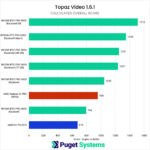
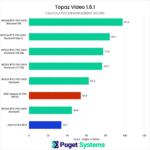
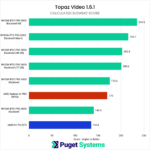
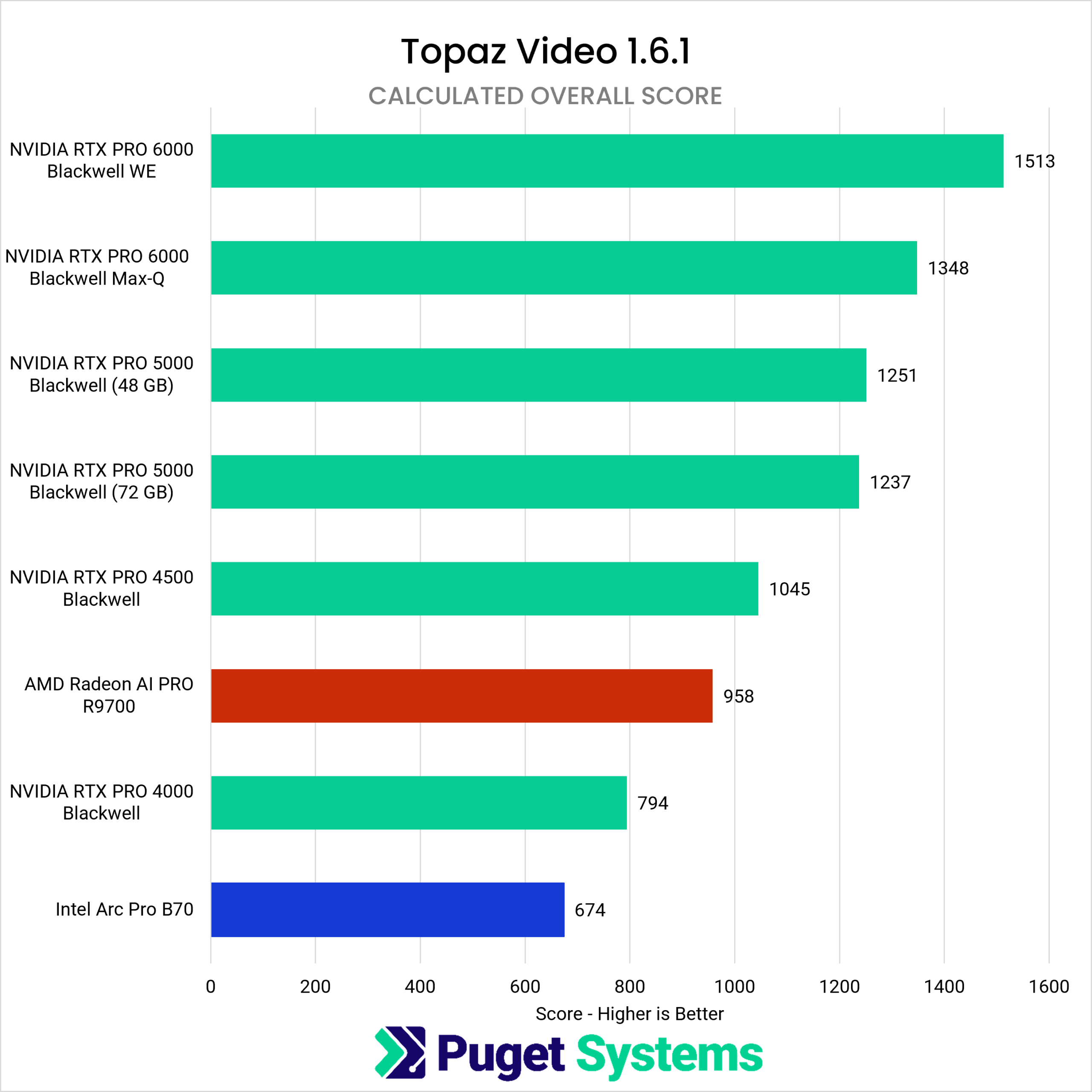
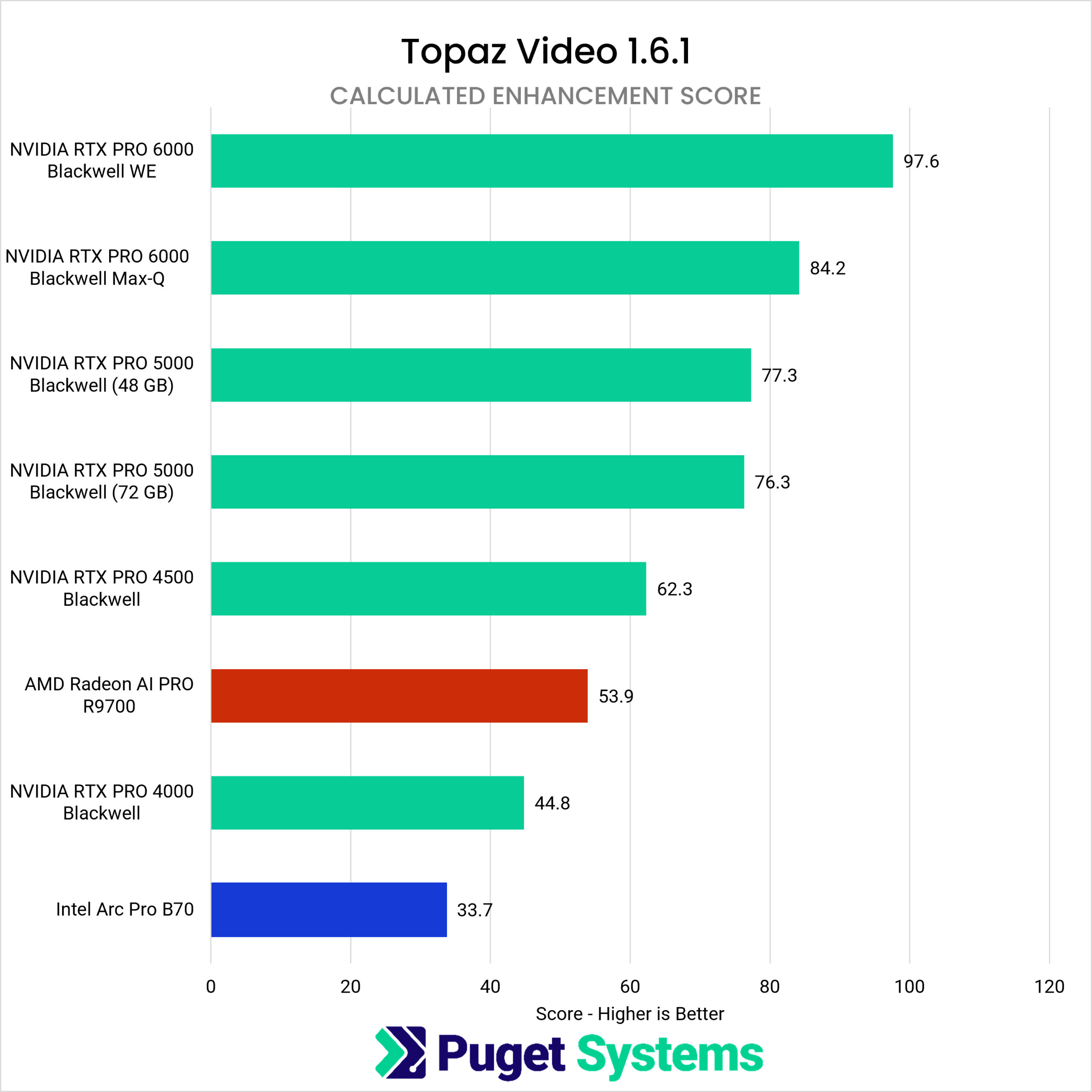
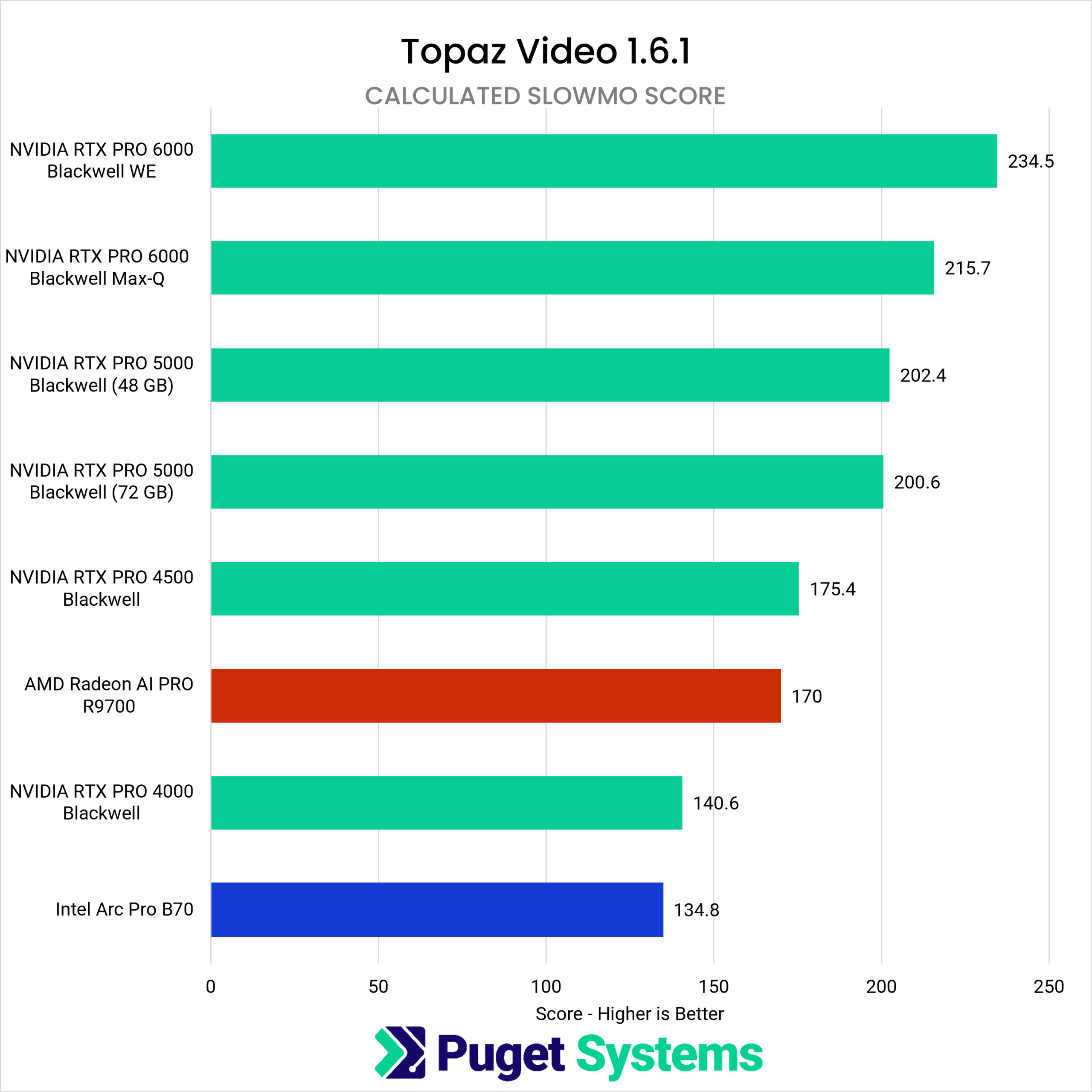
Based on the Overall score, NVIDIA’s RTX PRO 6000 Blackwell Workstation Edition is the highest performer, scoring 12% faster than the second-ranked RTX PRO 6000 Blackwell Max-Q variant. The main thing to note about both of these pro cards is that they have 96GB of VRAM. That is extremely beneficial for those running Topaz Video alongside other generative AI workflows, such as local LLMs or generative content production. Aside from performance and VRAM capacity, there’s another distinction worth mentioning between these two. The Workstation Edition delivers the strongest single-card performance but draws up to twice as much power, and is not designed for multi-GPU scaling. The Max-Q gives up some of that performance for a lower 300W maximum power draw, utilizing a blower-style cooler built for multi-GPU configurations. Regardless, no other professional-grade card currently matches either of these in terms of specifications and price. The initial MSRP at launch was roughly $8,500, but as of August 2026, the market price has climbed to around $15,000 – a significant premium over the other cards tested.
Further down the chart, the RTX PRO 5000 Blackwell has two variants that are identical except for VRAM capacity: one offers 48 GB, the other 72 GB. The results above show a negligible difference in performance between the two variants, small enough to fall within our margin of error, suggesting that VRAM at these capacities didn’t contribute to any performance differences in Topaz Video’s internal benchmark. Since the RTX PRO 6000 lineup commands a significant price premium, we recommend considering the RTX PRO 5000 as a lower-cost alternative. For those running Topaz Video as their primary application with a single graphics card, the RTX PRO 5000 Blackwell’s 48 GB variant runs 19% slower than the RTX PRO 6000 Blackwell Workstation Edition but costs roughly half as much. For those using Topaz Video as part of a larger generative AI pipeline, alongside local LLMs across multiple GPUs, the 72 GB variant is a cost-effective alternative to the RTX PRO 6000 Blackwell Max-Q. It is currently listed at ~$10,000, with a 7% performance decrease and 24 GB less VRAM compared to the Max-Q.
The last four professional GPUs in our test group have more brand variety. Within this segment, NVIDIA’s RTX PRO 4500 Blackwell performed 9% faster than AMD’s Radeon AI PRO R9700 and 43% higher than Intel’s Arc Pro B70. The R9700, in turn, is 35% more performant than the B70. Each of these cards has 32 GB of VRAM, although the AMD and Intel cards are significantly less expensive than NVIDIA’s offering. At the time of writing, both are priced around $1,800 – compared to ~$5,000 for the RTX PRO 4500.
NVIDIA’s RTX PRO 4000 Blackwell is the only card in this group with 24 GB of VRAM. It is 16% faster than the B70, but 18% slower than the R9700 and 27% less performant than the RTX PRO 4500. While these cards are significantly less expensive than the RTX PRO 6000 and 5000 products, they are also slower. However, their lower cost may make them worth considering for use in Topaz Video, where multiple GPUs can batch-process videos simultaneously. Aside from price and performance differences, compatibility is also an important consideration. All of these GPUs can run the Starlight Precise 2.5 model, but only NVIDIA GPUs support the full Starlight model series.
While there was no difference in GPU rankings across the Overall, Enhancement, and Slow Motion scores, it’s worth mentioning that there was a wider variation in performance between GPUs in the Enhancement score, while the Slow Motion score showed closer results between specific GPUs, like the RTX PRO 4500 and the R9700, as well as the RTX PRO 4000 and B70.
Which GPU Is Best for Topaz Video?
There are many GPUs available for Topaz Video, across a wide range of performance and price points. Whether someone is considering a consumer or professional-grade card, the best graphics card ultimately depends on what the user needs from their system and how Topaz Video fits into their overall workflow.
For those looking for a professional GPU with Topaz Video as the primary application, NVIDIA’s RTX PRO Blackwell cards are the strongest option. However, that should not be considered a blanket recommendation for every workflow.
If the priority is maximum performance from a single GPU, the RTX PRO 6000 Blackwell Workstation Edition is the clear choice.
If the goal is to build a multi-GPU system for a larger generative AI pipeline, the configuration should balance price, performance, and total VRAM. That could easily be multiple RTX PRO 6000 Blackwell Max-Q cards, or a lower cost alternative such as the 72 GB RTX PRO 5000 Blackwell. In systems like these, Topaz Video is often not the primary workload but rather a component of a broader AI pipeline, where total VRAM capacity takes priority over single-GPU performance.
From a price-to-performance perspective, consumer GPUs may be a better fit for users who use Topaz Video as their primary application. However, more affordable professional GPUs, such as AMD’s Radeon AI PRO R9700, Intel’s Arc Pro B70, and NVIDIA’s RTX PRO 4500 and 4000 Blackwell, are worth considering when higher VRAM capacities are needed. Most current-generation consumer cards max out at 16 GB, and certain Topaz models, like the Starlight series, approach or even exceed that limit. These cards also make sense for multi-GPU configurations, where Topaz Video settings are adjusted to process multiple videos in parallel. Individually they are slower than a higher-end consumer GPU on a single video, but running separate clips across multiple GPUs can increase overall output at a much lower price point than the RTX PRO 6000 and 5000 cards.
As mentioned earlier, we plan to publish a few more posts diving further into performance in Topaz Video. Our testing methodology for these articles has been built around a workstation-class Threadripper PRO platform for its ability to support multi-GPU configurations. That topic is next in our testing queue, covering both consumer and professional-grade cards. We also briefly mentioned the Starlight series of models in this article, but they are not included in Topaz’s internal benchmark and require a different testing and scoring approach. We will cover their performance separately for both consumer- and professional-grade cards.

Looking for a Content Creation workstation?
We build computers tailor-made for your workflow.

Don’t know where to start?
We can help!
Get in touch with one of our technical consultants today.