Introduction
Whenever Adobe or Blackmagic releases a new application update, one of the first things we do is evaluate it to see if there are any changes that affect the results of our Puget Bench benchmarks. We are interested in these results for a number of reasons:
- Deciding whether or not we need to make a new benchmark group (used to consolidate profiles and assist in comparing results)
- Catching any unexpected performance changes or bugs that we need to report to partners/press
- Seeing if it warrants more in-depth testing or might change the hardware we recommend in our workstations
Recently, Adobe released After Effects version 26.2, and although there were no update notes mentioning performance changes, we still followed our normal process to evaluate the new version. And it is a good thing we did!
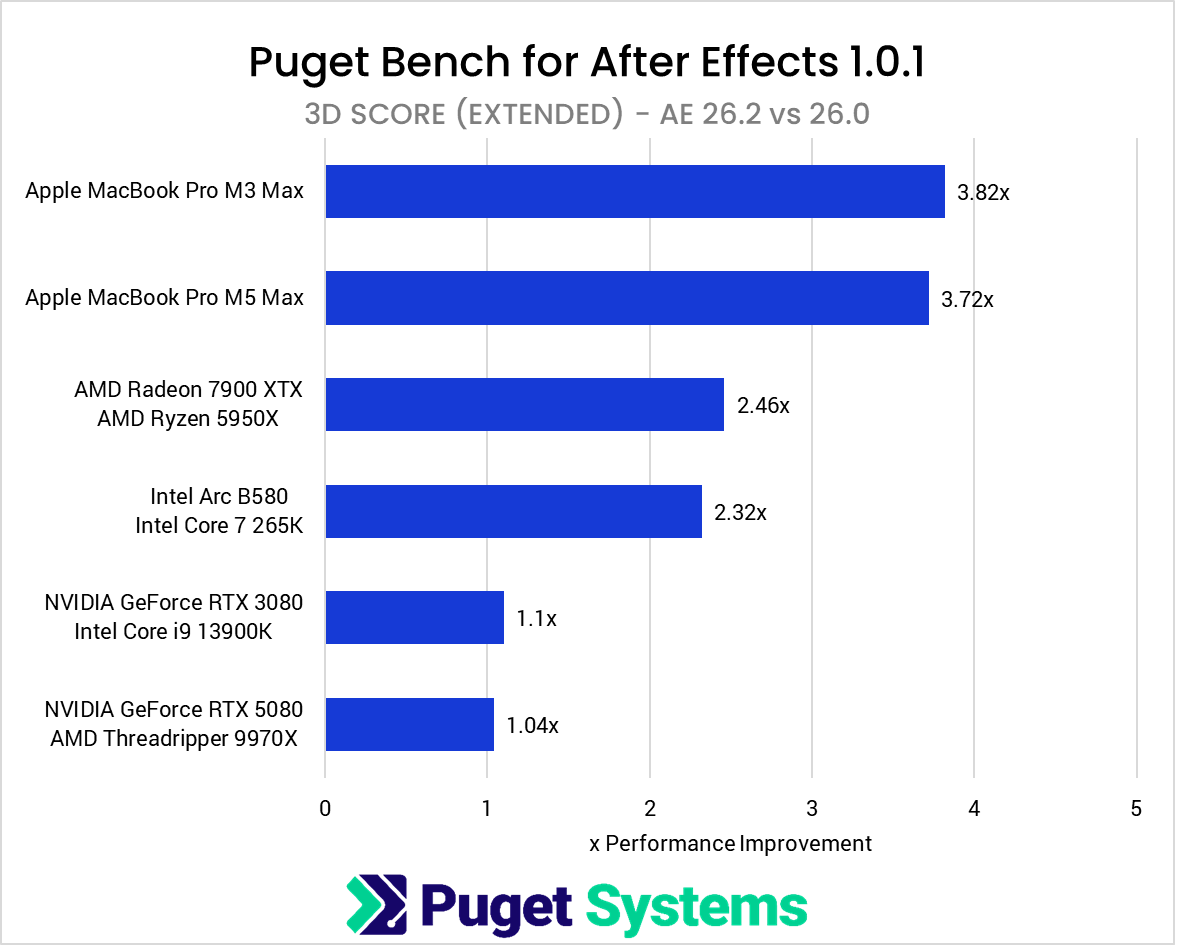
In After Effects26.2, we found major performance improvements of up to 3.8x for 3D-based workflows using the Advanced 3D renderer. The exact gain varies by GPU brand, with Apple seeing the largest gains, followed by AMD, Intel, and NVIDIA.
Example Benchmark Results
When we test new software updates with Puget Bench, we run them across a range of platforms with a mix of CPUs and GPUs from all brands. They are intentionally NOT all the latest generation, since we want to make sure that older hardware does not have any issues. The testing done as a part of our performance articles already focuses on the latest and greatest hardware.
Here is what we saw when we compared the new AE 26.2 release to the previous 26.0 version:
System Image
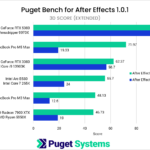
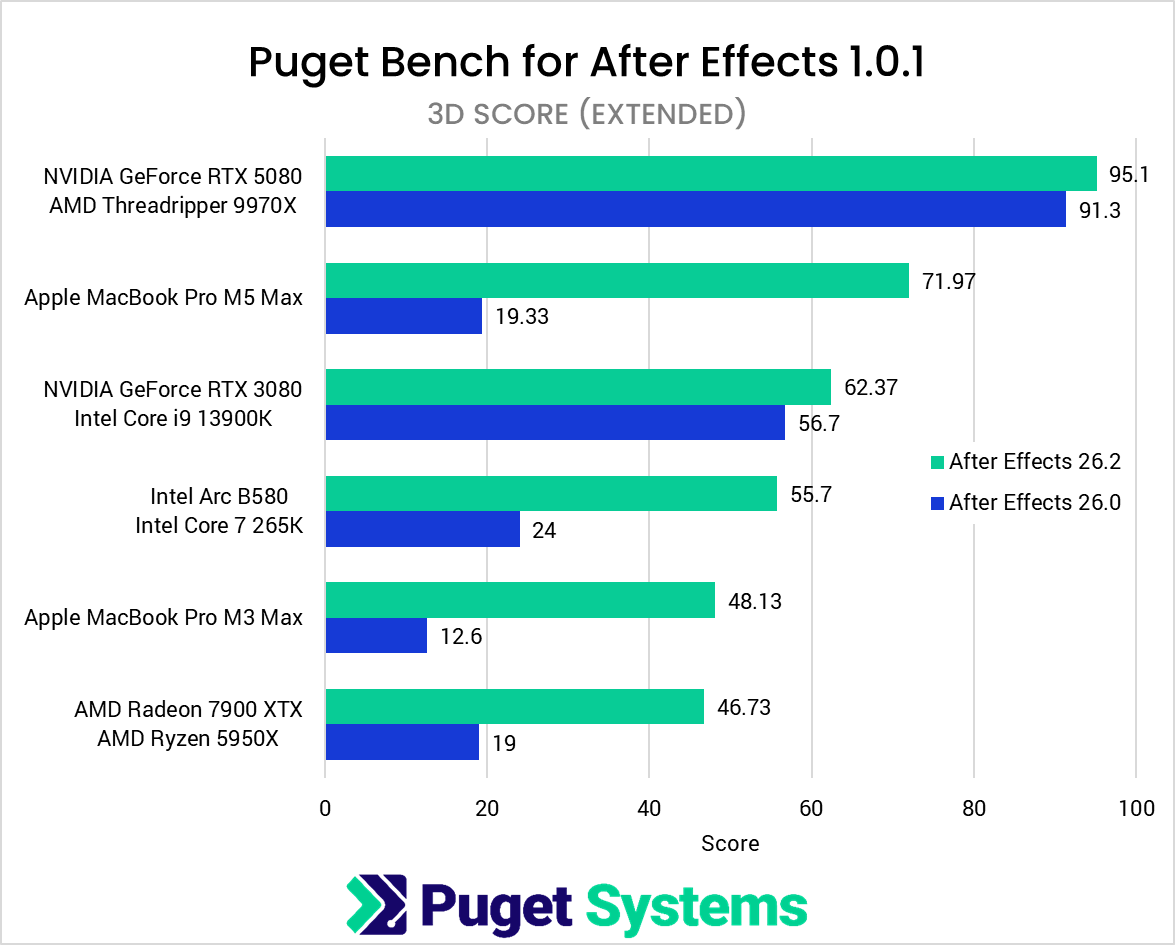
On the first chart, you can see how each of our platforms performed in the “3D Score (Extended)” result from Puget Bench for After Effects, with blue bars showing version 26.0 and green showing the new 26.2 release. The systems using NVIDIA GeForce cards saw minor boosts, but those using AMD Radeon, Intel Arc and Apple M3 / M5 Max all had huge jumps!
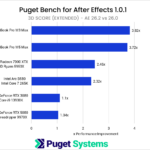
The second chart focuses on quantifying the improvement each of these testbeds saw. We used the results from the first chart, and calculated the performance increase going from After Effects v26.0 to v26.2. As you can see, Apple is the biggest beneficiary, showing around a 3.8x performance uplift with both an M3 Max and M5 Max MacBook Pro. This is a huge gain and will have a big impact on how well Apple can keep up with NVIDIA for 3D workflows in After Effects.
Behind Apple, AMD GPUs also had a large jump, with the Radeon™ 7900 XTX showing about a 2.5x increase in 3D performance. Intel GPUs are just a hair behind that, with a 2.3x increase on the Arc™ B580 GPU.
The only “loser” here is NVIDIA, and only in the sense that the gains on their GPUs are much smaller. Our GeForce RTX™ 3080 platform showed about a 1.1x improvement, and the RTX™ 5080 got just a 1.04x gain (close to the margin of error). To be fair, NVIDIA has long been a massive favorite for 3D in After Effects, and in previous versions was many times faster than any other GPU brand. This update simply levels the playing field a bit, allowing AMD, Intel, and Apple to compete more reasonably with NVIDIA.
Since our Puget Bench QA platforms are not meant for direct performance comparisons between CPUs and GPUs, these results are most useful for getting an idea about how an application update affects different types of components rather than directly comparing, say, NVIDIA to AMD. We will do more in-depth testing to answer those questions soon, but even without significant performance gains, NVIDIA remains the top choice for After Effects 3D workloads. Apple is right behind with its new M5 Max, now, and Intel has also really caught up – so their Arc cards could be an excellent choice for those on a budget.
Conclusion
Performance gains are always terrific to see and are a sign that companies like Adobe are working diligently to benefit their users. The interesting thing about this update is that, even though it is a massive shift, there was no mention of it that we could find in the After Effects 26.2 update notes. We reached out to Adobe to see if they could give us any additional information, and they responded that this improvement is “primarily due to under the hood 3D engine optimizations for AMD, Intel, and Mac GPUs.”
How this update might change your choice of hardware in an After Effects workstation is something we will look at in more detail soon, but there is no doubt that this is certainly a boon for any After Effects user without an NVIDIA GPU!
If you need a powerful workstation to tackle After Effects, the Puget Systems workstations on our solutions page are tailored to excel in various software packages. If you prefer to take a more hands-on approach, our custom configuration page helps you to configure a workstation that matches your exact needs. Otherwise, if you would like more guidance in configuring a workstation that aligns with your unique workflow, our knowledgeable technology consultants are here to lend their expertise.

Looking for an After Effects workstation?
We build computers tailor-made for your workflow.

Don’t know where to start?
We can help!
Get in touch with one of our technical consultants today.