Table of Contents
Introduction
Just under one year ago, AMD launched its highly acclaimed Ryzen™ 9000 processors based on its Zen 5 architecture. Although at the time, we found middling performance improvements, various microcode, firmware, and OS updates have elevated them further. Now, AMD has released the Zen 5 variants of its popular Ryzen™ Threadripper™ PRO Workstation processors: the AMD Ryzen Threadripper PRO 9000WX series.
Since at least Threadripper PRO 5000, AMD has dominated the workstation market. Intel continues to release competing Xeon processors—its latest being the Xeon W-3500 series—but they have been consistently behind in content creation applications. Although we prefer robust competition across market segments, Threadripper PRO 9000WX may be the final nail in Intel’s Workstation coffin.
Image
Much like the Ryzen 9000 desktop processors, the Ryzen Threadripper PRO 9000WX processors are based on AMD’s Zen 5 microarchitecture. We’re not going to get into the full details of all that that entails, but some top-level highlights are improved L1 and L2 data cache bandwidths (important for HPC workloads), support for true AVX-512 calculations, and overall higher IPC (instructions per cycle). We recommend interested readers check out Chips and Cheese’s article on the topic if they want to dive into the specifics.
Much like Ryzen 9000 desktop processors, the Ryzen Threadripper PRO 9000 WX processors are drop-in compatible with existing WRX90 and TRX50 (socket sTR5) motherboards. We recommend updating the BIOS first, though, to ensure the system will boot properly. This means that we will be considering these CPUs both as a new build/platform upgrade and as a CPU-only upgrade. If you are interested in learning about the differences between the two motherboard platforms, we have an article on them.
One reason you may not want to do only a CPU upgrade, however, is that the new Threadripper 9000 processors support faster memory than Threadripper 7000. Although we plan to investigate memory scaling on Threadripper in the future, on desktop platforms, we have found that this can translate to a greater than 4% improved performance.
Below, we have listed the most relevant CPU specifications from AMD and Intel. For more information, visit Intel Ark or AMD’s Threadripper page.
On the surface, the Threadripper PRO 9000WX processors appear to be an iterative improvement over the last-gen Threadripper PRO 7000WX processors. Mainline specifications are nearly identical, with the same core counts, cache setup, PCIe lanes, TDP, and base clock. The only top-level differences are the maximum boost clocks, which saw an increase of a few hundred megahertz at the top end, and the maximum supported RAM speed, which increased from 5200 to 6400 Mbps for the whole family.
Of course, as we discussed briefly above, there are a lot of “under the hood” changes which aren’t reflected here. Alongside these comes a price bump of between about 10 and 20%. We’re not fans of these already-expensive components becoming even more expensive, but whether it is an acceptable increase depends quite a bit on how the performance shakes out.
Comparing AMD’s Threadripper processors to Intel’s Xeon® Workstation processors is difficult. AMD uses a traditional core-scaling schema with processors containing 16, 24, 32, 64, and 96. Intel, on the other hand, has unusual core counts at 20, 24, 44, and 60. There are a few other Xeons we didn’t include above, but they are less comparable in terms of core counts or cost. Generally speaking, for a similar core count, Intel will come in a bit cheaper than AMD. However, it will offer slower RAM and lower clock speeds. We have also found that Intel’s core counts tend to play less nicely with how Windows likes to schedule work. Unfortunately, Intel does not offer any CPU that approaches AMD’s high-end 9995WX.
Test Setup
AMD WRX90 Test Platforms
| CPUs: AMD Ryzen™ Threadripper™ PRO 9995WX AMD Ryzen™ Threadripper™ PRO 9985WX AMD Ryzen™ Threadripper™ PRO 9975WX AMD Ryzen™ Threadripper™ PRO 9965WX AMD Ryzen™ Threadripper™ PRO 9955WX AMD Ryzen™ Threadripper™ PRO 7995WX AMD Ryzen™ Threadripper™ PRO 7985WX AMD Ryzen™ Threadripper™ PRO 7975WX AMD Ryzen™ Threadripper™ PRO 7965WX |
| RAM: TR 9000WX: 8x DDR5-6400 ECC Reg. 64GB (512 GB total) Running at 6400 Mbps TR 7000WX: 8x DDR5-5600 ECC Reg. 16GB (128 GB total) Running at 5200 Mbps |
| CPU Cooler: Asetek 836S-M1A 360mm |
| Motherboard: ASUS Pro WS WRX90E-SAGE SE BIOS version: 1106 |
Intel Xeon Test Platform
| CPUs: Intel® Xeon® w9-3595X Intel® Xeon® w9-3575X Intel® Xeon® w7-3565X Intel® Xeon® w5-3535X |
| RAM: 8x DDR5-4800 16GB (128 GB total) |
| CPU Cooler: Noctua NH-U14S DX-4677 |
| Motherboard: ASUS Pro WS W790E-SAGE SE BIOS version: 1502 |
Shared Parts
| GPU: NVIDIA GeForce RTX™ 5080 Driver 576.80 |
| Storage: Samsung 980 Pro 2TB |
| PSU: Super Flower LEADEX Platinum 1600W |
| OS: Windows 11 Pro 64-bit (26100) |
Benchmark Software
| Adobe Photoshop 26.8 – PugetBench for Photoshop 1.0.5 |
| Adobe Premiere Pro 25.2.3 – PugetBench for Premiere Pro 1.1.1 |
| Adobe After Effects 25.3.1 – PugetBench for After Effects 1.0 |
| DaVinci Resolve 20.0.1.6– PugetBench for DaVinci Resolve 1.2.0 |
| Blender 4.4.0 |
| V-Ray 6.00.01 |
| Cinebench 2024 |
| Unreal Engine 5.5 |
| Visual Studio 2022 |
| Llama.cpp 5122 |
In order to try to keep our results as comparable as possible, we standardize on a base setup on all of our testbeds, which closely aligns with the content creation workstation specs we recommend. As part of this, we keep our memory running at the officially supported JEDEC RAM speeds, disable overclocking features, and enforce power limits; all of the Xeon processors were run with PL1 = TDP, PL2 = 1.2*TDP, and Tau = 32 s.
However, this sometimes means more differences between our test platforms than we would prefer. For example, in this article, the RAM is not identical across platforms. Each product family we tested supports a different maximum memory frequency: 6400 for Threadripper PRO 9000WX, 5200 for Threadripper PRO 7000WX, and 4800 for Intel Xeon W-3500. Additionally, due to supply availability, we only had access to higher-capacity memory at 6400 Mbps. While this does make it more difficult to tease out what performance gain is due to memory and what is due to the CPU itself, ultimately, what matters is the holistic performance of the system rather than the contribution of any individual component. We will note that the total RAM capacity shouldn’t make a measurable difference for the benchmarks we are running for this article.
The coolers also vary. Due to thermal considerations, we have decided that the TRX50 and WRX90 systems we sell should be configured with an all-in-one liquid cooler (AIO) by default, so we have tested with one here. When testing, we did not have compatible AIOs for our W790 system, so we used our standard Noctua air coolers for that platform. However, we have compared the performance differences with a 64-core CPU between the two types of coolers and found no difference. That we are not using an AIO for Intel Xeon W should not impact our performance comparisons to a significant degree.
Finally, the Intel Xeon W processors were tested with the “High Performance” power plan due to our initial review findings, which saw a 20% performance loss from the “Balanced” power plan. We have not observed this behaviour with either the Threadripper PRO 7000 WX-Series or Threadripper PRO 9000 WX-Series, so those were tested with our standard settings: the “Balanced” plan.
On the software side, we are using many of our PugetBench benchmarks, some of which were also used by AMD as part of the official AMD Ryzen Threadripper PRO 9000 WX-Series unveiling. We supplement them with several other real-world benchmarks, primarily rendering packages like Blender and V-Ray.

Looking for a Content Creation Workstation?
We build computers tailor-made for your workflow.

Don’t know where to start?
We can help!
Get in touch with our technical consultants today.
Raw Results Tables
We choose our benchmarks to cover many workflows and tasks to provide a balanced look at the application and its hardware interactions. However, many users have more specialized workflows. Recognizing this, we like to provide individual results for benchmarks as well. If a specific area in an application comprises most of your work, examining those results will give a more accurate understanding of the performance disparities between components. Otherwise, we recommend skipping over this section and focusing on our more in-depth analysis in the following sections.
Graphic Design: Adobe Photoshop


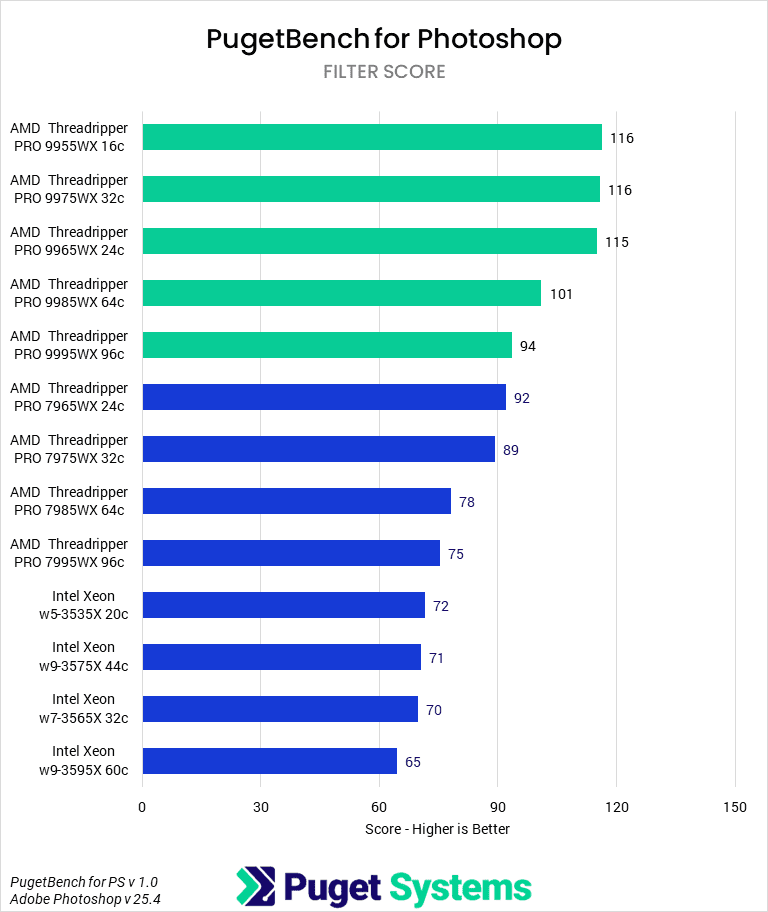
Adobe Photoshop is a relatively light, CPU-bound application. Most of the work is dependent on a small number of threads, so single-core performance tends to be the best predictor of performance in Photoshop. Due to this, workstation-class processors like Threadripper PRO or Xeon 3500 are not typically recommended for systems designed primarily for Photoshop. However, as it is a common secondary application, we consider it important to test the performance of these CPUs in this application.
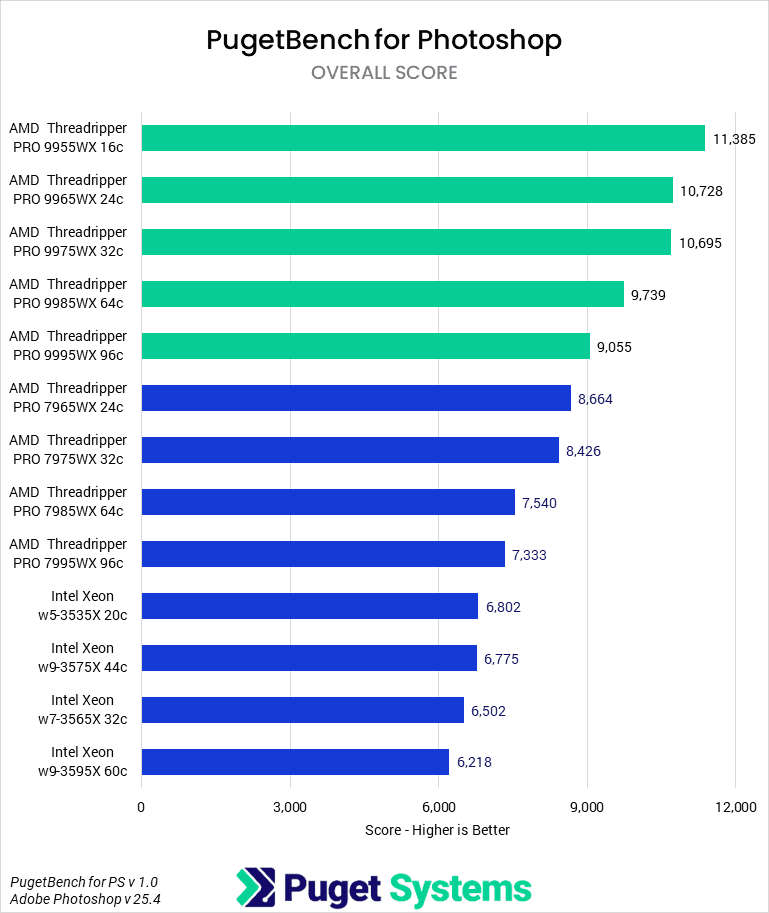
Looking at the Overall Score (Chart #1), the new AMD Threadripper PRO 9000 WX-series processors dominate the chart. The fastest is the 9955WX, likely due to its dual-CCD layout reducing core-to-core and core-to-cache latency, while the fewer cores allow for more consistent single-core boosting. The 24-core 9965WX and 32-core 9975WX follow 6% behind, with the 64- and 96-core 9985WX and 9995WX even slower. In the past, we have seen Windows struggle to properly schedule high core-count CPUs, particularly those over 64 logical processors. There may still be some of that happening, but all of the CPUs are at least 22% faster than their last-gen counterparts.
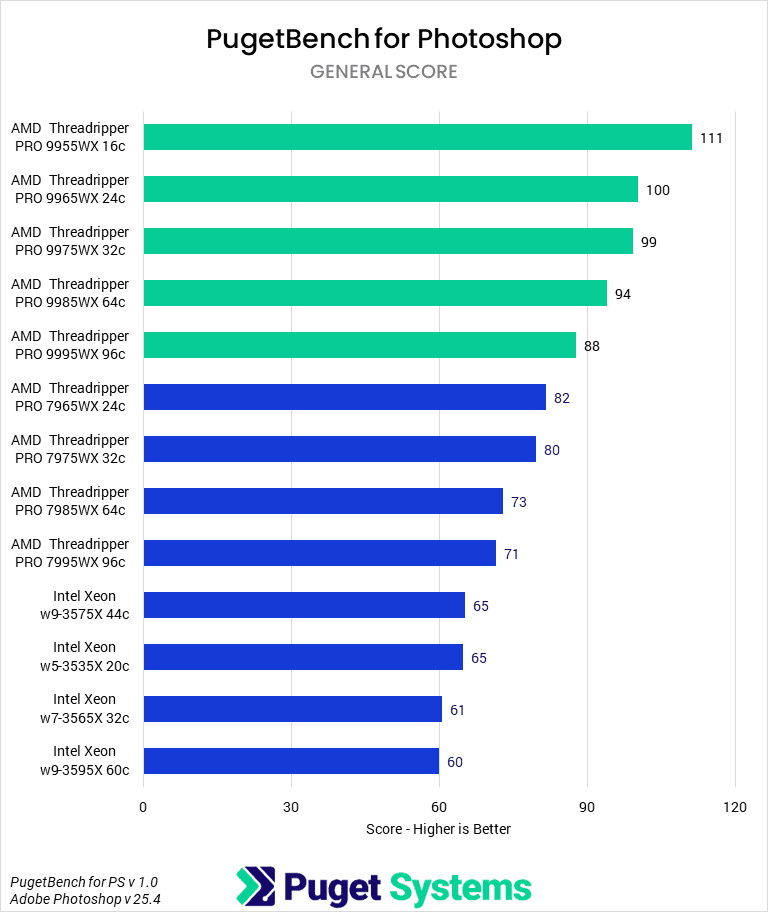
Even the slowest of the 9000WX CPUs is still faster than the fastest AMD Threadripper PRO 7000 WX-series processor. The 9995WX just barely leads the 7965WX, and the rest of the 7000WX family files in behind. Dead last in this benchmark is Intel’s Xeon 3500 family. The fastest of them, the 20-core w5-3535X, is only 60% as fast in Adobe Photoshop. The subscores (General: Chart #2 and Filter: Chart #3) are much the same.
Video Editing: Adobe Premiere Pro
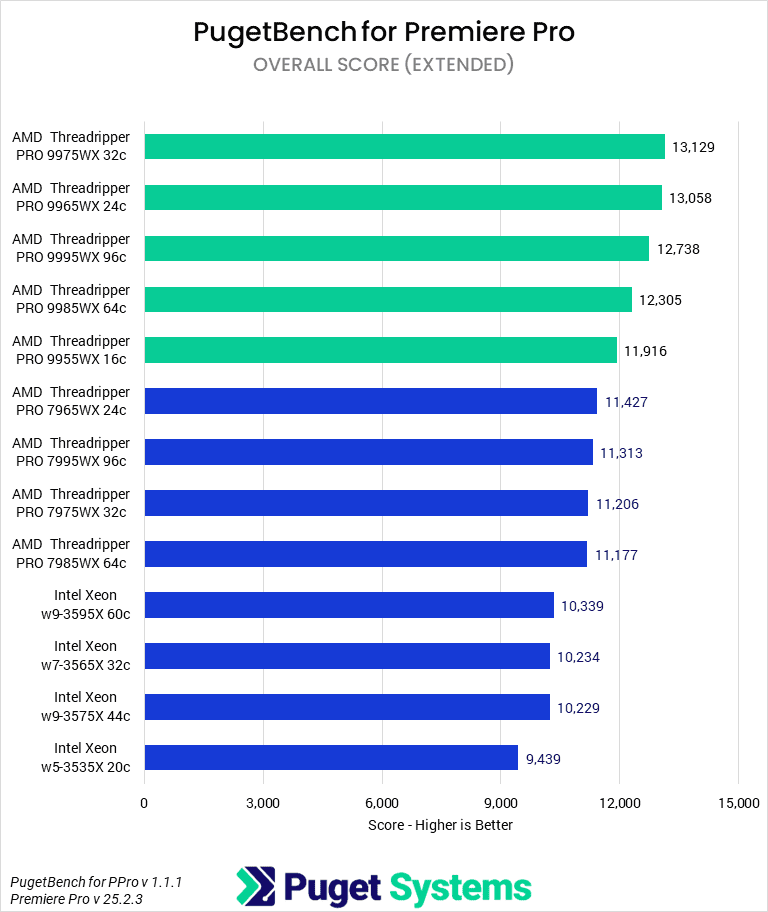
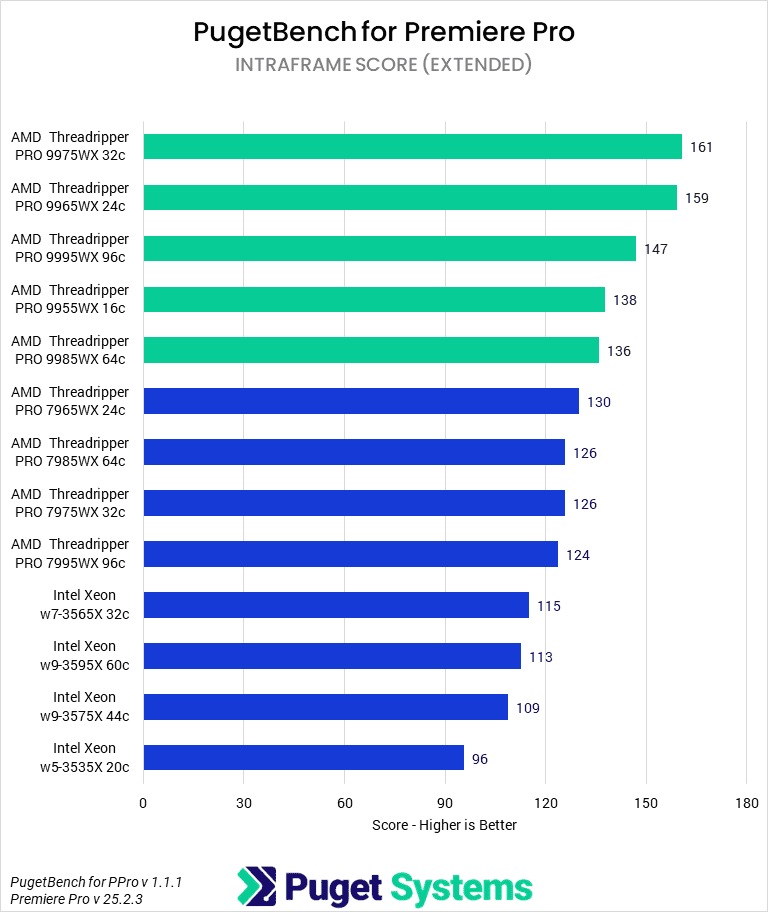
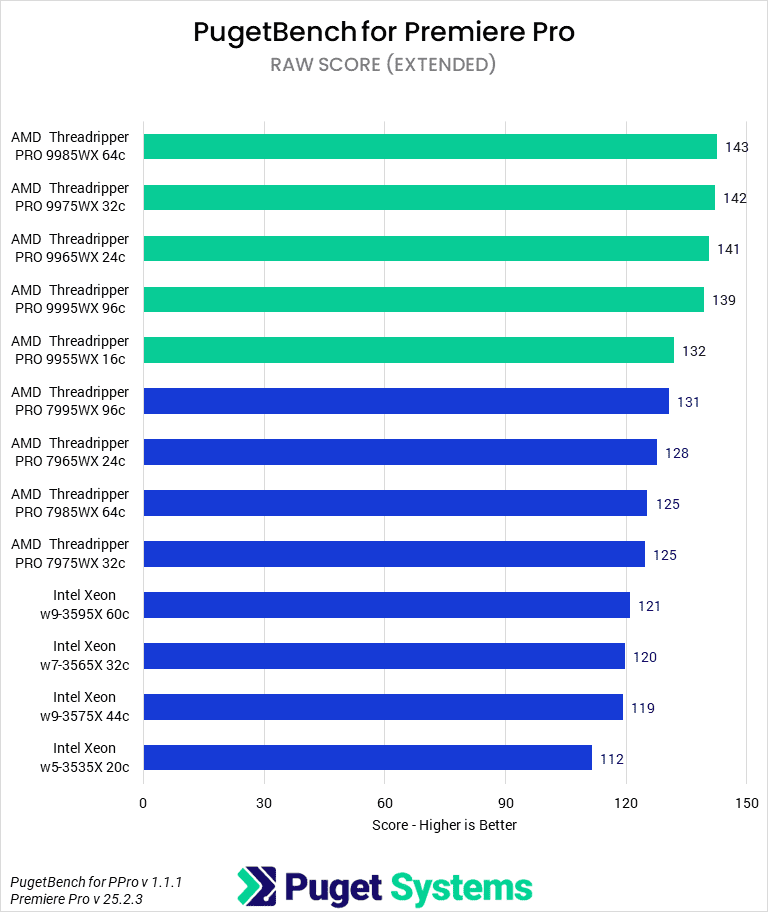
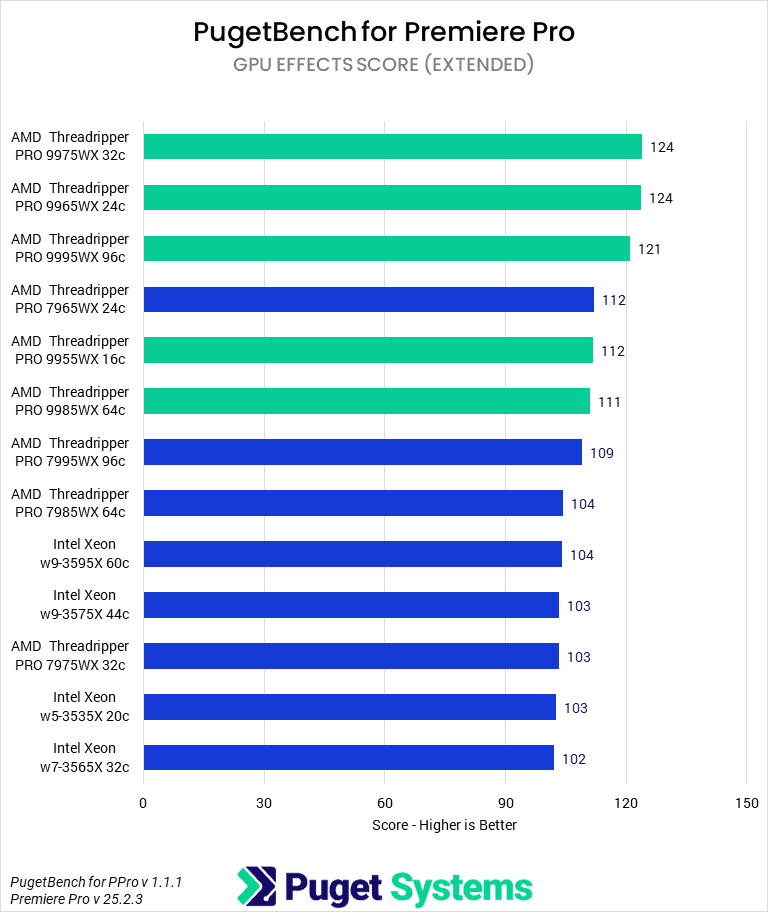
Next up is our PugetBench benchmark for Adobe’s Premiere Pro. Unlike Photoshop, some workflows in Premiere Pro can make use of large CPUs with tons of cores, so there are some cases where a Threadripper PRO processor could make sense. However, it is still an application where a desktop/enthusiast processor like a 9900X or 285K may be a better value for many users—we’ll be looking at some of those in our upcoming Threadripper 9000 (non-pro) article.
Starting with the Overall Score (Chart #1), the Threadripper PRO 9000WX family once again tops the charts. However, this time, the fastest CPU is (by a hair) the 32-core 9975WX. Interestingly, it is followed by the 9965WX and 9995WX, with the 9985WX and 9955WX even slower. Unlike with the previous generation Threadripper PRO 7000WX CPUs, we see a real differentiation between the various 9000WX processors. The 9975WX leads the 7975WX by 17% and the fastest Intel CPU (3595X) by 27%.
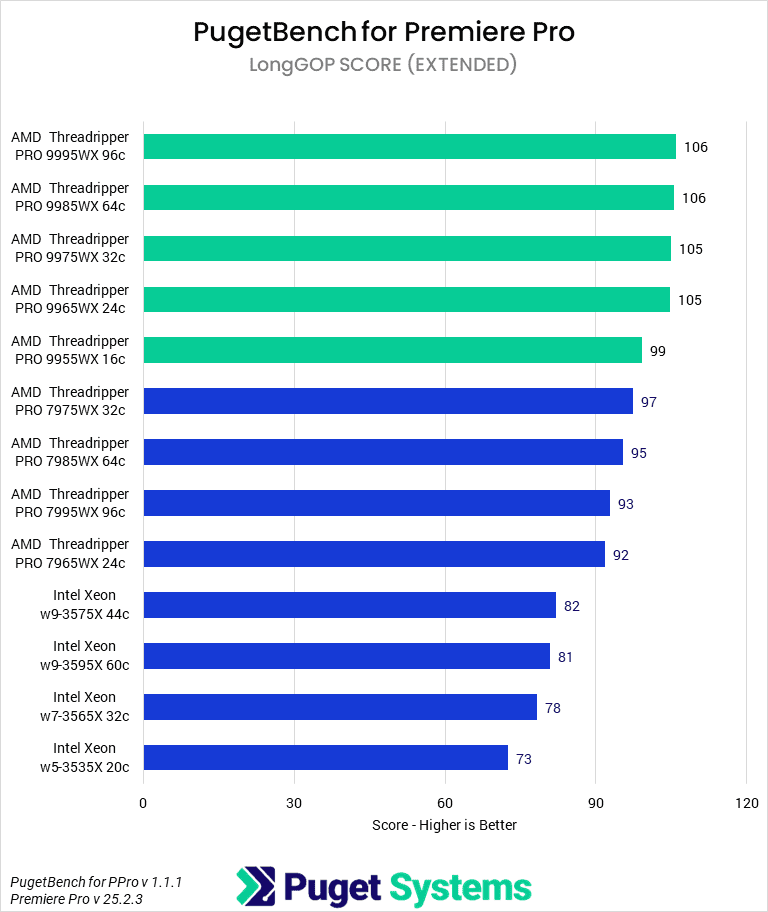
Moving on to LongGOP (Chart #2), we see slight uplifts across the board in real-world usage (that is, with hardware acceleration from a GPU). However, our current benchmark also looks at software encoding, which skews the results towards favoring high-core count processors. Those tests are likely to be dropped in the next iteration of our benchmarks due to dwindling usage of software encoding, and excluding those tests, we see an average performance uplift of about 4%, with Intel trailing about 16% behind.
Intraframe codecs (Chart #3) like Apple’s ProRes are entirely CPU-bound on PC. Our testing found that the 32-core 9975WX was the fastest CPU, with a 27% lead over the 7975WX and a 48% lead over the 44-core Intel 3575X. Just behind it was the 9965WX, 122% as fast as the 7965WX and 138% as fast as the 3565X. On the slower end, the 64-core 9985WX was only 8% faster than the 7985WX and 20% faster than the Xeon 3595X. We can’t wholly explain the spread for the Threadripper PRO 9000WX CPUs, but even at their slowest, they are blazing fast.
Similar to Intraframe, RAW codecs (Chart #4) are highly reliant on CPUs for processing, although GPUs are increasingly being used to accelerate them for debayering and decoding. Our results have the new Threadripper PRO 9000WX processors leading the charts, though with more clustering than we have seen in other workloads. Everything from the 24-core 9965WX to the 96-core 9995WX scores basically the same, with only the 16-core 9955WX being notably slower. But even then, it was faster than any last-gen Threadripper or current-gen Xeon.
Motion Graphics: Adobe After Effects

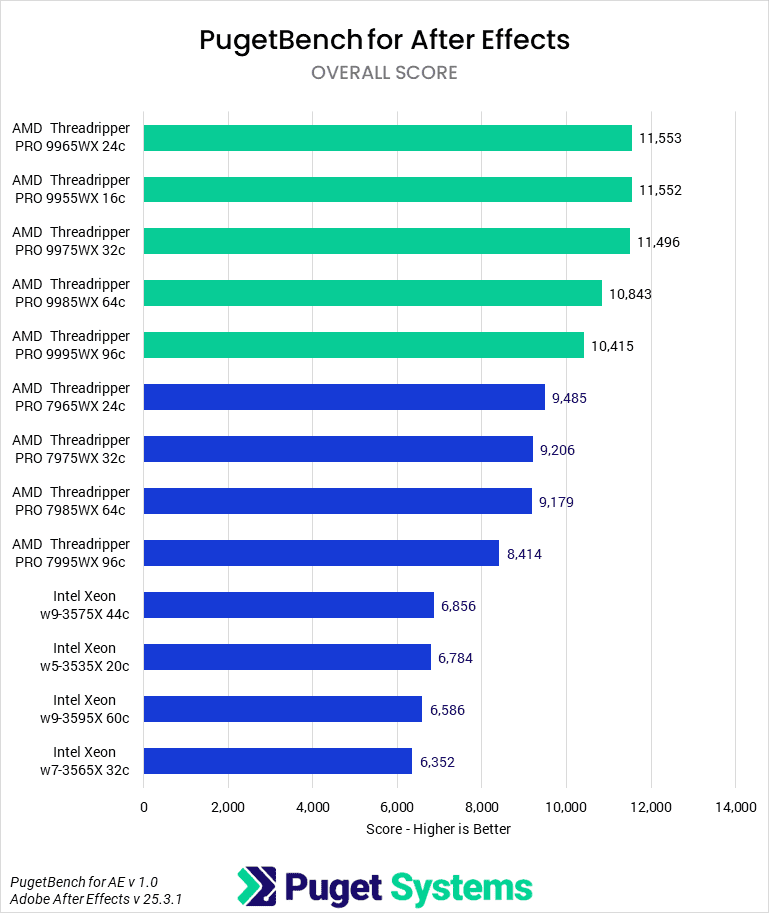
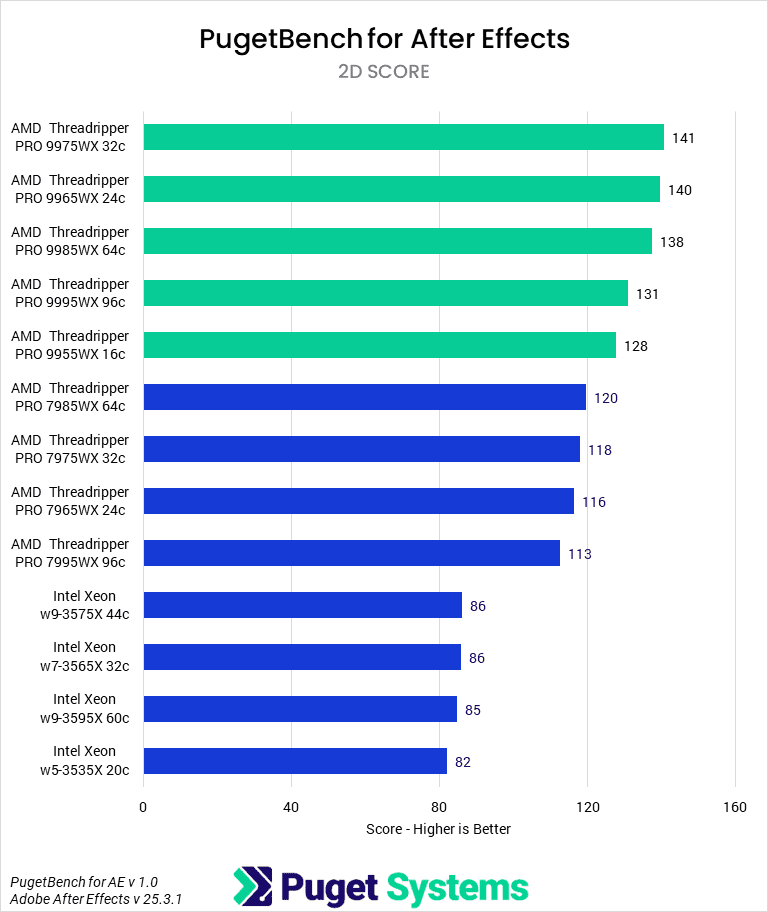
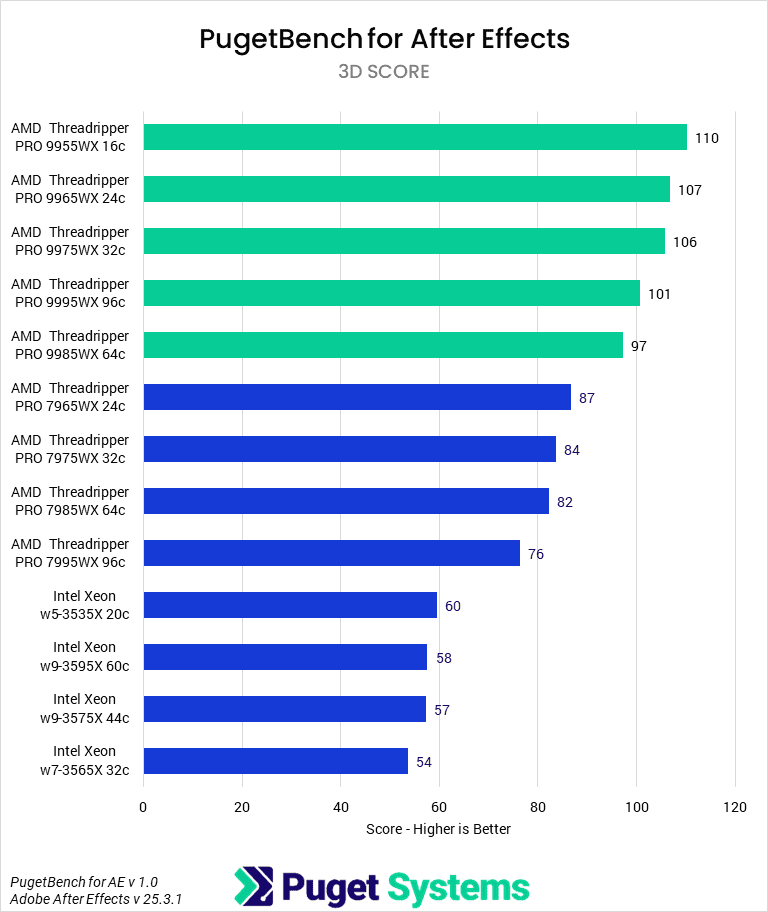
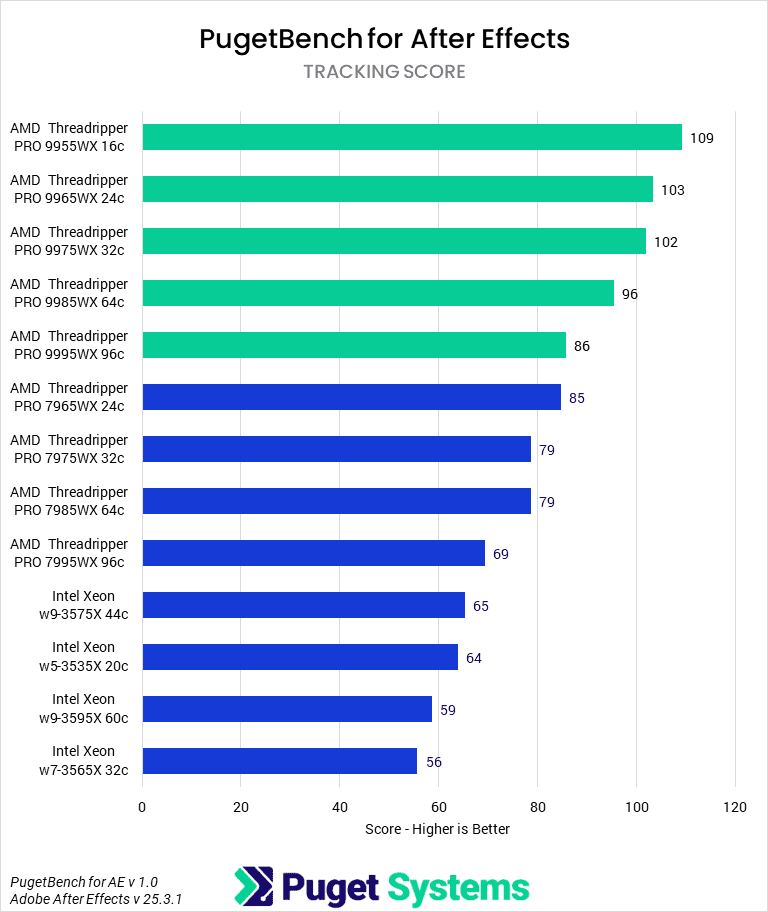
In our After Effects benchmarks, we currently look at two primary areas of performance: traditional 2D workloads and the newer 3D workflows. Both of these are affected by CPU performance, but in different ways. The 3D workflows are heavily GPU reliant, and so are most affected by single-core CPU performance. The 2D score, on the other hand, takes into account both single-threaded and multi-threaded (with the multi-frame rendering feature) scenarios, so it prefers a blend of performance in both.
Looking at the Overall Score (Chart #1), we find that the AMD Threadripper PRO 9965WX is the fastest CPU in After Effects of those tested here. However, there isn’t a lot of differentiation between it and the 9955WX or 9975WX, all of which score about 11,500. Following behind them is the 9985WX with a score of 10,843 and the 9995WX at 10,415. This represents a gen-on-gen uplift of about 22% for the Threadripper 9000WX processors. Embarassingly for Intel, the 9965WX is 82% faster than the 3565X.
Diving into the subscores, we see the differences between 2D and 3D that we discussed above. In 2D workflows (Chart #2), the 9975WX is the fastest CPU, 19% ahead of the 7975WX and 64% faster than the Xeon 3575X. The 9965WX is 20% faster than the 7965WX, while the 9985WX leads the 7985WX by 15%. The 9995WX is similar to the 7995WX.
Our 3D tests (Chart #3) show similar trends, but with the order shaken up. The 16-core 9955WX is now the fastest, with the other 9000WX CPUs following in (largely) ascending core-count order. With a score of 110, the 9955WX is 2% faster than the 9965WX and 9975WX, 9% ahead of the 9995WX, and 13% faster than the 9985WX. Across generations, we see a fairly consistent 23-27% uplift from Threadripper PRO 7000WX to 9000WX. And as expected, Intel trails far behind, with a best score of only 60—40% slower than the 9985WX.
Video Editing / Motion Graphics: DaVinci Resolve Studio





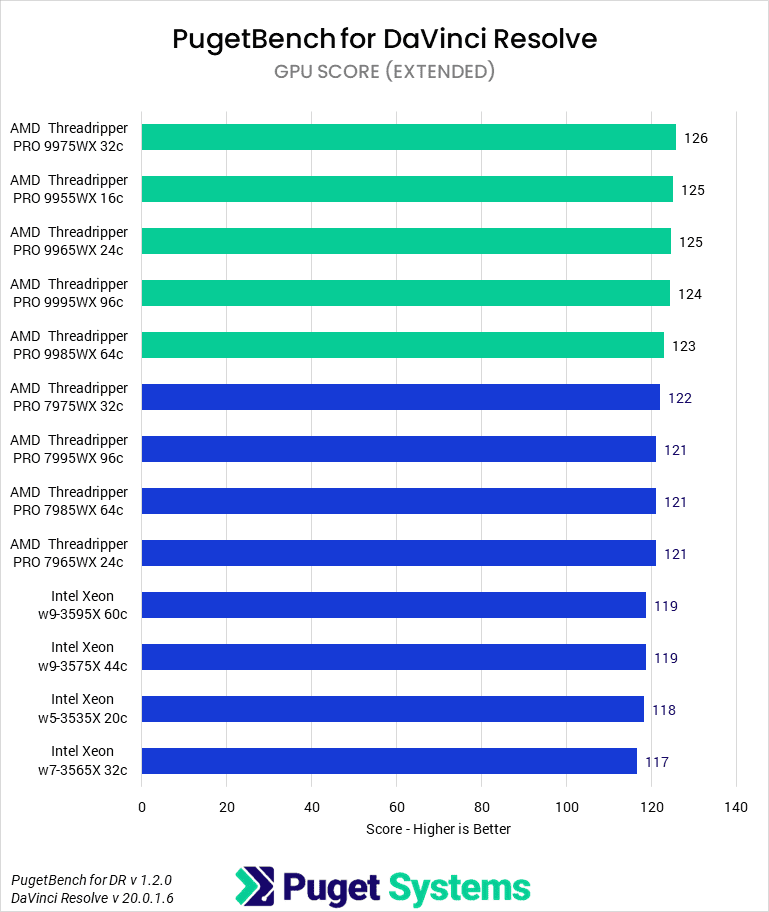
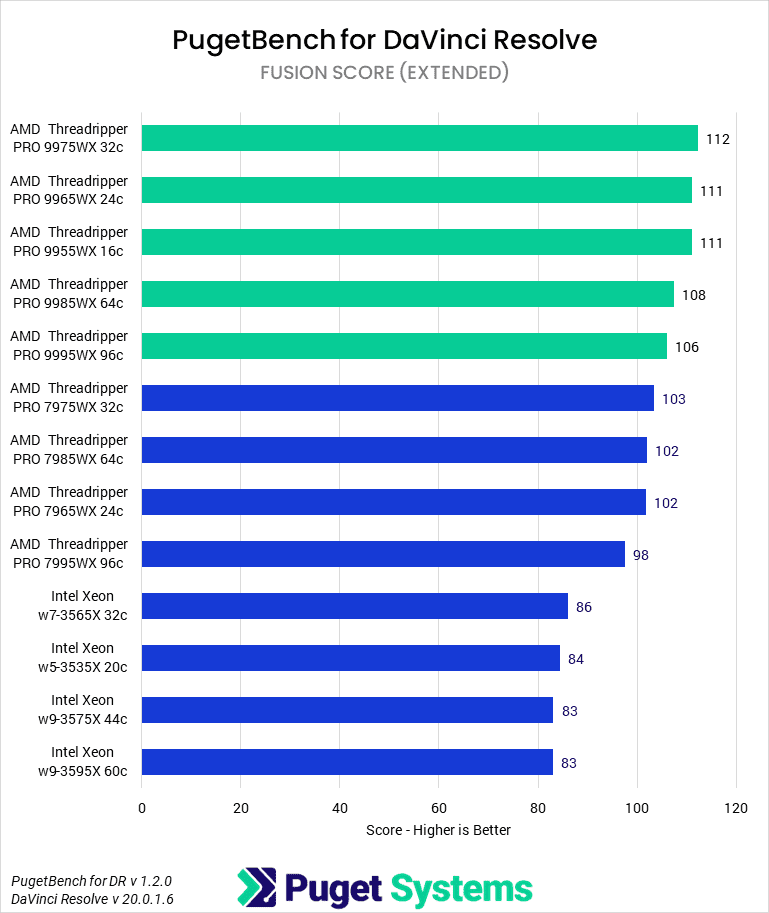
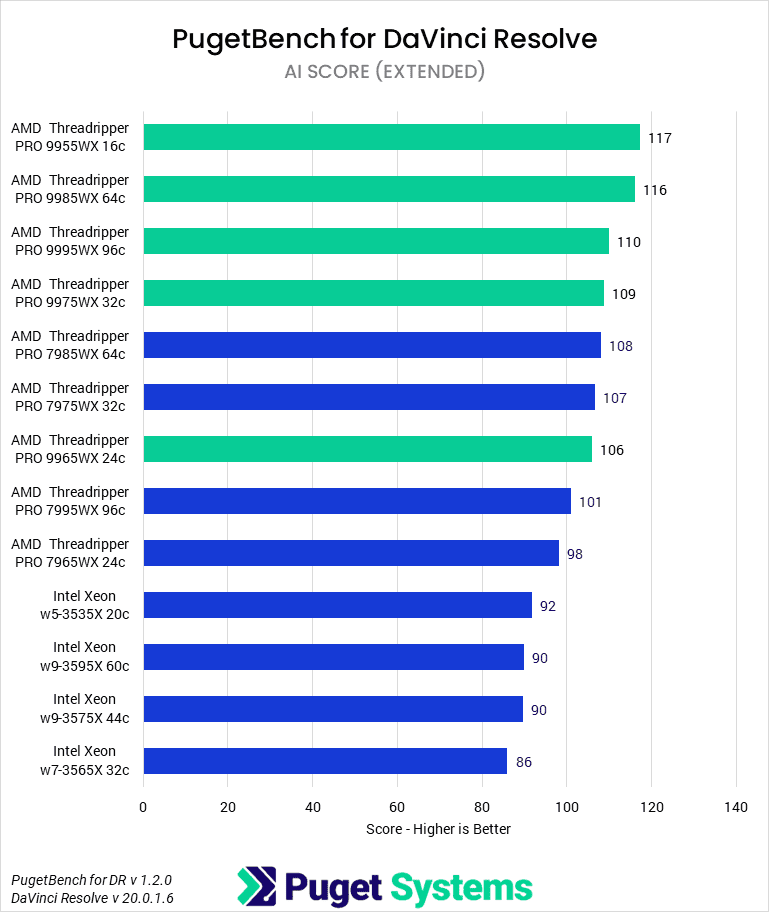
DaVinci Resolve Studio, like Premiere Pro, is a complex application with a variety of possible workloads. In addition to traditional video editing capabilities, it also has a built-in Fusion program for motion graphics/VFX and a bevy of AI features like auto-transcription and denoise. Different workflows within the application thus make use of your computer’s hardware in various ways, although Resolve is known in the industry for being more GPU-centric than most other NLEs.
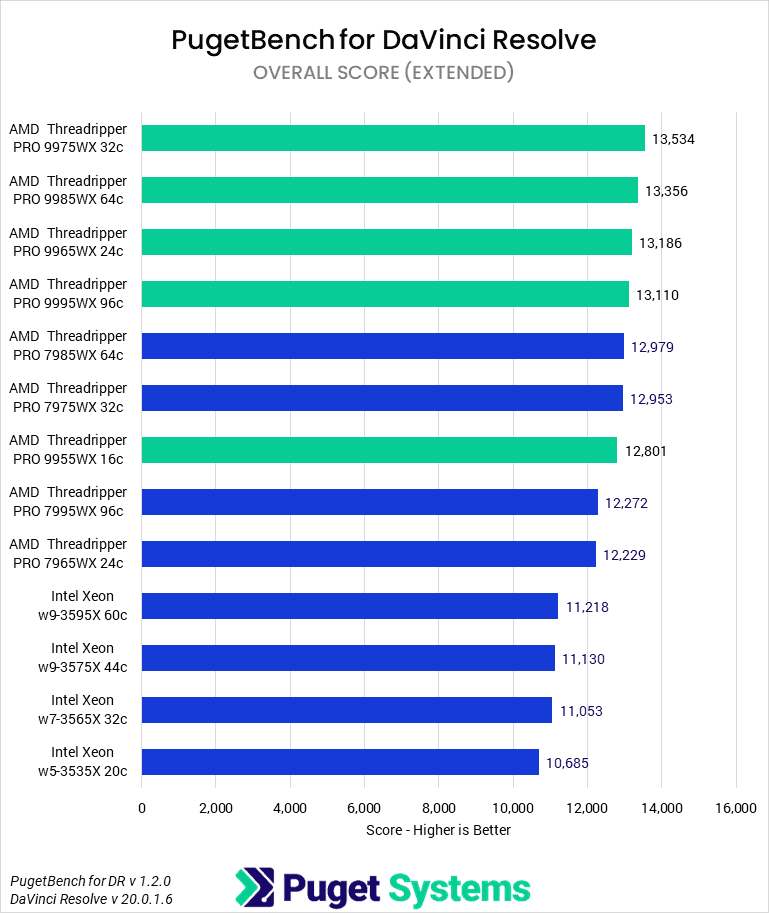
The first score we look at in DaVinci is, of course, the Overall Score (Chart #1). Interestingly, the fastest CPU we tested was the 32-core 9975WX, although all of the Threadripper PRO 9000WX processors—save the 16-core 9955WX—were within the margin of error of this benchmark. The Threadripper PRO 7000WX family follows closely behind, though with a slightly larger spread, while the Xeons are at least 20% slower than the 9000WX parts.
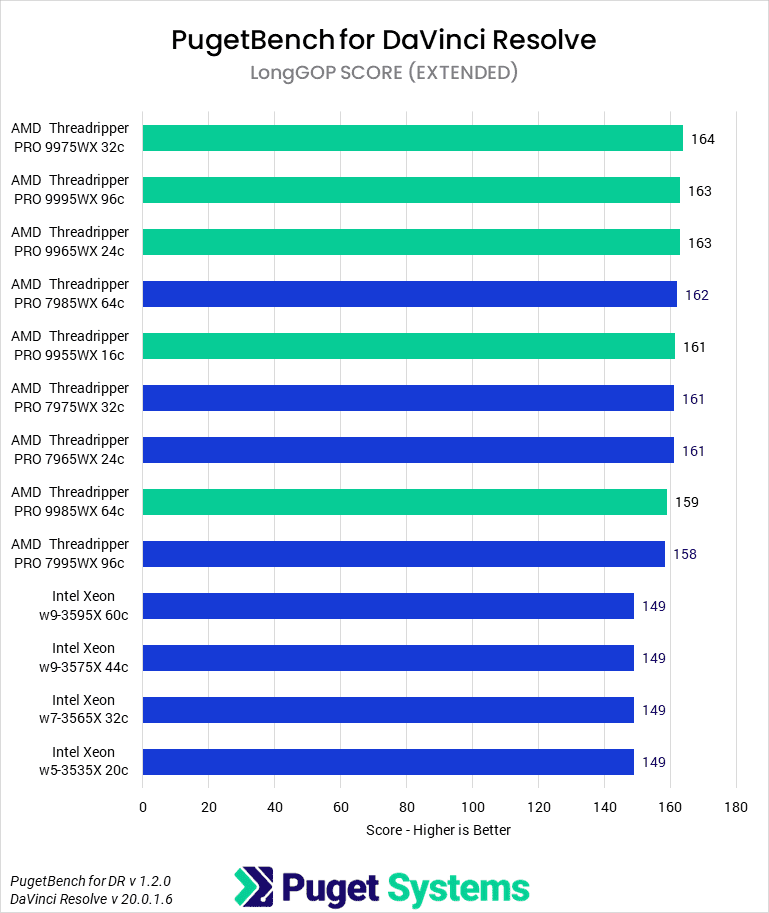
Although nominally ahead in LongGOP (Chart #2) and GPU Effects (Chart #5), those scores are dominated by the GPU, so CPU hardly matters. We would recommend avoiding a Xeon, as those do have the potential to reduce the GPU’s performance in these tasks, but otherwise, we can skip covering them in detail.
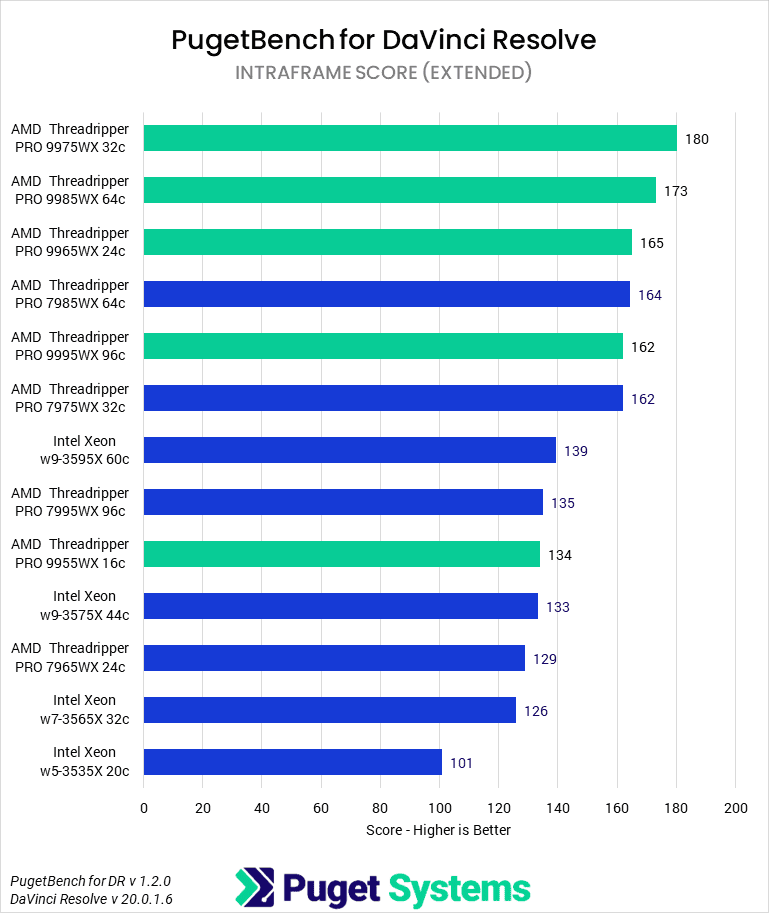
The first subscore that is CPU-reliant is the Intraframe score (Chart #3). Here, the fastest CPU was the 32-core 9975WX, with a score of 180. This represents a 10% improvement over the fastest 7000WX CPU, the 7985WX, at 164. The 9985WX and 9965WX are also very good, with scores of 173 and 165, respectively. Overall, the generational uplift appears to be about 20% on average in Intraframe workflows.
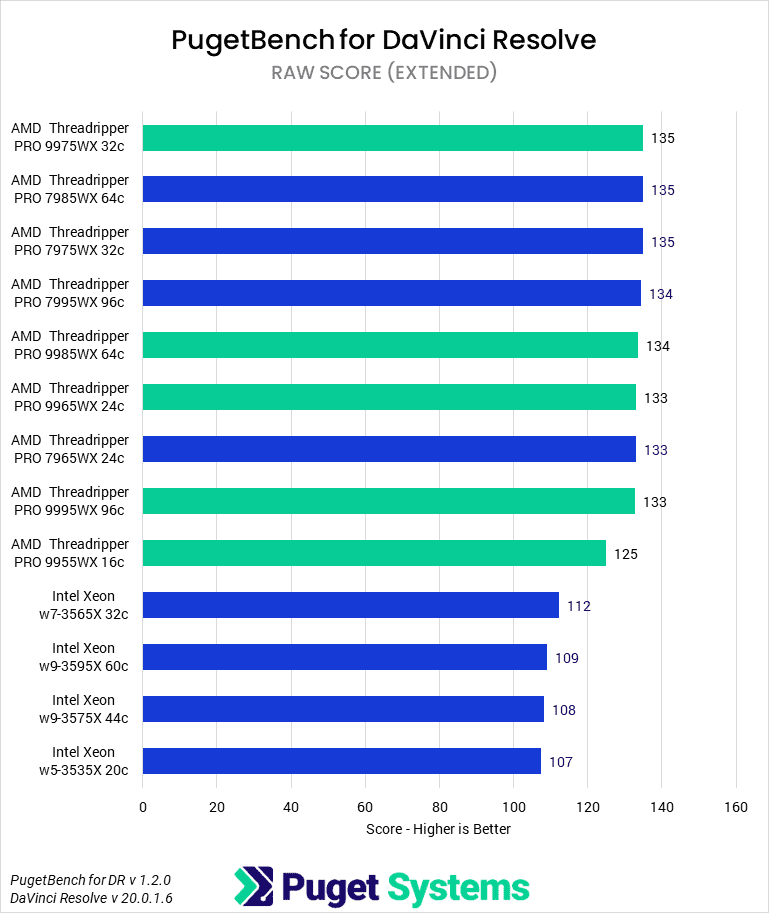
Moving on to RAW codecs (Chart #4), we see no difference between Threadripper PRO 9000WX and 7000WX—except for the 16-core 9955WX, which trails behind somewhat. However, Intel is decidedly behind here, by about 22%. Finally, in Fusion (Chart #6) and AI (Chart #7), the new 9000WX CPUs lead their last-gen counterparts by about 7%.
Game Dev / Coding: Unreal Engine
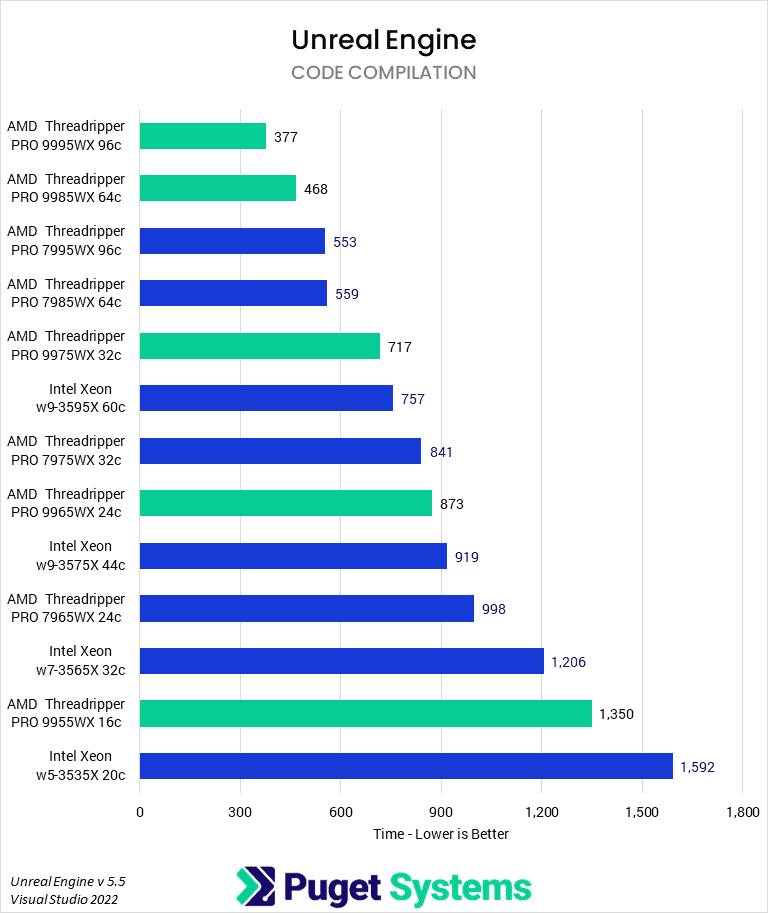
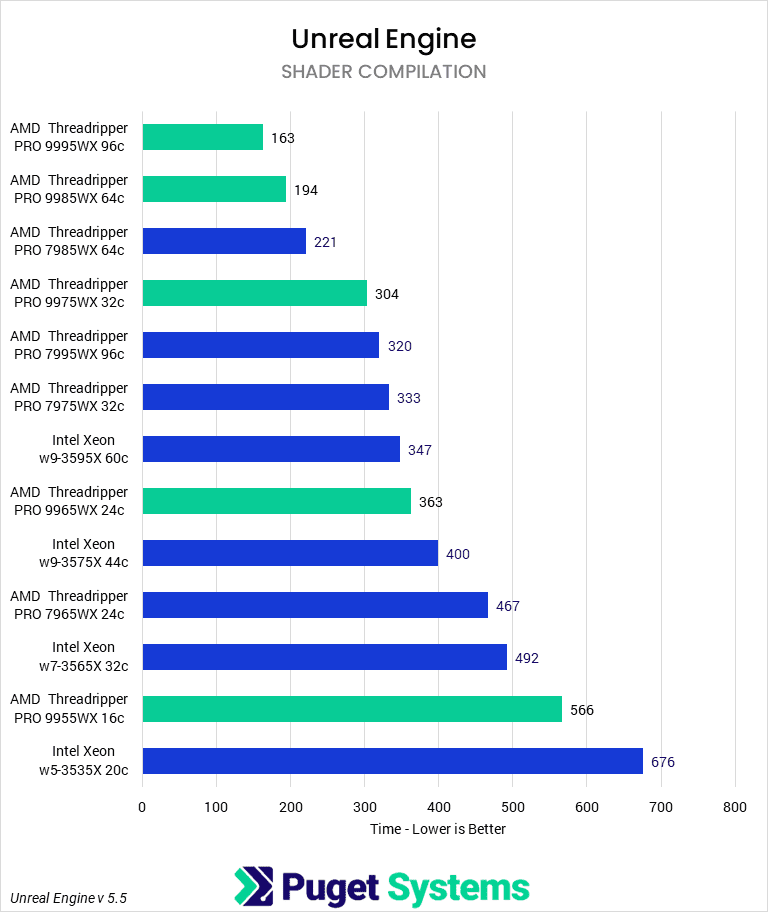
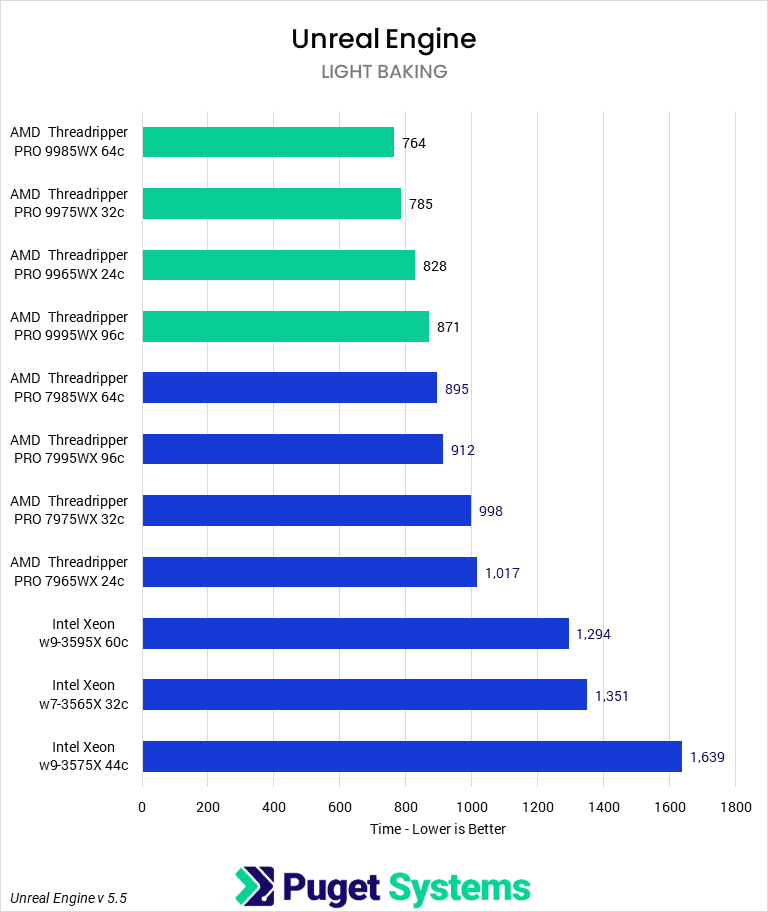
Moving on to our game development benchmarks, we have a variety of tasks related to Unreal Engine. First is compiling the engine, which can act as a proxy for other coding workflows, followed by shader compilation and building lighting. The latter two aren’t always the most common CPU-based task for game developers, but can be relevant to certain workflows.
Starting with Code Compilation time (Chart #1), we see clear scaling with core count. The 96-core 9995WX is the fastest processor, finishing in 68% the time of the 7995WX. Tailing directly behind it is the 9985WX, which manages to finish the benchmark 17% faster than the 7985WX, and 14% faster than even the 7995WX. The 32-core 9975WX follows the 7985WX, finishing in about twice the time of the 9995WX, but in 85% the time of the 7975WX, and even faster than the 60-core Xeon 3595X. Moving on to Shader Compilation (Chart #2), we see the same thing.
Light Baking (Chart #3) tends to be less sensitive to raw core count and more reliant on things like cache and RAM bandwidth. However, it is also the most temperamental of the three Unreal Engine-related benchmarks we run, and so there were a few “Did not completes” in our results—specifically, from the 3565X and 9955X. Nonetheless, we see interesting results where the four 9000WX CPUs that completed were also the fastest, with even the 9965WX outperforming the 7995WX.
CPU Rendering: Cinebench, Blender, & V-Ray

Offline renderers like V-Ray and Blender are some of the best use cases for these processors. Although GPU rendering is becoming increasingly common, sometimes CPU rendering is preferred for accuracy or scalability. Unlike consumer processors, workstation-class processors like the AMD Threadripper PRO 9000WX have the power and RAM capacity to be a real alternative to GPU-based rendering for some users. They can also act as an interesting proxy for some HPC workflows.
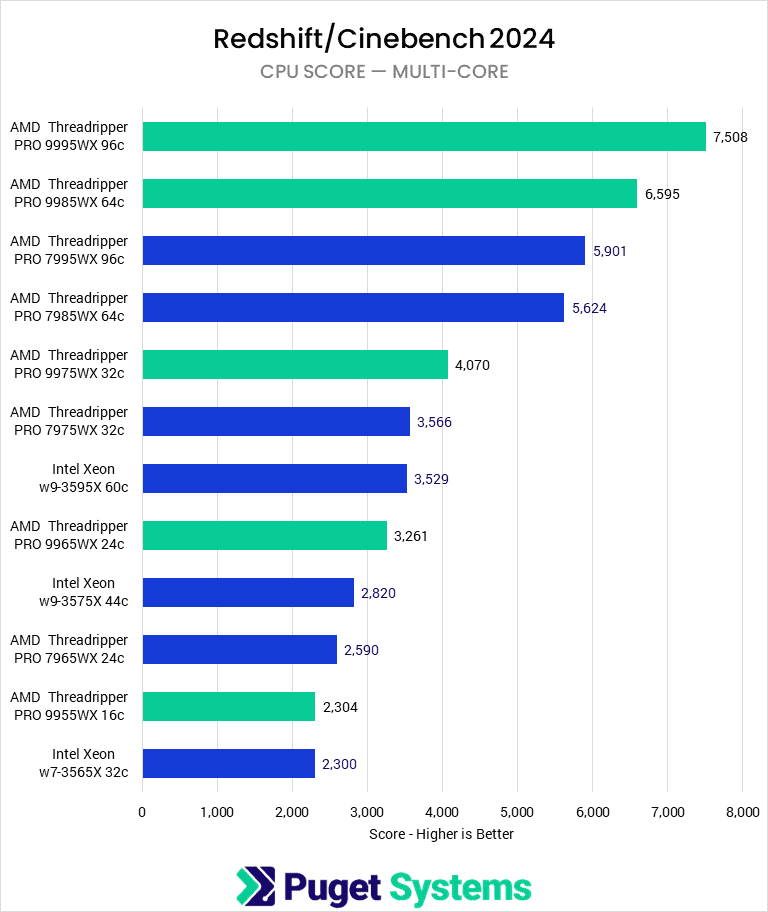
Starting with Cinebench 2024 multicore (Chart #1), we see huge generational gains from Threadripper PRO 7000WX. The 9995WX is the fastest CPU, scoring 7,508—27% higher than the 7995WX. The 64-core model sees a smaller uplift of only 17%, which is still enough to make it faster than the last-gen 96-core. Similarly, the 9975WX is 14% faster than the 7975WX and 15% faster than the most-performant Intel CPU. The 9965WX manages as 26% generational uplift, while the 16-core 9955WX manages to beat the 32-core w5-3565X.
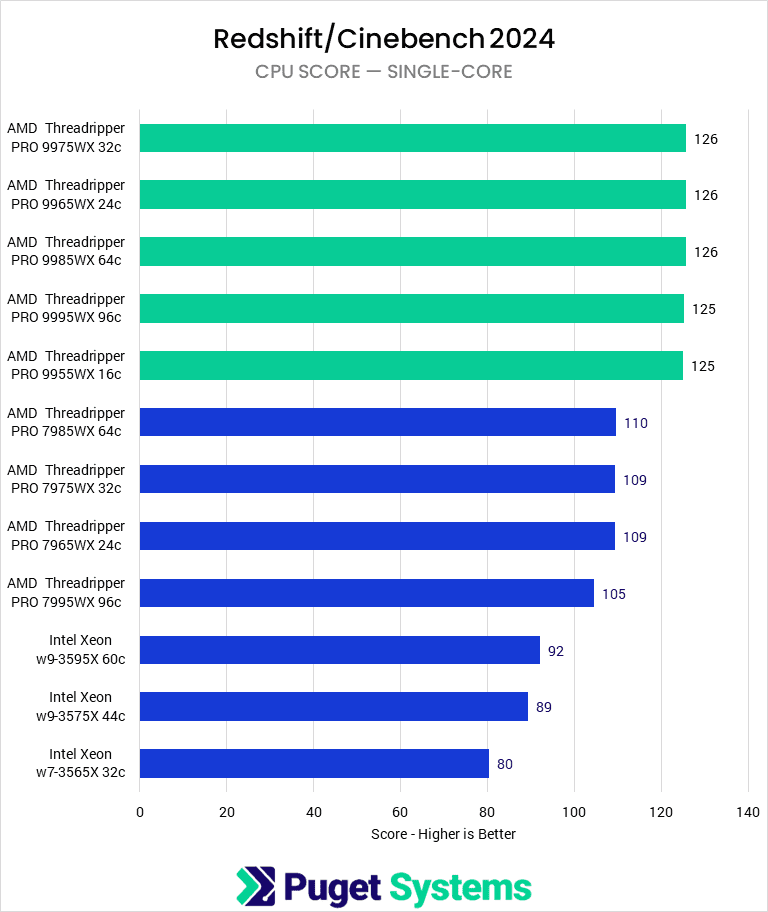
Cinebench 2024 single-core (Chart #2) is largely a synthetic benchmark as no one really renders on a single core. Nonetheless, it is interesting as a single-threaded workload. Here, the Threadripper PRO 9000WX processors lead the chart with a score of 125-126. The last-gen 7000WX processors are clustered around 110, while the fastest Xeon tops out at 92, with the 32-core 3565X only scoring 80.
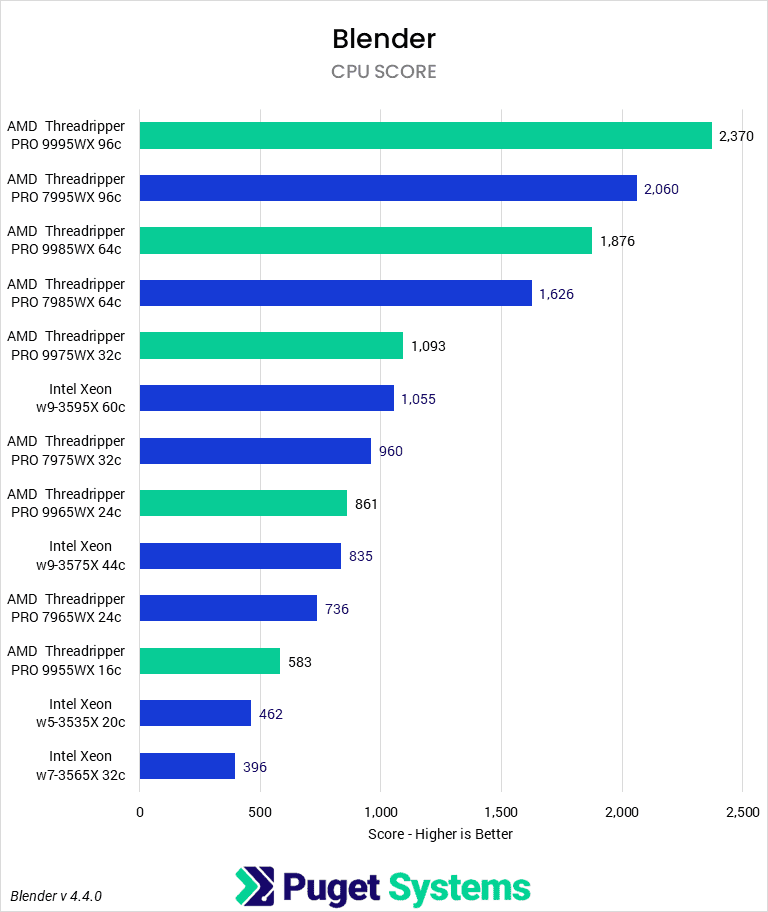
Moving on to Blender, we see more modest gains across the board. The 9995WX is still the fastest CPU, but it only leads the 7995WX by 15%. In fact, every Threadripper PRO processor outperforms their previous-gen counterpart by just about 15%. However, this does not save Intel. The 32-core 9975WX is faster than the 60-core w9-3595X by 4%, which means that the top-end 9995WX is 125% faster than the top-end Xeon.
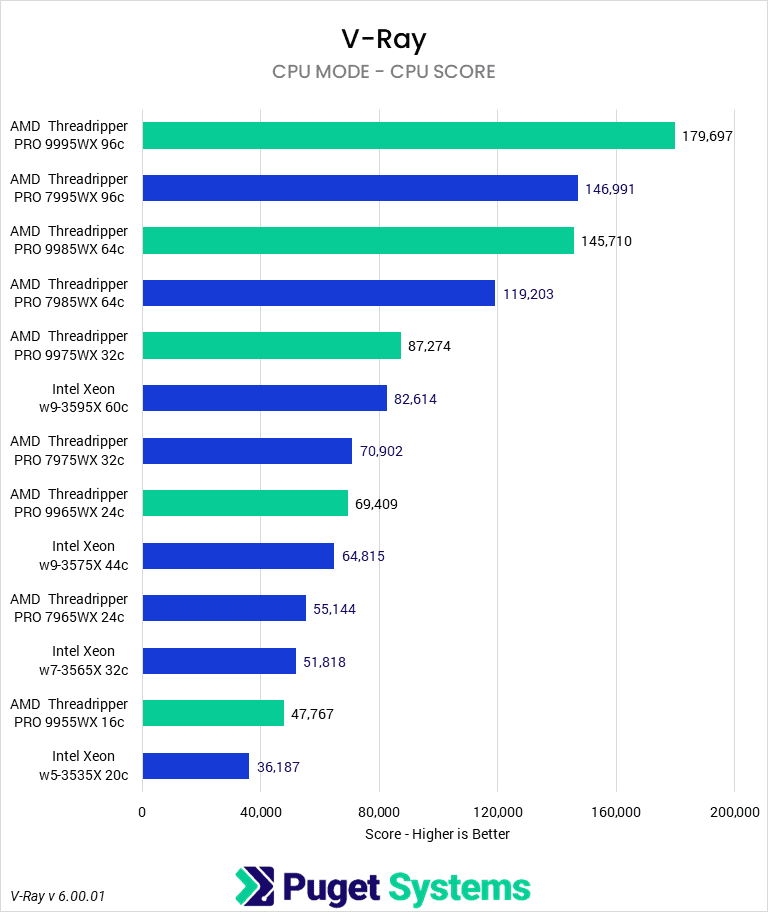
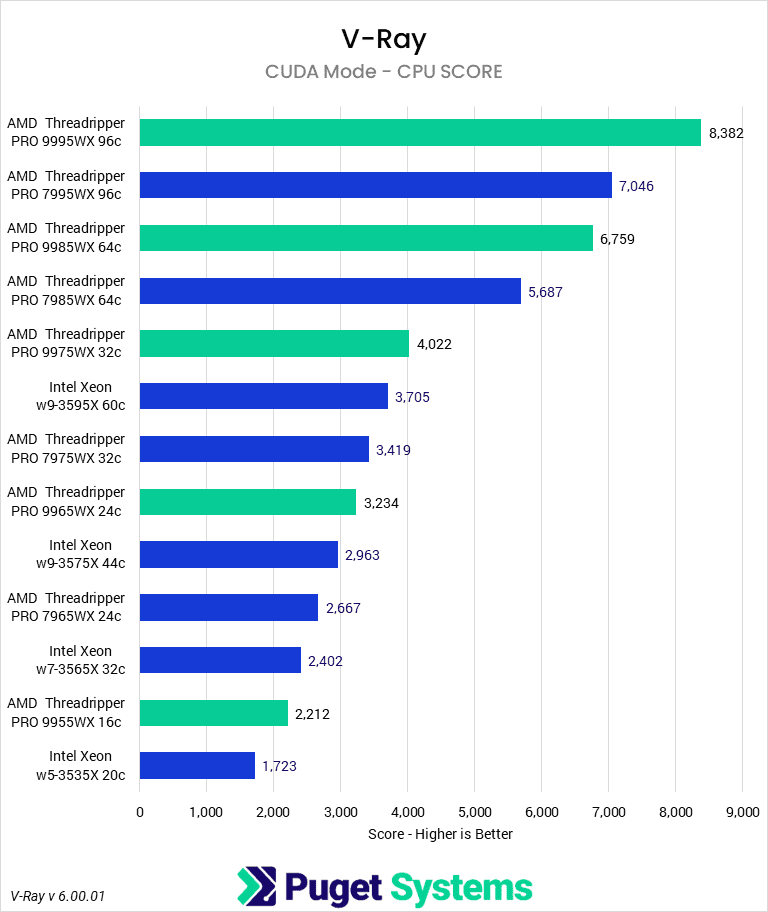
Our final offline rendering benchmark is V-Ray (Charts #4-5), which has two CPU rendering modes: “CPU” and “CUDA”. We will only be looking at results from the former. In the CPU mode tests, the 9995WX is 22% faster than the 7995WX, which is tied by the 9985WX. In turn, the 9985WX leads the 7985WX by 22%. Much like in Blender, this performance uplift is essentially the same across the board.
AI: LLM (Llama)
System Image
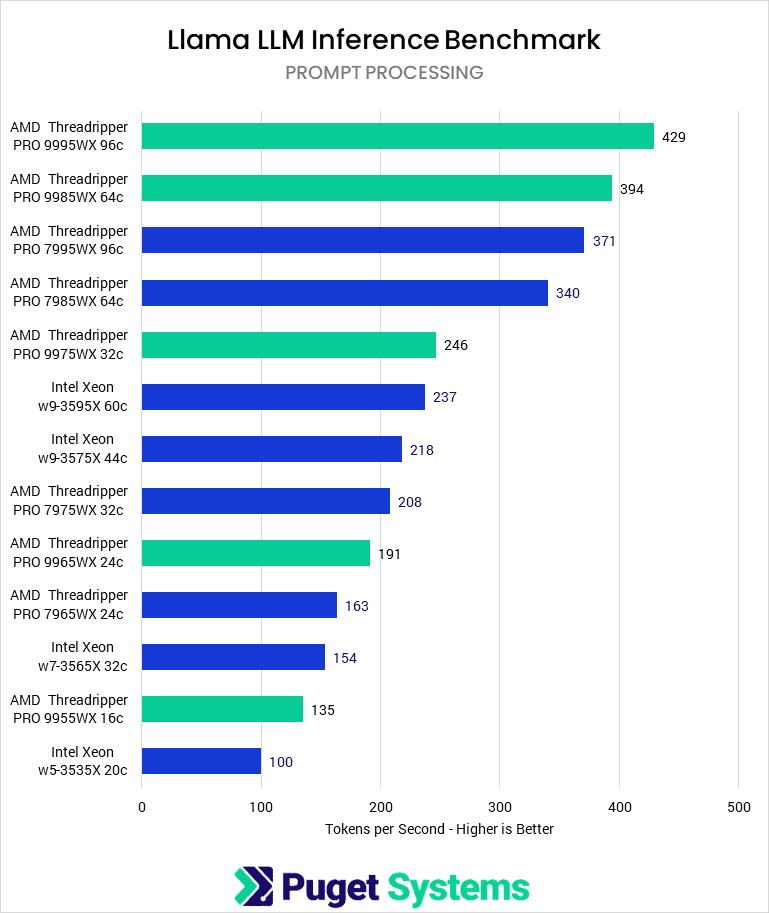
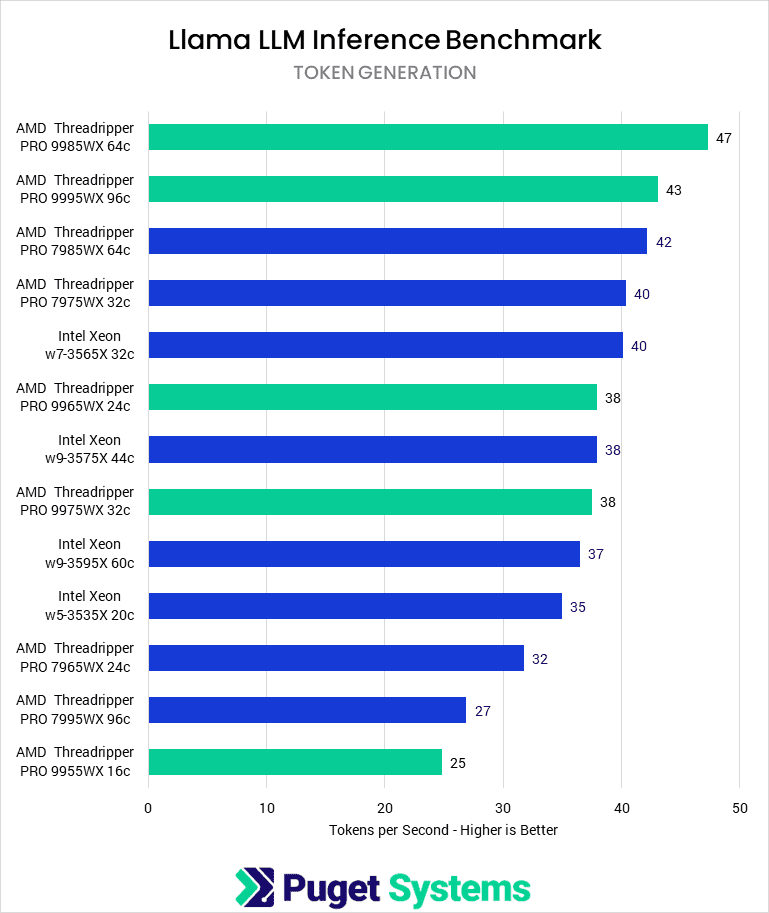
One of the more recent benchmarks we have begun to use is an LLM benchmark based on Llama.cpp. The benchmark looks at the performance in prompt processing and token generation (essentially, the input and output of a user-facing chatbot) using a lightweight model that scales across both CPUs and GPUs.
Starting with prompt processing (Chart #1), we found that the benchmark performance appears to scale well with core count. The 9995WX was the fastest CPU tested, leading the 9985WX by 9% and the 7995WX by 16%. This 16% generational uplift is fairly representative, with the 64-core seeing a 16% uplift, the 32-core an 18%, and the 24-core a 17% gain. Much like in our rendering benchmarks, Intel’s 60-core Xeon part falls just behind AMD’s 9975WX, with the other Xeons roughly matching the AMD CPU two tiers below them.
In the token generation portion of the benchmark (Chart #2), the results are much less clear. The spread of results is much larger than we would typically expect if it were random, but there doesn’t seem to be a great pattern to which CPUs perform best. Nonetheless, the Threadripper PRO 9000WX processors perform well, though we would recommend most users stick to GPUs for LLMs unless VRAM is a serious issue.
How do the AMD Ryzen Threadripper PRO 9000WX Processors Perform in Content Creation Applications?
Overall, the new AMD Ryzen Threadripper PRO 9000 WX-series are a fantastic generational update to the already-impressive Threadripper PRO family. Although they come with a slight price bump, the processors we tested today offer notably improved performance across a variety of workloads while maintaining compatibility with current WRX90 motherboards.
In traditional “media and entertainment” workflows with applications like Photoshop, Premiere Pro, After Effects, and DaVinci Resolve, the new Threadripper PRO 9000WX CPUs offered good generational improvements. In nearly all of those applications, we saw uplifts of 15-25% in CPU-bound scenarios. However, even in traditional GPU workloads, like GPU Effects in Premiere Pro or LongGOP processing in DaVinci Resolve, the 9000WX processors increased performance by around 5% over the 7000WX processors. In many cases, a desktop Ryzen (or Intel Core Ultra) processor may still be a better value for these workflows, so we’d recommend checking out reviews of those parts as well. However, if you need a Threadripper PRO processor for the high RAM capacity, huge number of cores, or high PCIe lane count, they certainly won’t detract from your ability to do work in these applications.
For heavily CPU-based applications like CPU Rendering in V-Ray, Blender, or Redshift, or compiling code and scenes for Unreal Engine, the Threadripper PRO 9000WX family is even more impressive. The 9995WX is the new king of workstation CPU rendering, outperforming the 7995WX by up to 27% and Intel’s top-end Xeon by up to 125%. We saw average generational performance improvements of 26% in Cinebench, 15% in Blender, and 22% in V-Ray.
AMD’s latest update to its Ryzen Threadripper PRO line is very impressive, offering great performance at a modest price increase. While we would have liked to see the price stay constant, the drop-in compatibility with existing WRX90 platforms should hopefully reduce the sting of the already-expensive CPUs. We are particularly impressed that AMD managed to dramatically improve memory support, with the new processors officially supporting DDR5-6400.
If you need a powerful workstation to tackle the applications we’ve tested, the Puget Systems workstations on our solutions page are tailored to excel in various software packages. If you prefer to take a more hands-on approach, our custom configuration page helps you to configure a workstation that matches your exact needs. Otherwise, if you would like more guidance in configuring a workstation that aligns with your unique workflow, our knowledgeable technology consultants are here to lend their expertise.

Looking for a content creation workstation?
We build computers tailor-made for your workflow.
Don’t know where to start?
We can help!
Get in touch with one of our technical consultants today.