How does the new Puget Mobile 17″ compare to the top-end M3 Max MacBook Pro 16″ in performance for content creation?
How does the new Puget Mobile 17″ compare to the top-end M3 Max MacBook Pro 16″ in performance for content creation?
With the launch of the new Puget Systems 17″ laptop, there are a lot of performance questions we want to address. Today, we will be examining the performance of this new mobile workstation compared to a more traditional desktop.
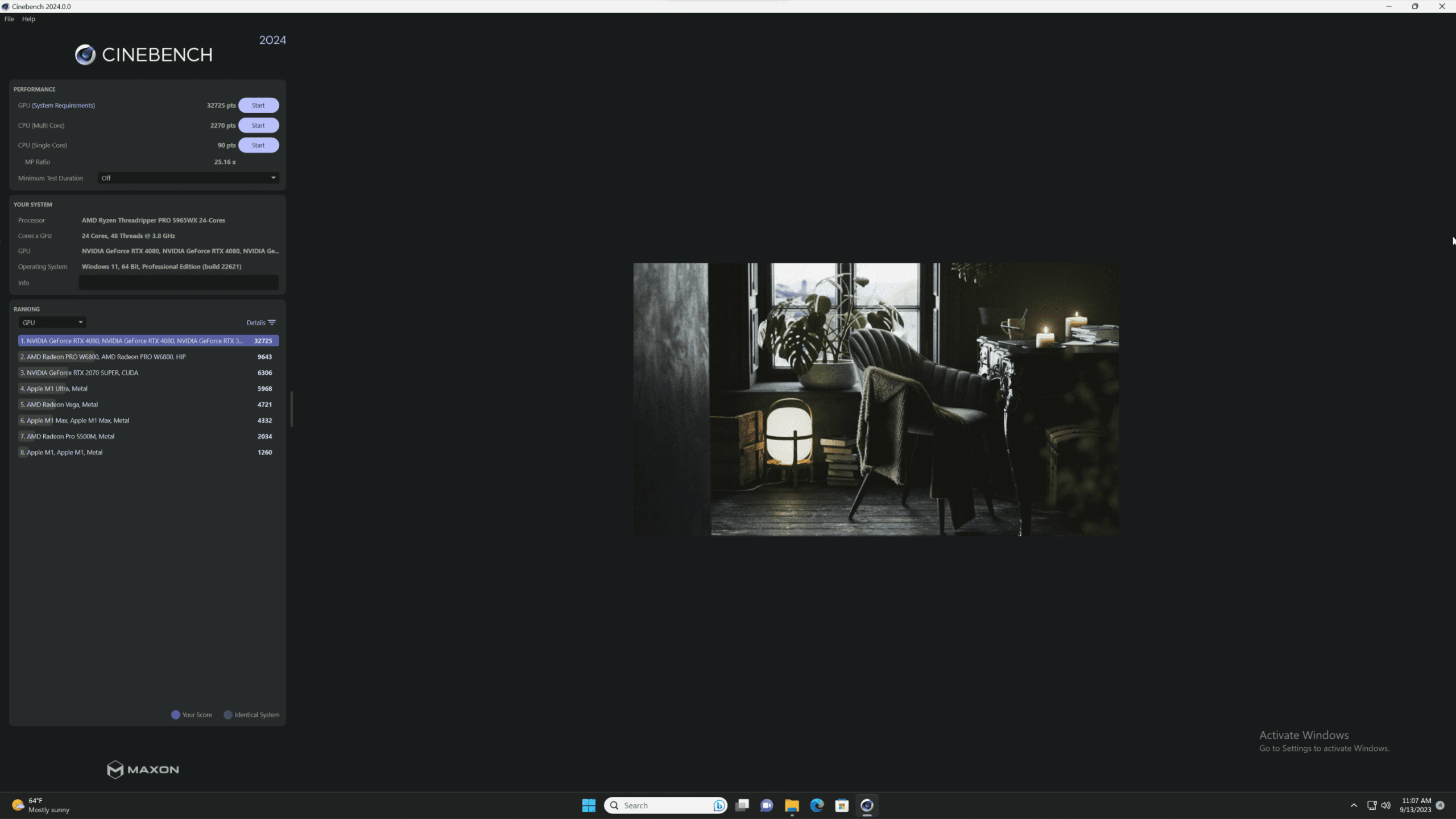
Cinebench 2024 is with with new features and expanded compatibility. We look into what these features are and what this update means for benchmarking.
Hardware-accelerated GPU scheduling is a behind-the-scenes change in Windows to move processing GPU requests from the CPU to the GPU. Does enabling the feature have any impact on content creation performance?
A short article covering some of the best computer system configurations for rendering with V-Ray at the close of 2020.

We’ve previously tested the new Hybrid Mode in V-Ray RT 3.6, which combines CPUs and GPUs in order to speed up rendering, on Intel’s Skylake X processors. This time around we are going to test on AMD’s Threadripper 1950X, and use even more powerful GPUs than before. We also take a look at GeForce GTX 1080 Ti vs Titan Xp performance.

New in V-Ray RT 3.6, Chaos Group has added Hybrid Rendering: the option to combine CPUs and GPUs in order to render images and animations even faster. We give an overview of how this works, and then explore the impact it can have on rendering speeds.
Puget Systems builds custom PCs tailored for your workflow
Extensive in-house testing
making you more productive and giving you more performance for your dollar
Reliable workstations
with fewer crashes and blue screens means more time working, less time waiting on your computer
Support that understands
your complex workflows and can get you back up and running ASAP
Proven track record
check out our customer testimonials and Reseller Ratings
Select your workflow: